Table of Contents
Have you ever walked into a room only to forget why you’re there, or found yourself grasping for a familiar name that’s just out of reach? In those quiet moments of frustration, it’s natural for a flicker of fear to arise: Is this just a “senior moment,” or is it something more?
The core difference is simple: Normal cognitive aging involves slow, mild shifts—such as occasionally misplacing your keys or struggling to recall an appointment—that do not interfere with your ability to live a full, independent life. In contrast, dementia is a progressive medical condition that causes a decline in memory, language, and judgment severe enough to disrupt your daily functioning and autonomy.
Distinguishing between the two isn’t just about checking off symptoms on a clinical list; it’s about “coming home” to a deeper understanding of your body’s natural evolution. While the medical world often speaks in cold, sterile terms, we believe that clarity should feel like a deep, grounding breath.
As we cross the threshold of 60, our internal “library” becomes incredibly vast—a reflection of a life lived with depth. Sometimes, it simply takes a little longer to find the right book on the shelf. This is a natural part of the human experience, not a failure of the spirit. However, knowing the subtle boundaries between a full, busy mind and a progressive cognitive shift is essential for your peace of mind.
In this guide, we are moving away from the clinical “lecture” and into a conversation about longevity. Together, we’ll explore the true warning signs and discover the somatic rituals designed to keep your mind as vibrant and fluid as your movement.
What Is Normal Cognitive Aging?
To understand the aging brain, we must first look at it as a masterpiece in progress rather than a machine in decline. From a biological perspective, normal cognitive aging involves subtle structural changes. Our brain’s white matter—the “cabling” or neural pathways that connect different regions—gradually undergoes a natural thinning. This typically leads to a slight decrease in processing speed. You might find it takes a few seconds longer to recall a movie title or calculate a tip, a common experience often called the “tip-of-the-tongue” phenomenon.
However, the beauty of the somatic experience is that while the “hardware” might slow its pace, the “software” is becoming more sophisticated.
The Wisdom Shift: Crystallized Intelligence

While “fluid intelligence” (the ability to solve new puzzles quickly) may dip, your crystallized intelligence—the lifetime accumulation of knowledge, vocabulary, and expertise—actually tends to stay stable or even improve well into your 70s and 80s.
Think of your brain like a library. A younger brain is a small, half-empty room where it’s easy to find a single book on the floor. An aging brain is a vast, grand archive filled with thousands of volumes of lived experience. It takes longer to walk to the back of the library to find the right book, but the collection is incomparably richer.
Emotional Regulation
From a somatic and philosophical standpoint, this shift is often accompanied by an increased capacity for emotional regulation. Research suggests that older adults are often better at “zooming out”—using their neural pathways to prioritize positive information and maintain a sense of calm during stress. In the Mindfullyoga practice, we call this the “Coming Home” effect: your brain is trading raw speed for deep-seated wisdom and a more grounded presence. Your mind isn’t fading; it is refining.
Normal Aging vs. Dementia: The Comparison Chart
| Feature | Normal Cognitive Aging | Potential Signs of Dementia |
| Memory & Recall | Forgetting a name or appointment but remembering it later. | Forgetting recently learned info or major life events entirely. |
| Problem Solving | Occasional errors when balancing a checkbook or managing bills. | Struggling to follow a familiar recipe or manage routine tasks. |
| Orientation | Briefly forgetting the day of the week but figuring it out later. | Losing track of the season, the year, or getting lost in familiar places. |
| Language | Having a “tip-of-the-tongue” moment where you search for a word. | Stopping mid-conversation; struggling with vocabulary or repetition. |
| Judgment | Making a poor decision once in a while (like an impulse buy). | Consistent decline in judgment, such as neglecting hygiene or safety. |
| Object Placement | Misplacing keys but being able to retrace your steps to find them. | Putting items in unusual places (like keys in the sugar bowl) without recall. |
| Mood & Spirit | Feeling irritable when a routine is disrupted; remaining socially aware. | Noticeable shifts in personality, such as becoming suspicious or fearful. |
Normal Aging vs. Mild Cognitive Impairment (MCI)
Before we move into our somatic rituals, it’s important to acknowledge the “middle ground.” You may have heard the term Mild Cognitive Impairment (MCI).
Think of MCI as a bridge between normal aging and dementia. In this stage, a person may have more memory or thinking problems than other people their age, but their symptoms are not severe enough to interfere with their daily life or independence. Many people with MCI actually stay stable for years, and some even improve with the right lifestyle interventions—which is why the somatic habits we are about to discuss are so vital.
Normal Memory Loss at 70: What is Expected?
Reaching the milestone of 70 is a testament to a life lived deeply, but it often comes with a new, quiet hyper-awareness of our own thoughts. You might find yourself standing in the kitchen wondering why you opened the fridge, or struggling to remember the name of a neighbor you’ve known for years. In the medical world, this is often categorized as benign senescent forgetfulness. In our community, we prefer to view it as a “full library.”
At 70, your brain’s short-term memory works a bit like a computer with too many tabs open. It’s not that the processor is broken; it’s simply managing a massive archive of crystallized wisdom.
What is “Normal” Now?
- The Search for Words: Experiencing the “tip-of-the-tongue” moment occasionally is perfectly normal. Your brain is navigating a more complex web of associations than it did at 30.
- The Multi-Tasking Myth: You may find that your focus rituals need to be more intentional. If you are talking on the phone while boiling water, you might forget the tea. This isn’t a cognitive failure; it’s a biological signal to return to single-tasking awareness.
- Prompted Recall: If you forget a name but it “pops” into your head an hour later while you’re gardening or resting, your retrieval system is healthy. It just needed a moment of somatic stillness to find the file.
The Somatic View: Memory is a Full-Body Experience
At Mindfullyoga, we believe that memory isn’t just stored in the gray matter of the brain; it’s held in the nervous system. When we are stressed, our focus rituals break down. By practicing grounding movements, we lower cortisol—the stress hormone that acts like static on a radio, making it harder to hear our own thoughts. Forgetfulness at 70 isn’t a sign that you are “leaving”; it’s a gentle invitation to “come home” to the present moment more slowly and with more intention.
Normal Aging vs. Mild Cognitive Impairment (MCI)
In the landscape of cognitive health, there exists a “clinical gray area” known as Mild Cognitive Impairment (MCI). It is the bridge between the expected shifts of a maturing brain and the more serious concerns of dementia. Understanding this middle ground is essential for establishing a true “peace of mind,” as it allows us to act with intention rather than fear.
MCI is characterized by a level of memory or thinking loss that is noticeable to the individual or their loved ones—and often measurable in clinical tests—but does not yet interfere with daily independence. You might forget appointments more frequently or struggle to follow a complex conversation, yet you are still perfectly capable of managing your home, your finances, and your mindful practice.
What makes MCI a unique “threshold” is its unpredictability. For some, it remains a stable state for many years; for others, it may be an early signal to prioritize deeper somatic interventions. Because the brain remains plastic at this stage, focusing on neuro-nutrition and somatic movement can be incredibly powerful. It is not a final destination, but rather a vital invitation to listen more closely to what your body and mind need to stay vibrant.
The Somatic Method: 6 Daily Habits to Slow Brain Aging
While medical journals focus on the “what,” the Mindfullyoga philosophy focuses on the “how.” We believe that the brain is not an island; it is deeply integrated with your nervous system and your physical movement. To slow the clock on cognitive aging, we must move beyond passive puzzles and into active, somatic engagement.
Here is our signature “Coming Home” protocol for long-term brain vitality.
1. Proprioceptive Challenges: Balance as Brain Power

Every time you practice a balance pose—whether it’s a full Tree Pose (Vrikshasana) or simply standing on one leg while you wait for your tea to steep—your brain is performing high-level gymnastics. To keep you upright, your brain must constantly process “proprioception” (the sense of where your body is in space). This fires up the prefrontal cortex, the area responsible for executive function and focus. Think of balance as “weightlifting” for your cognitive clarity.
2. Vagal Tone & Conscious Breath

“Brain fog” is often just a nervous system that has been stuck in “fight or flight” for too long. Chronic stress floods the brain with cortisol, which can literally shrink the hippocampus—the seat of memory. By practicing long, slow exhalations, you stimulate the Vagus Nerve. This sends an immediate “all-clear” signal to the brain, clearing the mental fog and allowing your neural pathways to communicate without the “static” of anxiety.
3. Neuro-Nutrition: The Mindful Kitchen

We feed our brains with more than just thoughts. To build a resilient mind, incorporate these five “Soma-Superfoods” into your daily rituals:
- Walnuts: Rich in DHA, an omega-3 fatty acid crucial for neural health.
- Blueberries: Packed with anthocyanins that protect the brain from oxidative stress.
- Turmeric & Black Pepper: A powerful duo to reduce systemic inflammation.
- Leafy Greens: High in vitamin K and lutein, which slow cognitive decline.
- Dark Chocolate: A small ritual of cocoa flavanols can improve blood flow to the brain.
4. Sensory Grounding: The 3-3-3 Rule
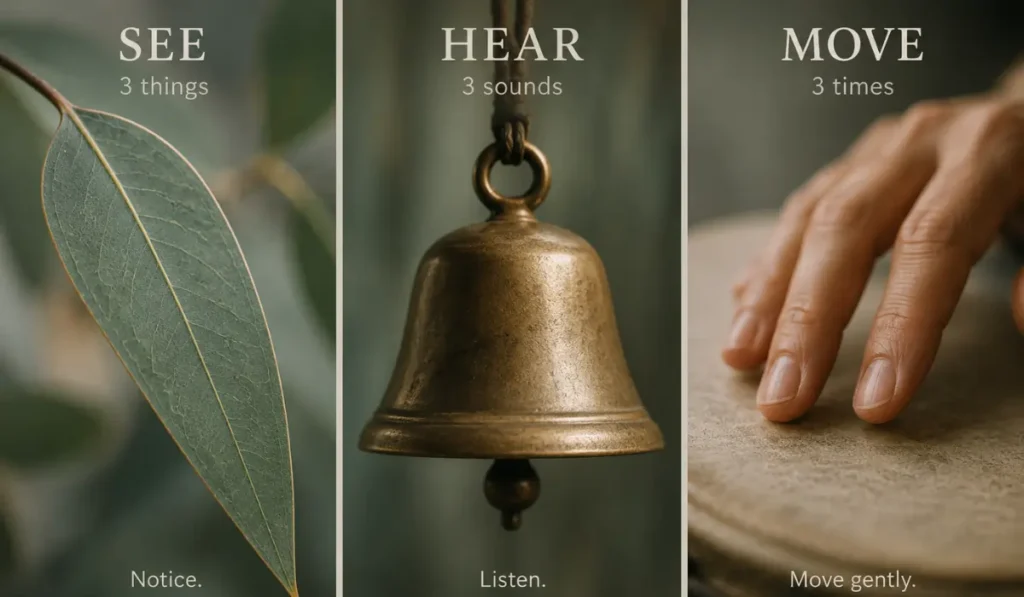
When the world feels overwhelming and your memory feels scattered, return to your senses. The 3-3-3 rule is a somatic grounding technique designed to lower cortisol instantly:
- Acknowledge 3 things you see (a bird, a leaf, a candle).
- Acknowledge 3 sounds you hear (the wind, a clock, your breath).
- Move 3 parts of your body (wiggle your toes, roll your shoulders, circle your wrists). This ritual pulls you out of the “worry loops” and back into the present moment.
5. Cognitive Novelty over Sudoku

While crosswords have their place, the brain thrives on novelty in movement. When you learn a new yoga sequence or try a new path on your morning walk, you are forcing your brain to map new territory. This creates “cognitive reserve.” Learning to move your body in a new way creates more robust neural connections than repeating the same mental puzzles every day.
6. The “Coming Home” Sleep Ritual

In 2026, we understand that the brain has its own internal “cleanup crew” called the glymphatic system. This system only activates during deep sleep to flush out “brain waste” (proteins associated with cognitive decline). To support this, create a “Coming Home” ritual: dim the lights, put away screens 60 minutes before bed, and practice five minutes of Box Breathing. You aren’t just sleeping; you are giving your brain the space to restore and remember.
When to See a Doctor: Listening to Your Intuition
While we celebrate the natural evolution of the aging mind, being a mindful guardian of your health means knowing when a “senior moment” requires a conversation with a professional. At Mindfullyoga, we believe in proactive care rather than reactive fear.
Consider scheduling a visit with your healthcare provider if you or your loved ones notice the following “red flags” that persist over time:
- Impact on Daily Safety: Forgetting to turn off the stove, getting lost in your own neighborhood, or struggling to follow basic safety signs.
- Significant Personality Shifts: Uncharacteristic bouts of suspicion, withdrawal from social “Sanghas” (communities) you once loved, or sudden, intense anxiety.
- Repetitive Communication: Asking the same question several times within a few minutes, unaware that it has already been answered.
- Loss of Familiar Sequences: Finding that you can no longer follow the steps of a recipe you have made for twenty years or struggling to manage the sequence of dressing yourself.
Choosing to see a doctor isn’t an admission of defeat; it is an act of Svatantra (self-sovereignty). It gives you the data you need to adjust your somatic rituals and support your brain with the right tools.
Frequently Asked Questions (FAQ)
Is it normal to forget names at 70?
Yes. It is very common for adults over 70 to experience the “tip-of-the-tongue” phenomenon. As long as the name eventually comes back to you or doesn’t prevent you from communicating your needs, it is considered a part of normal aging.
Can I improve my memory naturally after 60?
Absolutely. Through the power of neuroplasticity, your brain can continue to form new neural pathways at any age. Focus on “Cognitive Novelty” (learning new movements), anti-inflammatory nutrition, and stress-reduction techniques like Vagal breathing.
What is the main difference between aging and dementia?
The main difference is independence. Normal aging may make you slower to recall information, but it doesn’t stop you from living your life. Dementia is a progressive decline that eventually makes it difficult to perform daily tasks without help.
What are the best exercises for brain health?
While any movement is good, balance-based exercises (like Chair Yoga) and activities that require you to learn new sequences (like dance or specific yoga flows) provide the most significant “cognitive load” to help keep the brain sharp.
The “Clinical Verification” Block

“Physical activity is a primary non-pharmacological strategy for preserving brain health. According to recent findings published in The Lancet, regular movement and improved cardiorespiratory fitness mitigate cognitive impairment by enhancing cerebral blood flow, reducing systemic inflammation, and stimulating neuroplasticity. Furthermore, research in the journal Geriatrics highlights the ‘muscle–brain axis,’ where contracting skeletal muscles release signaling molecules—known as myokines (such as BDNF, Irisin, and Cathepsin B)—that cross the blood–brain barrier to support hippocampal neurogenesis and synaptic strength. By integrating structured movement into our daily routines, we are not merely exercising muscles; we are actively upregulating the neurobiological pathways necessary to build cognitive reserve and delay age-related decline.”
— Sources: The Lancet (2025) | Geriatrics (Basel) (2025)
Also Read: 5 Simple Erector Spinae Exercises to Relieve Lower Back Pain at Home
Also Read: Free 28-Day Chair Yoga for Seniors (Printable PDF & Chart + Daily Challenge Plan)
Also Read: Is Chair Yoga a Scam? An Honest, Evidence-Based Guide for Seniors (Weight Loss, Costs & App Reviews)