Table of Contents
Medical Disclaimer: The following educational insights are intended for informational purposes and should not be substituted for professional medical diagnosis or orthopedic treatment.
Last Updated: May 2026
If you’ve spent a 6-hour block at a desk only to find a deep, radiating ache across your lumbar region, you are likely experiencing fatigue in the erector spinae muscle group. These are not merely “back muscles”; they function as the primary axial stabilizers of the human frame.
Running vertically from the sacrum to the base of the skull, this trio, the iliocostalis, longissimus, and spinalis, acts as the body’s mechanical support cables, maintaining upright posture against constant gravitational shear.
Through my years of teaching yoga and focusing on somatic movement, I’ve noticed a consistent pattern: many of us treat back pain as if it’s just a “broken part” that needs a quick mechanical fix.
But from what I’ve seen on the mat, the human spine is a living, integrated system that responds more to awareness than to force.
When we approach erector spinae exercises, our goal at Mindfullyoga isn’t just a high-intensity “workout” in the traditional sense. Instead, we’re looking to calm the nervous system and build a foundation that actually feels safe and supported from the inside out.
When we implement targeted erector spinae exercises, our objective isn’t a high-intensity “workout” in the traditional sense. Instead, we are looking to de-escalate the sympathetic nervous system and establish a resilient, proprioceptive foundation.
Research into spinal mechanics suggests that strengthening these stabilizers through mindful, low-impact intervention is one of the most effective pathways to improving long-term spinal stability.
By shifting focus from “muscling through” to building somatic awareness, we transform these five movements into a protocol for systemic health.
Below, I will detail how to isolate these muscles accurately and why a nervous-system-first approach is the missing link in lower back resilience.
Anatomy & Functional Mechanics: Defining the Erector Spinae
To understand the etiology of lower back discomfort, one must first analyze the complex architecture of the erector spinae muscle group.
Contrary to the common perception of a single muscle “band,” this is a sophisticated muscular system composed of three primary columns: the iliocostalis (the lateral column), the longissimus (the intermediate column), and the spinalis (the medial column).

These muscle fibers span the entire length of the posterior trunk, originating at the sacrum and inserting at various points up through the thoracic vertebrae and into the cervical spine.
In my practice, I refer to this group as the body’s “internal scaffolding.” While their primary concentric function is spinal extension, the act of returning the torso to an upright position after forward flexion, their true clinical value lies in their eccentric and isometric capabilities.
They provide constant micro-adjustments to stabilize each individual vertebra during every lift, rotational twist, and gait cycle.
When we design erector spinae yoga poses, the goal is not “maximal power” or muscle hypertrophy in isolation. Instead, we are training for functional endurance.
We are teaching these three columns to act as the reliable protectors of your spinal alignment, ensuring that the load of daily movement is distributed across the muscle tissue rather than being dumped directly onto the intervertebral discs.
The Biomechanics of Injury Prevention: Why Spinal Strength Matters
When students seek out the best exercises, the underlying goal is usually to mitigate the physical “collapse” that occurs after prolonged sedentary behavior.

From a physiological standpoint, if these muscles demonstrate low endurance or underactivity, the body does not simply cease function; it enters a state of compensation.
In this state, the mechanical load of the torso is transferred away from the muscular system and “dumped” directly onto the passive structures of the lumbar spine, specifically the intervertebral discs and the posterior longitudinal ligaments.
By prioritizing targeted exercises for the erector spinae muscles, you are essentially integrating biological “shock absorbers” into your posterior chain. This functional strength manifests in several critical ways:
- Axial Posture Support: Resilient erectors serve as a structural anchor, preventing the kyphotic “rounded shoulder” slump. This slumping is a primary trigger for cervicogenic tension headaches and chronic mid-back fatigue.
- Neural Protection & Stability: When these muscles maintain high tonicity, they effectively “hug” the vertebrae. This stabilization protects the delicate pathways of the nervous system during high-velocity movements or eccentric loading, such as lifting heavy objects.
- Reduction of Secondary Compensatory Strains: In many clinical cases, “lower back pain” is actually a secondary symptom. It is the cry of overtaxed stabilizing muscles that are forced to do the work the larger erector spinae should be handling. Strengthening the primary columns breaks this cycle of muscular exhaustion.
In our somatic approach, we differentiate between “rigidity” and “resilience.” We don’t just tighten these muscles; we train them to be supportive yet supple.
This specific balance of strength and flexibility is the clinical secret to a spine that feels structurally steady rather than habitually “stuck.”
The Clinical Perspective: Diagnostic Indicators of Spinal Weakness
In my professional practice in Jaipur, the most frequent inquiry I receive is: “How do I clinically determine if my erector spinae is underperforming?” This is a vital question because myopathic weakness in the posterior chain rarely manifests as acute pain initially; instead, it presents as “systemic fatigue” or a progressive loss of structural integrity.
If you find yourself experiencing a physiological “need” to lean back against a chair for support, or if you develop a deep, myofascial ache in the mid-back after only ten minutes of upright standing, your primary spinal stabilizers are likely in a state of chronic struggle.
When these muscles lack the necessary endurance, the nervous system initiates “tightness” protocols—essentially a protective “locking” mechanism designed to force the body into a state of rest.
The Somatic Endurance Assessment
To establish an objective baseline for your spinal health, you can perform this erector spinae tightness and weakness test independently. This assessment measures the isometric endurance of the posterior stabilizers:

- Positioning: Utilize a firm stool or chair, sitting specifically on the anterior edge to ensure the spine has no external posterior support.
- Alignment: Plant your feet flat at shoulder-width, lengthen the axial spine, and rest your hands neutrally on the thighs.
- Duration: Set a digital timer for 180 seconds (3 minutes).
- Clinical Observation: Monitor for a “burning” sensation in the paravertebral muscles or an involuntary urge to slouch prior to the 60-second mark. Note if your respiratory rate increases or if your breath becomes shallow.
If you are unable to maintain a neutral, upright spinal position without significant strain for a minimum of 120 seconds, it indicates that your spinal erector exercises must prioritize isometric endurance and nervous system tolerance rather than high-load intensity.
This result is not a failure; rather, it is a critical diagnostic signal that your body requires more robust foundational support.
Therapeutic Yoga Interventions for Spinal Stabilization
While the targeted movements we are about to detail offer excellent isolation, integrating erector spinae yoga exercises into a traditional practice provides a holistic approach to spinal health.
In my experience, certain classical asanas are uniquely effective at recruiting these deep stabilizers through sustained isometric holds.
- Cobra Pose (Bhujangasana): This serves as a foundational movement for progressive spinal extension. The clinical “key” to this pose is the elimination of upper-body leverage; by lifting the chest using only the posterior muscle groups rather than pushing with the hands, you teach the erectors to engage with a “soft” yet firm contraction. This prevents the “hinging” effect that often leads to lumbar compression.
- Locust Pose (Salabhasana): From a biomechanical standpoint, this is arguably one of the best erector spinae exercises in the yoga repertoire. By lifting the chest and lower extremities simultaneously, you fire the entire posterior chain in unison. This builds the specific type of resilience needed for high-load daily activities, such as lifting heavy objects or maintaining spinal integrity while reaching for overhead shelving.
These poses serve as a vital complement to any home routine by adding a layer of somatic awareness. They challenge the practitioner to move the spine through its natural range of motion while maintaining a regulated respiratory rate and a grounded center of gravity. This integration of breath and movement is what ultimately converts “exercise” into “rehabilitative medicine.”
Targeted Protocol: 5 Effective Erector Spinae Exercises for Home Intervention
Developing a resilient posterior chain does not necessitate specialized yoga equipment or gym memberships. Whether you are navigating erector spinae exercises for beginners, managing geriatric mobility, or recovering from a musculoskeletal strain, these five movements are designed to enhance both isometric strength and functional flexibility using only bodyweight resistance.
1. Bird-Dog (Foundational Spinal Stabilization)
This is widely regarded as the best exercise for erector spinae health due to its ability to challenge contralateral balance while forcing the stabilizers to maintain a neutral spine.
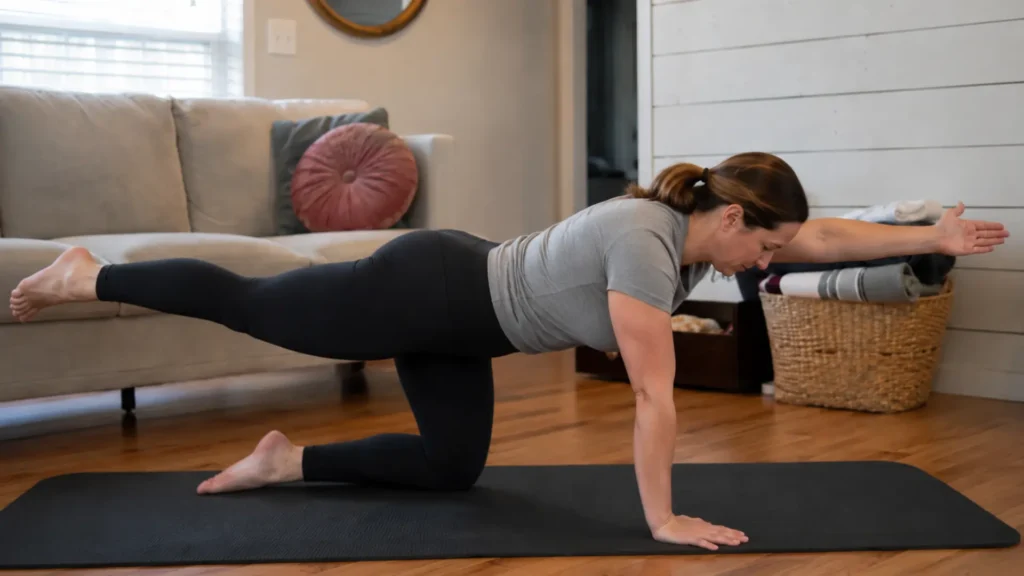
- Execution: Begin in a quadruped position (on all fours) with wrists aligned under shoulders and knees under hips. Simultaneously extend the right arm forward and the left leg back.
- Clinical Alignment: Maintain square hips and avoid pelvic rotation or lumbar arching. Hold the extension for 2–3 seconds before returning with eccentric control.
- Somatic Benefit: Improves cross-body coordination and integrates the core with the deep spinal extensors.
2. Superman Hold (Posterior Chain Endurance)
For those requiring erector spinae muscle exercises that target the full length of the spinal column, this prone extension is highly effective.

- Execution: Lie prone (face down) on a mat. Simultaneously elevate the chest, arms, and legs approximately 2–4 inches off the floor.
- Clinical Alignment: Keep the cervical spine neutral by gazing at the floor. Hold for 5 seconds.
- Modifications: If bilateral elevation causes discomfort, perform the lift with the upper body only to reduce lumbar pressure.
3. Glute Bridge (Lumbopelvic Support)
While often categorized as a lower-body movement, the bridge is a critical erector spinae workout exercise because it recruits the glutes to support the base of the spine.

- Execution: Lie supine (on your back) with knees flexed and feet flat. Elevate the pelvis until the torso forms a linear path from the shoulders to the knees.
- Clinical Alignment: Avoid “rib-flaring” or over-arching the lower back. Focus on a “segmental” roll-down, moving one vertebra at a time.
- Somatic Benefit: Teaches the lower back to work in synergy with the hips, preventing compensatory strain.
4. Cat-Cow Stretch (Neuromuscular Mobility)
Effective erector spinae stretch exercises are essential for decompressing the vertebrae and improving the “slide and glide” of the myofascial tissue.

- Execution: In a quadruped position, inhale to arch the back into extension (Cow), then exhale to round the spine into flexion (Cat).
- Clinical Alignment: Move with extreme slowness to identify “stuck” segments in the thoracic or lumbar spine.
- Benefit: Reduces chronic stiffness and promotes the flow of synovial fluid through the spinal joints.
5. Forearm Plank (Core-Spine Integration)
The plank is a premier erector spinae exercise because it requires the back muscles to hold the spine steady against gravitational pull.

- Execution: Support the body weight on the forearms and toes, maintaining a rigid, straight line from head to heels.
- Clinical Alignment: Prevent the hips from sagging (which strains the ligaments) or piking too high. Hold for 20–40 seconds.
- Somatic Benefit: Builds the “bracing” capability of the trunk, providing a protective shield for the spinal nerves.
Clinical Contraindications & Safety Protocol
Not all movement is beneficial during an acute pain cycle. To ensure safety, practitioners should avoid erector spinae exercises to avoid, such as high-velocity deadlifts or aggressive hyperextensions, if they lack foundational stability. These movements can exert excessive shearing forces on the lumbar discs.
To maximize the efficacy of this erector spinae workout at home, pair these strengthening protocols with consistent hip mobility work.
Maintaining a balance between “strength” and “suppleness” ensures that the spine remains a dynamic, shock-absorbing system rather than a rigid structure.
Clinical Modifications & Risk Mitigation Strategies
In any therapeutic movement protocol, the objective is to maintain a “safety threshold” for the nervous system. From a somatic perspective, if a practitioner’s body perceives a movement as a threat, the erector spinae muscle will reflexively “guard” or seize, which counteracts the benefits of the exercise.
Therefore, understanding clinical modifications is essential for maintaining a progressive, injury-free trajectory.
Erector Spinae Exercises to Avoid: A Risk-Benefit Analysis
When addressing active inflammation or acute lumbar pathology (such as a disc herniation or spondylolysis), certain movements present a disproportionately high risk of injury.
- High-Velocity Deadlifts: I strongly advise beginners or those with a history of recurrent back strain to avoid heavy, high-velocity deadlifts without one-on-one professional supervision. While effective for power, the sheer mechanical load can exceed the structural tolerance of an underconditioned erector spinae muscle group, leading to severe ligamentous strain.
- Aggressive Hyperextensions: Movement that forces the spine into its absolute maximum range of extension—often seen in advanced yoga “backbends”—can cause facet joint compression. Our goal is functional strength, which occurs within a controlled, neutral range, rather than extreme spinal contortion.
Senior Modifications: Adapting for Geriatric Mobility
For the aging population, building erector spinae exercises for seniors is a matter of maintaining the “activities of daily living” (ADLs). We can achieve significant spinal stabilization without requiring the participant to transition to the floor. Clinical Contraindications & Safety Protocol
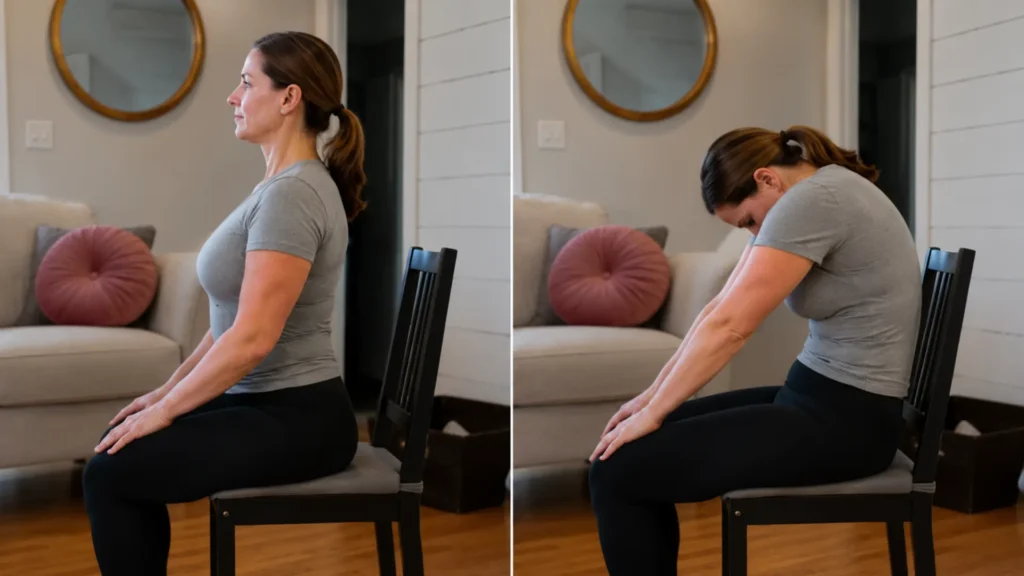
- Seated Cat-Cow Interventions: For those with limited mobility or vertigo, the Cat-Cow can be performed from a seated position in a sturdy, armless chair. By inhaling to lift the sternum and exhaling to round the lumbar spine, the participant achieves spinal decompression while remaining fully supported.
- Vertical (Wall) Planks: If a traditional forearm plank generates excessive intra-abdominal pressure or shoulder strain, the “Wall Plank” serves as an excellent entry point for erector spinae exercises for beginners. Standing at a 45-degree angle against a wall engages the spinal stabilizers while significantly reducing the gravitational load on the vertebrae.

- Standing Contralateral Extensions (Bird-Dog Variant): Using a chair for balance, the senior participant can extend one leg back just 2–3 inches while keeping the opposite hand on the chair. This isolates the erector spinae without the risk of a fall.

By respecting these boundaries, the practitioner builds a foundation of neurological trust. You are not forcing the musculoskeletal system to perform; rather, you are inviting it to adapt at a rate that is physiologically sustainable.
Protocol Implementation & Progressive Overload
To achieve measurable improvements in spinal resilience, the implementation of these erector spinae workouts at home must follow a structured progression.
Weekly Beginner Routine
For optimal tissue adaptation, I recommend a frequency of 3 sessions per week, allowing a 48-hour recovery window between bouts of exercise.
| Movement | Dosage | Primary Clinical Focus |
|---|---|---|
| Bird-Dog | 10 Reps (Alternating) | Contralateral Stability |
| Superman Hold | 5 Reps (5s Isometric Hold) | Posterior Chain Endurance |
| Glute Bridge | 12 Reps (Segmental) | Lumbopelvic Integration |
| Cat-Cow | 8 Cycles (Slow Tempo) | Synovial Fluid Circulation |
| Forearm Plank | 20–30 Seconds | Isometric Core Bracing |
Strategies for Functional Progression
As the baseline strength of the erector spinae increases, we do not simply add external weight. Instead, we manipulate the variables of “Time Under Tension” (TUT):
- Isometric Duration: Increase the hold time of the Superman or Plank by 5-second increments weekly. This builds the slow-twitch muscle fibers responsible for all-day posture.
- Temporal Control (Tempo): Slowing down the eccentric phase (the “lowering” part) of the Bird-Dog or Bridge forces the nervous system to maintain control through the entire range of motion.
- Variable Resistance: Once a “100% Human” form is achieved, a light resistance band can be added to the Glute Bridge to increase the lateral stabilization demands on the hips and lower back.
Progression in spinal health is rarely linear. It is a gradual accumulation of biological resilience. Monitor your “breath test” throughout each session; if the respiratory rate becomes erratic, the load has exceeded your current somatic capacity. Only progress when the movement feels grounded, steady, and mechanically sound.
Clinical Recovery & Long-Term Preventative Strategies
In any evidence-based erector spinae workout, the physiological adaptations occurring between sessions are as critical as the mechanical loading itself.
Within a somatic framework, recovery is defined as the period during which the nervous system integrates new motor patterns and the myofascial tissues undergo cellular repair.
Protocol for Recovery and Injury Mitigation
To maintain spinal resilience and inhibit the recurrence of hypertonicity (stiffness), the erector spinae muscle must be viewed as a single component within the “posterior chain”—a functional unit that includes the gluteal complex and the hamstrings.
- Active Myofascial Recovery: On non-training days, prioritize low-intensity erector spinae stretching exercises. Implementation of a sustained child’s pose or a low-impact walk facilitates the clearance of metabolic byproducts and maintains the “slide and glide” of the thoracolumbar fascia.

- Hydration & Viscoelasticity: Spinal discs and connective tissues are highly dependent on hydration to maintain their viscoelastic properties. Adequate water intake ensures these structures retain their “bouncy” shock-absorbing capacity.
- Intermittent Postural Resets: For those in sedentary occupations, utilize your developing strength to perform “axial resets” every 30 minutes. Briefly engaging the erectors to lengthen the spine prevents “neuromuscular inhibition“—the process where muscles effectively “switch off” due to inactivity.
Clinical Indicators: When to Cease Intervention
A core objective of somatic education is developing the interoceptive ability to distinguish between “delayed onset muscle soreness” (DOMS) and “nociceptive” (warning) pain.
- Productive Muscle Fatigue (Safe): A localized dull ache, a transient “burning” sensation, or a feeling of muscular heaviness indicates that the erector spinae workout exercises have successfully reached the threshold for adaptation.
- Neurological Warning Signals (Red Flags): If you experience acute, stabbing sensations, “electrical” shocks, or peripheral symptoms like numbness and tingling (sciatica), cease all movement immediately. These are diagnostic indicators of potential nerve root compression or excessive joint facet stress.
Contraindications & Population-Specific Precautions
While improving spinal endurance is a universal health goal, specific clinical conditions necessitate a modified or supervised approach. Consult with a healthcare professional before initiating exercises for the erector spinae muscles if the following are present:
- Confirmed lumbar disc herniation or extrusion.
- Structural instabilities such as Spondylolisthesis.
- Recent surgical intervention or acute spinal trauma.
- Advanced Osteoporosis (where prone extension movements like the Superman may require a standing, reduced-load modification).
Spinal rehabilitation is a lifelong trajectory of maintenance. By prioritizing biological recovery and respecting the physiological limits of your system, you ensure that your progress is not merely rapid but permanent.
Strength established on a foundation of neurological safety is the only form of resilience that is truly sustainable.
Conclusion: Integrative Resilience and the Mind-Body Axis
Reconstructing the integrity of the posterior chain is not merely a matter of anatomical “correction” or the completion of a specific repetition count.
When you commit to a structured erector spinae workout, the implications reach far beyond musculoskeletal health; you are fundamentally reclaiming your physical and emotional center.
At Mindfullyoga, our philosophy is rooted in the belief that the structural strength of the spine is inextricably linked to the regulation of the nervous system.
A fatigued or underconditioned back often manifests as a sense of vulnerability, characterized by a “braced” or slumped posture that reflects internal stress.
However, as you develop a more resilient erector spinae muscle group, you will observe a shift that transcends simple alignment. You begin to occupy space with a sense of quiet confidence and a stabilized, grounded presence.
By approaching your erector spinae workout exercises through a somatic lens—prioritizing slow-tempo movement, deep diaphragmatic breathing, and interoceptive awareness—you signal to the brain that it is safe to inhibit old, maladaptive patterns of chronic tension.
In this way, you aren’t just building a stronger lumbar foundation; you are cultivating a more regulated and peaceful state of being within your own skin.
Your trajectory toward a resilient spine is a foundational act of self-care. Prioritize consistency over intensity, and recognize that every mindful movement is a strategic step toward a life lived with increased comfort and ease.
Your spine is the central pillar of your experience; it is time to provide it with the professional support it requires.
Also Read:
6 Best Chair Yoga Apps for Seniors in US 2026 {Free Download & iOS Options Included)
Kriya Yoga Breathing Techniques: 5 Powerful Methods for Inner Peace
Yoga for Beginners: Complete Step-by-Step Guide to Start at Home 2026 (Poses, Routine & Free PDF)