Table of Contents
Why So Many People Feel Disconnected From Their Bodies
For a long time, I thought feeling tired, stiff, and tense was just part of being an adult.
My shoulders were always tight. My jaw was almost always clenched. Even when I sat down to rest, my body didn’t feel rested.
It felt like my mind was moving at 100 miles an hour while my body was desperately trying to catch up.
And honestly, I think a lot of us are living this way. We wake up and immediately reach for our phones. We rush through breakfast. We sit for hours. We scroll while eating. We push through stress. Then we wonder why our bodies feel exhausted, achy, disconnected, or stuck.
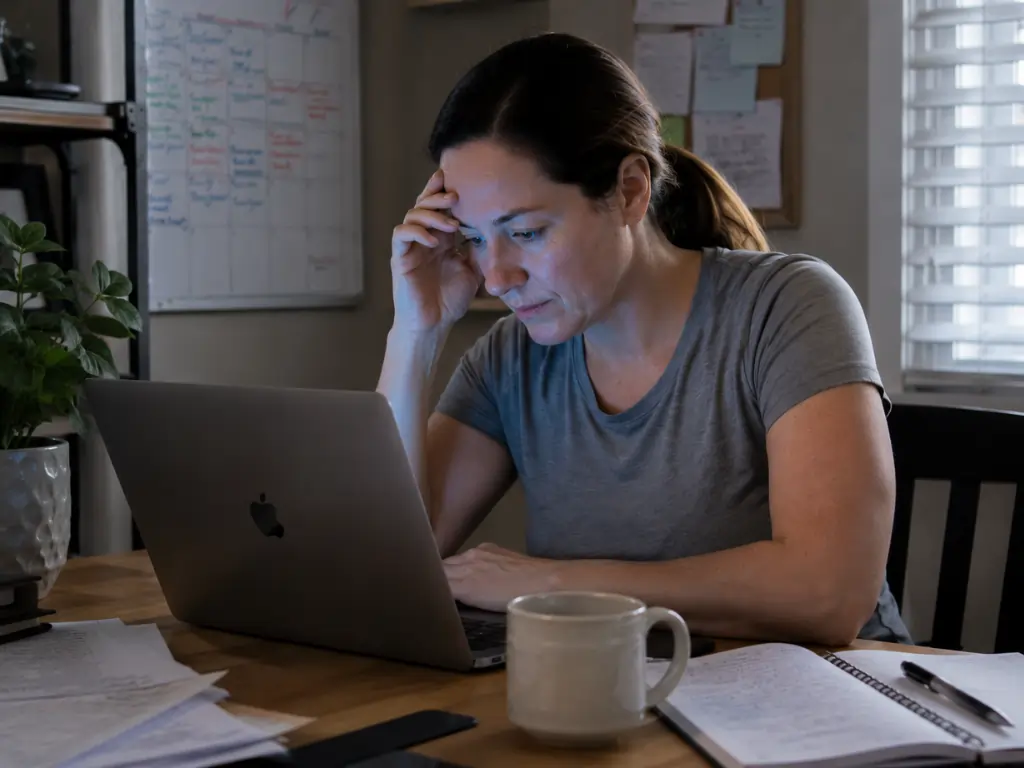
The strange thing is that most of us aren’t taught how to actually listen to our bodies.
We’re taught how to push harder. Work harder. Exercise harder. Fix ourselves.
But very few people teach us how to slow down long enough to notice what our body has been trying to tell us all along.
That’s exactly why practices like somatic Pilates have become so popular.
Not because they’re trendy. Not because they’re a miracle workout. But because they help people reconnect with something they’ve often lost: awareness. And awareness changes everything.
My First Experience With Somatic Pilates
I’ll be honest.
The first time I tried somatic Pilates, I thought I was doing it wrong.
The movements felt almost too simple. Too slow. Too gentle.
I kept waiting for the “real workout” to begin.
The burn. The sweat. The feeling that I had accomplished something. But something unexpected happened.
About halfway through the practice, I noticed tension in places I hadn’t even realized I was carrying it.
My jaw softened. My shoulders dropped. My breathing became deeper without me forcing it. For the first time in a while, I wasn’t trying to improve my body. I was actually paying attention to it.
That was the moment everything clicked. Somatic Pilates wasn’t asking me to push harder. It was asking me to listen more carefully. And that felt surprisingly difficult.
Because slowing down sounds easy until you actually try to do it. Now, I want to be clear about something. Somatic Pilates didn’t magically transform my life overnight. I didn’t suddenly become stress-free.
My posture wasn’t perfect after one session. And I certainly didn’t wake up with a completely different body.
What changed was much quieter than that.
I started noticing tension sooner. I caught myself holding my breath during stressful moments. I became more aware of how I was moving throughout the day.
And over time, those small moments of awareness created changes that felt far more sustainable than chasing another intense workout.
That’s why I wanted to write this guide. Not as a fitness expert trying to sell a quick fix.
But as someone who genuinely understands what it feels like to be disconnected from your body and is still learning how to come back home to it.
What You’ll Learn In This Guide
If you’re completely new to somatic Pilates, you’re in the right place.
In this beginner-friendly guide, we’ll explore:
✔ What somatic Pilates actually is (and how it’s different from traditional Pilates)
✔ The science-backed benefits of somatic movement
✔ Who somatic Pilates may help most
✔ Simple somatic Pilates exercises for beginners
✔ A gentle 7-day somatic Pilates roadmap
✔ Common beginner mistakes to avoid
✔ Answers to the most frequently asked questions
✔ A free printable Somatic Pilates PDF to help you get started
By the end of this guide, you’ll have a clear understanding of what somatic Pilates is, how it works, and whether it’s the right practice for your body.
And more importantly, you’ll learn that you don’t need to become stronger, more flexible, or more “fit” before you begin.
You simply need a willingness to notice.
Because sometimes the most powerful thing we can do isn’t push harder.
It’s finally slowing down enough to listen.
Since then, I’ve spent hundreds of hours exploring somatic movement, nervous system regulation, yoga, and mindful movement practices. While I’m still learning, Somatic Pilates has become one of my favorite tools for reconnecting with my body when life feels overwhelming.
What Is Somatic Pilates?
Somatic Pilates is a mindful movement practice that combines traditional Pilates exercises with somatic awareness. Instead of focusing only on strength or form, it encourages you to pay attention to internal sensations, release unnecessary tension, improve body awareness, and move with greater ease and control.
At first glance, Somatic Pilates can look a lot like regular Pilates.
You’ll still see familiar movements that strengthen the core, improve posture, and increase mobility. But the experience feels very different once you actually begin practicing.
Traditional Pilates often emphasizes precision, control, and performance. Somatic Pilates shifts the focus inward. Instead of asking, “Am I doing this exercise correctly?” you’re encouraged to ask, “What am I noticing in my body right now?”
That small shift changes everything.
The goal isn’t simply to move better.
It’s to become more aware of how you’re moving in the first place.
The Origins of Somatic Movement
The word somatic comes from the Greek word soma, which means “the living body experienced from within.”
Somatic movement practices became more widely known during the twentieth century through educators and movement pioneers who explored the relationship between the nervous system, movement habits, tension patterns, and body awareness.
Rather than treating the body like a machine that needs fixing, somatic approaches view the body as something we can learn from.
The idea is simple:
When we become aware of unconscious tension patterns, we gain the ability to change them.
This is why many people use somatic practices to improve movement quality, reduce stress, and reconnect with their bodies after years of rushing through daily life.
How Pilates and Somatic Awareness Work Together
Pilates and somatic movement complement each other surprisingly well.
Pilates provides structure. It helps build strength, stability, balance, coordination, and postural awareness.
Somatic awareness brings curiosity into the process. It encourages you to notice your breathing, your tension patterns, your movement habits, and how each exercise actually feels in your body.
When combined, the result is a practice that feels less like a workout and more like a conversation with your body.
Instead of forcing movement, you’re learning from it. Instead of pushing through discomfort, you’re paying attention to it.
Instead of trying to control every inch of your body, you’re developing a deeper sense of trust in how your body naturally moves.
Why Somatic Pilates Feels Different
The first thing most beginners notice is how slow it feels. The movements are often smaller. The pace is gentler. And there is far more attention on sensation than repetition. That can feel strange at first, especially if you’re used to workouts that measure success through calories burned, sweat, or intensity.
But the slower pace serves a purpose. When you move more slowly, your brain has time to notice patterns it usually misses. You may realize you’re gripping your jaw during certain movements. You may notice one hip feels tighter than the other. You may discover you’re holding your breath without realizing it.
These moments of awareness are often where the real practice begins.
What Somatic Pilates Is Not
There’s a common misconception that Somatic Pilates is simply an easier version of Pilates.
It isn’t.
It’s a different approach with a different goal.
Somatic Pilates is not:
✘ A calorie-burning cardio workout
✘ A punishment-based exercise program
✘ Advanced Pilates for experienced athletes only
✘ Physical rehabilitation or medical therapy
✘ A quick fix for pain, stress, or posture problems
Instead, Somatic Pilates is a practice of awareness.
It teaches you to slow down, notice more, and develop a healthier relationship with your body over time.
And in a world that constantly encourages us to do more, that simple act of paying attention can be surprisingly powerful.
Who Is Somatic Pilates For?
One of the things I appreciate most about somatic Pilates is that it doesn’t require you to already be flexible, fit, coordinated, or experienced.
You don’t need expensive equipment. You don’t need a fitness background.
And you definitely don’t need to be the kind of person who loves intense workouts.
In my experience, somatic Pilates tends to attract people who are tired of constantly pushing their bodies and are looking for a gentler way to reconnect with movement.
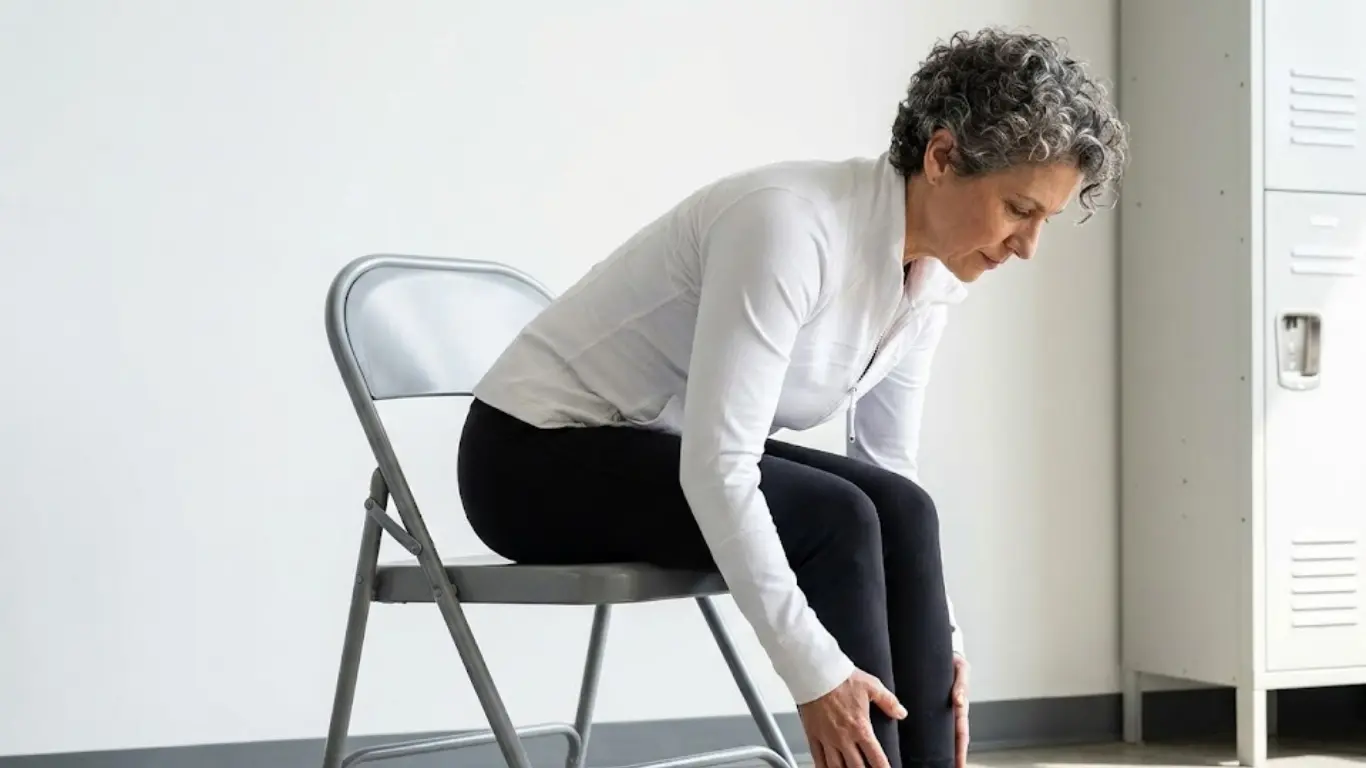
Desk Workers & People Who Sit Most of the Day
If you spend hours sitting at a desk, working on a laptop, driving, or looking down at your phone, your body often adapts to those positions without you realizing it.
The shoulders creep forward. The neck becomes stiff. The hips start feeling tight. The lower back works harder than it should.
I’ve noticed that many people don’t realize how much tension they’re carrying until they slow down enough to feel it.
Somatic Pilates creates space to notice those patterns and gently explore different ways of moving. It isn’t about fixing your posture overnight.
It’s about becoming aware of habits that may be contributing to discomfort in the first place.
People Recovering From Burnout
Burnout doesn’t just affect the mind.
It affects the body too.
When we’re under constant stress, the nervous system often remains in a heightened state for long periods of time.
Many people experience shallow breathing, muscle tension, fatigue, sleep difficulties, or a constant feeling of being “on.”
I personally found that slow movement felt surprisingly challenging when I was stressed.
Not because the exercises were difficult, but because slowing down forced me to notice how overwhelmed my body actually felt.
For many people, gentle somatic Pilates can become a supportive practice for rebuilding awareness after periods of chronic stress and exhaustion.
Women Over 40 & During Menopause
Many women notice significant physical changes during midlife.
Joints may feel stiffer. Recovery may take longer. Stress can feel more physically intense. Sleep may become less predictable.
During this stage, aggressive fitness approaches don’t always feel supportive. Somatic Pilates offers a slower and more sustainable alternative.
Rather than focusing on punishment or performance, the practice emphasizes mobility, body awareness, breathing, and nervous system regulation.
Many women find that this gentler approach feels more aligned with what their bodies need during periods of transition.
People Living With Chronic Stress
Sometimes stress becomes so normal that we stop recognizing it. We assume tight shoulders are normal. We assume jaw tension is normal. We assume constantly feeling wired or exhausted is normal.
Then one day we realize we’ve been carrying that tension for years. This is one reason why somatic Pilates for stress has become increasingly popular.
The practice encourages slower movement, intentional breathing, and greater awareness of physical tension patterns.
For many people, simply noticing these patterns is the first step toward changing them.
Seniors Looking For Gentle Movement
One reason I often recommend exploring somatic Pilates for seniors is because the focus isn’t on intensity.
The focus is on awareness. Movements can often be modified. The pace is slower. And there is less pressure to perform.
Many older adults are looking for ways to maintain mobility, balance, coordination, and confidence without feeling overwhelmed by complicated exercise routines.
Gentle somatic Pilates can provide a welcoming place to start.
Of course, anyone with medical conditions, balance concerns, recent surgeries, or significant mobility limitations should speak with a healthcare professional before beginning a new exercise program.
Beginners Intimidated By Fitness Culture
If you’ve ever felt uncomfortable walking into a gym or frustrated by workout programs that seem designed for already-fit people, you’re not alone.
Modern fitness culture often sends the message that every workout should leave you exhausted.
More sweat. More intensity. More pain.
Somatic Pilates follows a very different philosophy.
The goal isn’t to prove how hard you can work.
The goal is to develop a better relationship with your body.
For many beginners, that feels refreshing.
And honestly, it’s one of the reasons so many people stick with it.
People Recovering From Injury
Many people discover somatic movement after an injury changes the way they think about exercise.
When movement becomes painful, frustrating, or limited, awareness often becomes more important than intensity.
Somatic Pilates may help some people reconnect with their bodies in a gentler way by encouraging slow, mindful movement and greater body awareness.
That said, every injury is different.
If you’re recovering from surgery, dealing with acute pain, or following a rehabilitation program, it’s important to follow the guidance of your healthcare provider or physical therapist first.
Who Should NOT Choose Somatic Pilates?
This is an important conversation because not every movement practice is the right fit for every goal.
Somatic Pilates may not be the best choice if you’re primarily looking for:
- High-intensity calorie-burning workouts
- Rapid weight-loss programs
- Competitive fitness training
- Athletic performance conditioning
- Advanced strength development
- Sports-specific performance training
You may also need a different approach if you’re dealing with significant injuries, severe pain, neurological conditions, or medical concerns that require professional supervision.
Somatic Pilates can be a valuable complement to other forms of movement, but it is not a replacement for medical treatment, physical therapy, or individualized healthcare advice.
The biggest misconception I see is people expecting somatic Pilates to completely transform their bodies in a few sessions.
That’s not really what it’s designed for.
Its greatest strength is something much quieter. It teaches you how to notice.
And once you begin noticing how your body responds to stress, movement, breathing, and daily habits, you start building a relationship with your body that many of us never learned growing up.
That’s where the real value begins.
Somatic Pilates vs Pilates vs Yoga
One of the most common questions I hear is:
“Is somatic Pilates just Pilates?”
Or sometimes:
“Isn’t it basically yoga?”
I understand the confusion because all three involve mindful movement, breathing, and body awareness to some degree.
But after practicing each of them, I’ve found they feel surprisingly different once you experience them firsthand.
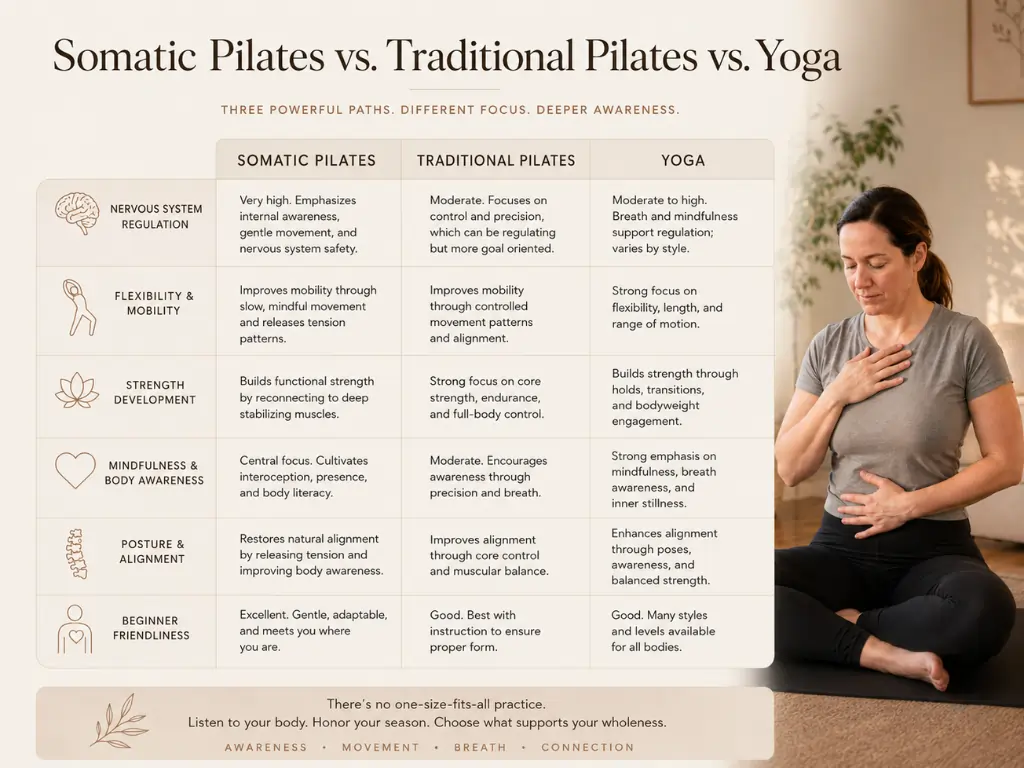
The easiest way to understand the difference is to look at the primary goal behind each practice.
| Feature | Somatic Pilates | Pilates | Yoga |
|---|---|---|---|
| Primary Goal | Awareness & nervous system regulation | Strength & stability | Flexibility, mindfulness & balance |
| Pace | Slow | Moderate | Varies by style |
| Nervous System Focus | Very High | Low to Moderate | Moderate |
| Core Strength Focus | Moderate | High | Moderate |
| Flexibility Focus | Moderate | Moderate | High |
| Body Awareness Focus | Very High | Moderate | High |
| Beginner-Friendly | Very High | Medium | Medium |
| Performance-Oriented | Low | High | Varies |
| Competitive Feeling | Very Low | Moderate | Low |
Somatic Pilates vs Traditional Pilates
Traditional Pilates is primarily a strength and stability practice.
Movements are usually more structured, more precise, and often performed with specific muscle engagement goals in mind.
You’ll frequently hear cues about activating the core, maintaining alignment, and executing movements correctly.
Somatic Pilates takes a different approach.
Instead of asking, “Am I doing this correctly?”
It often asks:
“What am I feeling right now?”
The movement becomes less about performance and more about awareness.
The pace is slower. The focus shifts toward tension patterns, breathing, movement quality, and nervous system regulation.
When I first tried somatic Pilates, I remember feeling like I wasn’t doing enough. The movements felt almost too simple.
But that’s exactly what made me realize how disconnected I had become from my body. Pilates taught me how to strengthen. Somatic Pilates taught me how to listen.
Somatic Pilates vs Yoga
This comparison is a little more nuanced because yoga is such a broad practice.
Some yoga styles are incredibly gentle.
Others are physically demanding.
Many forms of yoga include meditation, breathwork, philosophy, and spiritual traditions that extend far beyond movement.
Somatic Pilates is generally more movement-focused and body-awareness focused.
It tends to spend more time exploring subtle sensations, movement habits, muscular tension, and nervous system responses.
Yoga often asks:
“Can I hold this pose?”
Somatic Pilates often asks:
“What changes when I move differently?”
Neither approach is better.
They’re simply different tools.
As someone who has spent years practicing yoga, I see somatic Pilates as a complementary practice rather than a replacement.
In many ways, they support each other beautifully.
Which Is Better For Beginners?
If someone has never exercised consistently before, I would usually recommend somatic Pilates for beginners as one of the most approachable starting points.
Not because it’s easier.
Because it’s less intimidating.
There is less pressure to perform.
Less concern about flexibility.
Less emphasis on achieving a perfect shape or posture.
The goal is awareness rather than achievement.
That creates a safer and more welcoming experience for many beginners.
Best Choice For Most Beginners
🥇 Somatic Pilates
🥈 Gentle Yoga
🥉 Traditional Pilates
Which Is Better for Weight Loss?
This is where expectations matter.
Neither yoga nor somatic Pilates should be viewed as a rapid weight-loss solution.
Weight loss is influenced by many factors, including nutrition, sleep, stress levels, daily activity, hormones, and overall lifestyle.
That said:
Traditional Pilates generally burns more calories than somatic Pilates because movements are often more physically demanding.
Yoga varies significantly depending on style.
Power yoga may burn substantially more calories than restorative yoga.
If your primary goal is calorie expenditure and fitness conditioning:
🥇 Traditional Pilates
🥈 Dynamic Yoga
🥉 Somatic Pilates
However, there is another side to the conversation.
Many people discover that stress, poor sleep, and nervous system dysregulation affect their eating habits, recovery, and overall wellbeing.
For those individuals, somatic Pilates may support healthier habits indirectly by helping them reconnect with their bodies and stress signals.
Which Is Better For Stress?
This is where somatic Pilates truly stands out.
Most workouts challenge the body.
Somatic Pilates often helps calm it.
The slower pace, breath awareness, sensory focus, and emphasis on reducing unnecessary tension create an environment that encourages nervous system regulation.
When people search for somatic Pilates for stress, this is usually what they’re looking for.
Not another workout.
A way to feel more present.
More grounded.
More connected.
From my own experience, this is the biggest difference.
After traditional Pilates, I often feel stronger.
After yoga, I often feel balanced.
After somatic Pilates, I often feel like I’ve finally exhaled.
Best Choice For Stress Relief
🥇 Somatic Pilates
🥈 Gentle Yoga
🥉 Traditional Pilates
My Honest Take After Practicing All Three
I don’t think the question is which practice is better.
I think the better question is:
What does your body need right now?
If you want strength and core stability, Pilates may be the best fit.
If you’re seeking flexibility, mindfulness, and a broader mind-body practice, yoga may resonate more.
If you’re feeling overwhelmed, disconnected, chronically tense, or exhausted from always pushing harder, somatic Pilates may be exactly the place to begin.
Because sometimes the most powerful movement isn’t the one that challenges your body the most.
It’s the one that helps you finally pay attention to it.
Why Your Body Holds Tension
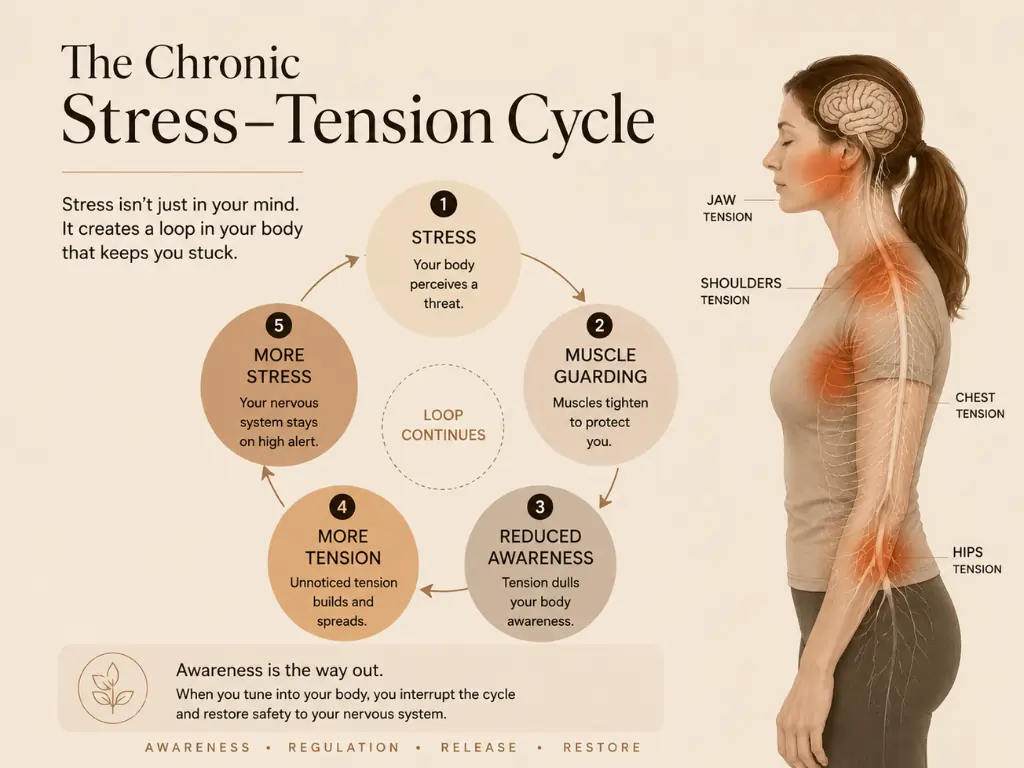
The Mindfullyoga Tension Loop™
One of the biggest misconceptions I used to have was thinking tension came from my muscles.
I thought tight shoulders meant I needed more stretching.
I thought neck pain meant I needed a massage.
I thought stiffness meant I simply wasn’t moving enough.
Sometimes those things help.
But over time, I realized something deeper was happening.
The tension wasn’t starting in my muscles.
It was starting in my nervous system.
That’s why I created what I call the Mindfullyoga Tension Loop™.
A simple way to understand why so many of us feel stuck in patterns of stress, tightness, and discomfort.
The Mindfullyoga Tension Loop™
Stress
↓
Muscle Guarding
↓
Reduced Awareness
↓
More Tension
↓
More Stress
↓
The Cycle Continues
Let’s break it down.
Step 1: Stress Arrives
Stress isn’t always dramatic.
Sometimes it’s obvious.
A difficult conversation.
A work deadline.
Financial pressure.
Bad news.
But often stress shows up in smaller ways.
Too much screen time.
Constant notifications.
Poor sleep.
Rushing through every part of the day.
Trying to do ten things at once.
The nervous system doesn’t always distinguish between major threats and constant low-level pressure.
It simply responds.
And when it responds, the body responds too.
Step 2: Your Muscles Begin Guarding
When the brain senses stress, it often prepares the body for action.
Even when you’re sitting at a desk.
Even when you’re scrolling social media.
Even when you’re lying in bed.
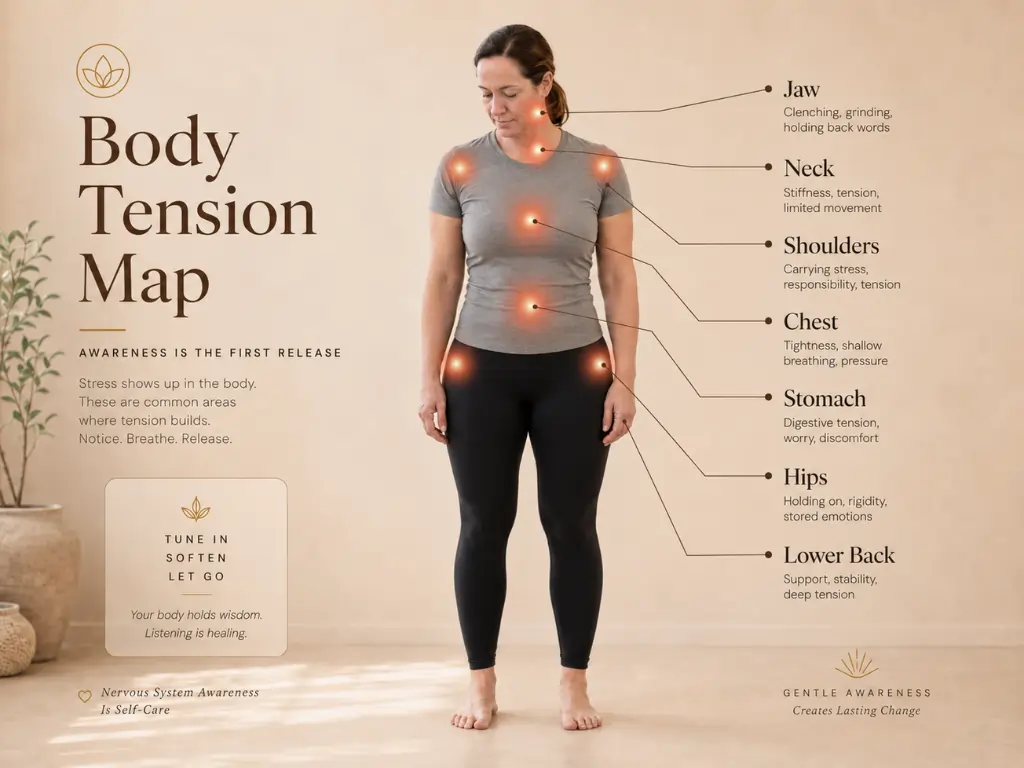
Certain muscles begin holding tension automatically.
The shoulders rise.
The jaw tightens.
The stomach contracts.
The neck becomes rigid.
The breath becomes shallow.
This process is called protective muscle guarding.
Your body is trying to help.
The problem is that many of us never switch this response off.
Step 3: Awareness Starts Disappearing
This is where things get interesting.
At first, you notice the tension.
But if it stays long enough, it begins feeling normal.
You stop noticing your clenched jaw.
You stop noticing your tight shoulders.
You stop noticing you’re holding your breath.
The body adapts.
Awareness fades.
And because you no longer notice the tension, you stop responding to it.
This is the stage where many people tell me:
“I didn’t realize how tight I was until I finally slowed down.”
I’ve experienced that myself countless times.
Step 4: Tension Builds On Top Of Tension
Now the original stress might be gone.
But the physical pattern remains.
The shoulders stay elevated.
The neck stays tight.
The breathing stays restricted.
The nervous system continues receiving signals that something feels unsafe or stressful.
The body begins treating tension as its default setting.
And because movement becomes less efficient, discomfort often increases.
Step 5: More Stress Is Created
Here’s the part most people miss.
The tension itself can become a new source of stress.
You feel uncomfortable.
You sleep poorly.
You become frustrated.
You worry about the discomfort.
You move less.
Your body feels even worse.
The cycle feeds itself.
And before long, you’re stuck inside a loop that seems impossible to escape.
A Real-Life Example
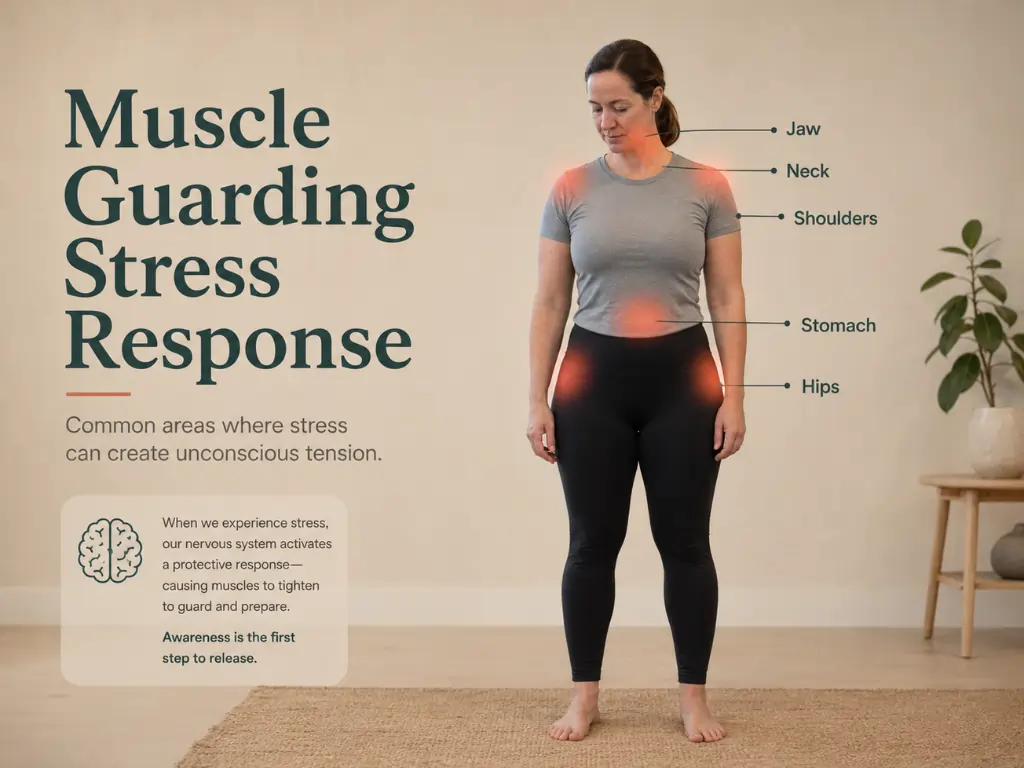
Imagine you’re working on your laptop for six hours.
You have deadlines.
Messages are constantly arriving.
You skip lunch.
You barely move.
Your shoulders slowly creep toward your ears.
Your jaw tightens.
Your breathing becomes shallow.
But you don’t notice.
The next morning, your neck feels stiff.
You assume you slept wrong.
A few days later, you have a headache.
A week later, your upper back feels constantly tight.
The original stressor may have passed.
But the physical pattern remains.
This is the Mindfullyoga Tension Loop™ in action.
Why Somatic Pilates Interrupts The Loop
Most people try to solve tension at the very end of the cycle.
They stretch the muscle.
Massage the muscle.
Foam roll the muscle.
And sometimes that helps temporarily.
But somatic Pilates approaches the problem differently.
Instead of asking:
“How do I get rid of this tension?”
It asks:
“Can I become aware of it first?”
Because awareness is often the missing piece.
The moment you notice your shoulders.
Notice your jaw.
Notice your breathing.
Notice how you’re sitting.
The loop begins to weaken.
You create choice where there used to be autopilot.
And that small shift is often where meaningful change begins.
The Most Important Thing I’ve Learned
I don’t believe most people are carrying tension because they’re broken.
I think they’re carrying tension because they’re busy.
Busy people stop noticing.
And when we stop noticing, tension quietly becomes our normal.
That’s why somatic Pilates isn’t really about stretching.
Or strengthening.
Or burning calories.
At its core, it’s a practice of awareness.
Because awareness is often the first thing that breaks the loop.
And once the loop begins to break, the body finally gets an opportunity to do what it has been trying to do all along:
Let go.
The Science Behind Somatic Pilates
One reason I became interested in somatic Pilates is that it doesn’t rely on the idea of “pushing through” discomfort.
Instead, many of its principles align with what researchers have learned about movement, learning, stress, and the nervous system.
Now, it’s important to be honest here.
Somatic Pilates itself is still an emerging area with limited direct research.
However, many of the concepts it draws from—such as neuroplasticity, motor learning, body awareness, breath regulation, and nervous system function—are supported by a growing body of scientific evidence.
Let’s look at what the research actually suggests.
Neuroplasticity: Your Brain Can Learn New Movement Patterns
For many years, scientists believed the brain became largely fixed after childhood.
Today we know that’s not true.
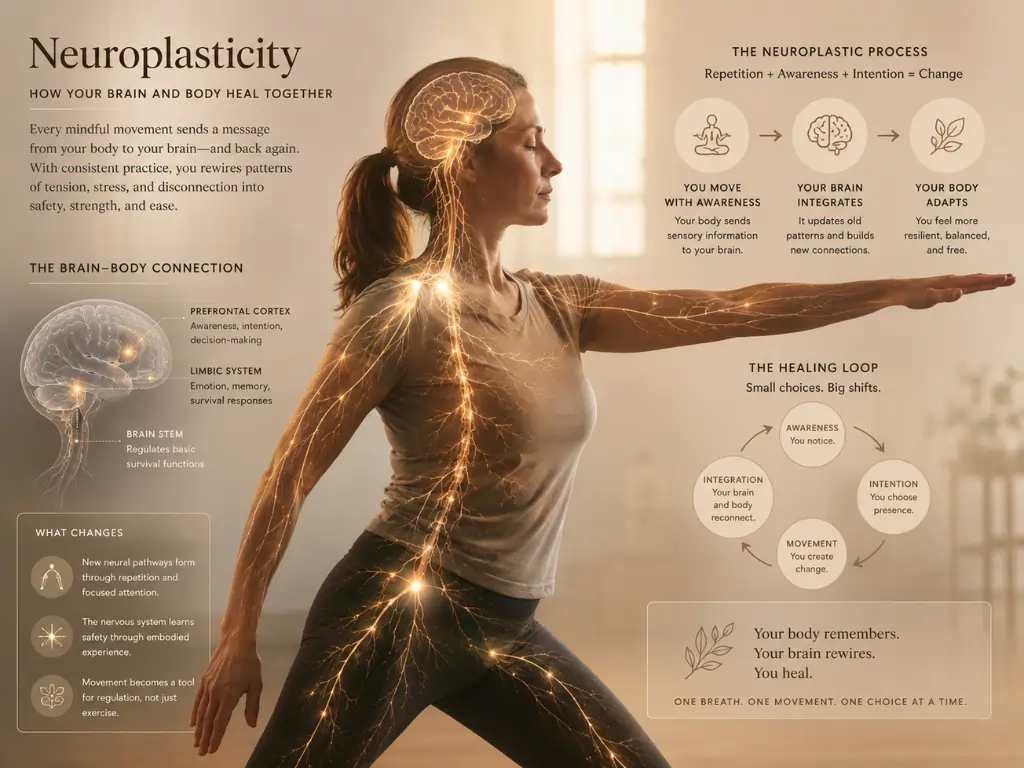
The brain remains adaptable throughout life through a process called neuroplasticity.
Neuroplasticity refers to the brain’s ability to create new neural pathways based on experience and repetition.
In practical terms, this means movement habits can change.
If you’ve spent years hunching your shoulders, clenching your jaw, or moving in a way that creates unnecessary tension, your nervous system can learn different patterns over time.
This is one reason somatic practices emphasize slow, mindful repetition.
The goal isn’t simply moving more.
It’s helping the brain recognize and refine how movement is organized.
Why This Matters
When you move with awareness, you’re not only training muscles.
You’re also teaching your nervous system new options.
And often, lasting change begins there.
Pandiculation: The Missing Link Most People Never Hear About
One of the foundational concepts in many somatic movement approaches is pandiculation.
Pandiculation is a natural process that occurs when muscles gently contract, slowly lengthen, and then completely release.
You’ve probably done it countless times without realizing it.
Think about the way a cat stretches after a nap.
Or how your body naturally stretches when you wake up in the morning.
That instinctive movement is pandiculation.
Unlike passive stretching, pandiculation actively involves the brain and nervous system.
The goal isn’t forcing muscles longer.
The goal is helping the nervous system recognize and release habitual tension patterns.
Many somatic Pilates exercises incorporate this principle through slow, conscious movement.
Why This Matters
The nervous system often controls tension more than the muscles themselves.
Pandiculation helps retrain that control system.
Motor Learning: Why Slow Movement Works
Most people assume faster movement means better progress.
Research on motor learning suggests the opposite is often true when learning new skills.
Motor learning refers to how the brain acquires, refines, and automates movement patterns.
When movements are performed slowly and deliberately, the brain receives clearer sensory feedback.
This allows for greater awareness and improved movement quality.
That’s one reason somatic Pilates feels different from many fitness programs.
The slower pace isn’t a limitation.
It’s part of the learning process.
Why This Matters
Sometimes moving slower creates more lasting improvements than moving harder.
Body Awareness (Interoception & Proprioception)
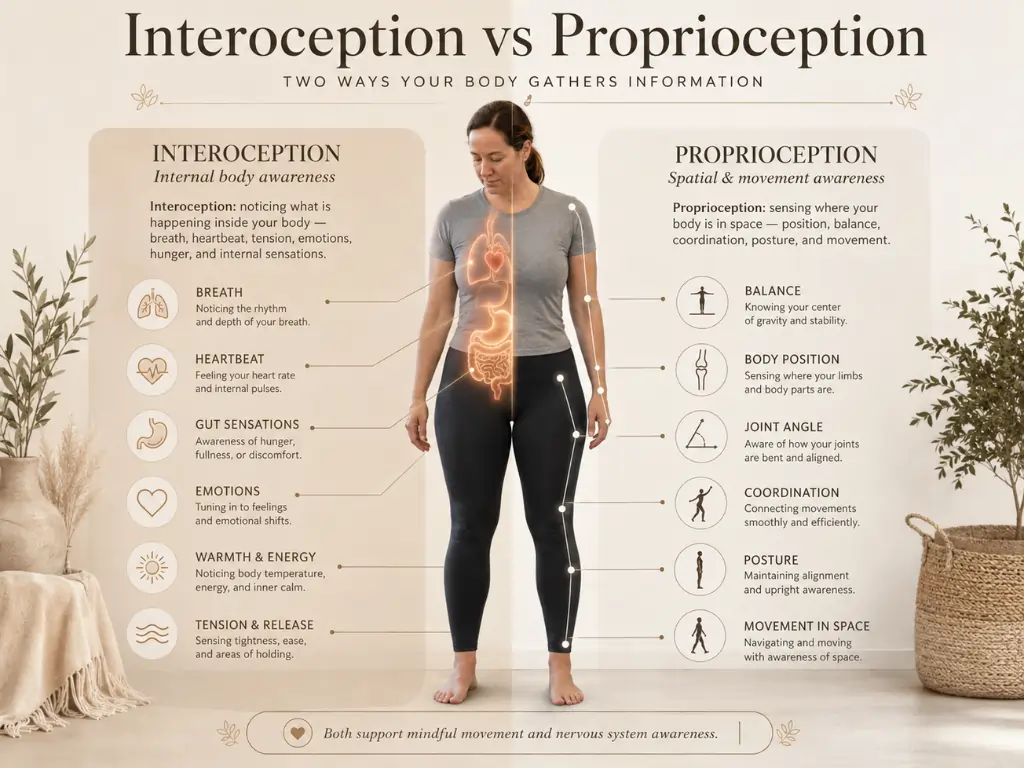
One of the most researched aspects of somatic movement involves body awareness.
Scientists typically discuss two important systems:
Interoception
Interoception is your ability to notice internal sensations.
Examples include:
- Hunger
- Breathing patterns
- Heartbeat awareness
- Muscle tension
- Fatigue
- Emotional sensations
Proprioception
Proprioception is your awareness of where your body is in space.
It’s what allows you to move without constantly looking at your limbs.
Somatic Pilates encourages both systems.
As awareness improves, many people begin noticing tension patterns, posture habits, and stress responses much earlier than before.
Why This Matters
You can’t change a pattern you don’t notice.
Awareness often comes before improvement.
Cortisol, Chronic Stress, And The Body
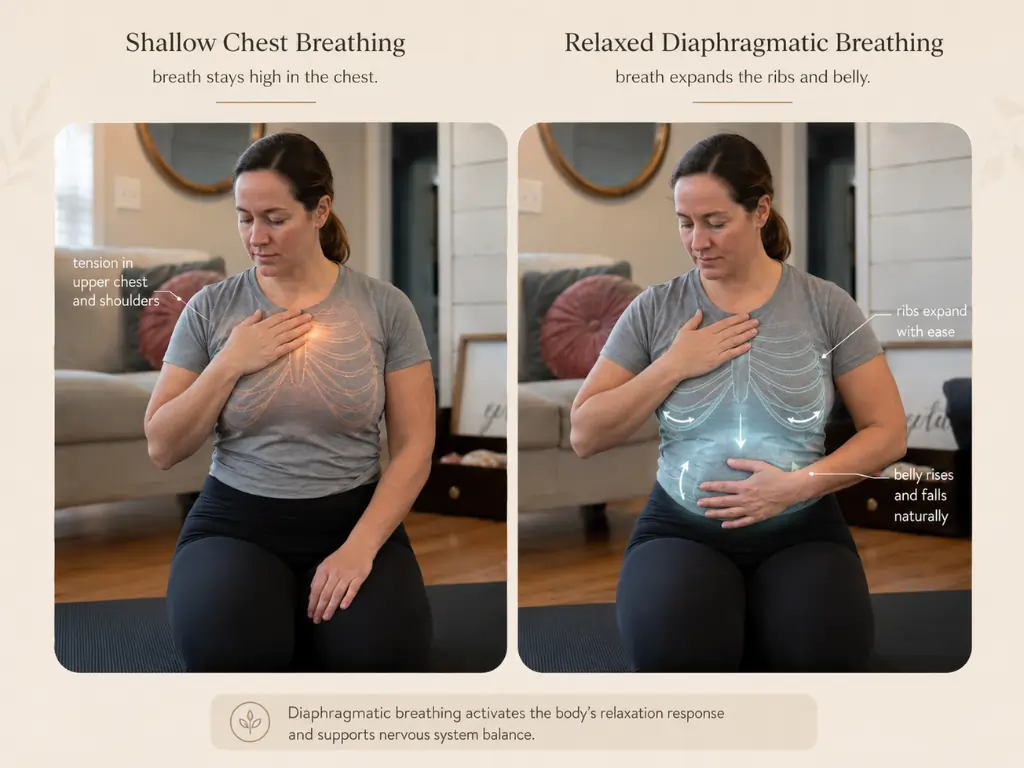
When stress becomes chronic, the body often remains in a prolonged state of alertness.
The stress response involves several hormones, including cortisol.
Cortisol itself isn’t bad.
It’s essential for survival.
Problems tend to arise when stress becomes constant and recovery becomes limited.
Chronic stress has been associated with:
- Muscle tension
- Sleep difficulties
- Fatigue
- Reduced recovery
- Increased pain sensitivity
- Mood disturbances
Somatic Pilates is not a treatment for high cortisol.
However, its emphasis on slow movement, breathing, and nervous system awareness may support healthy stress-management habits.
Important Note
Current research supports movement and stress-management practices as part of overall wellbeing, but no single exercise system can “cure” chronic stress by itself.
Vagus Nerve Regulation And The Parasympathetic Nervous System
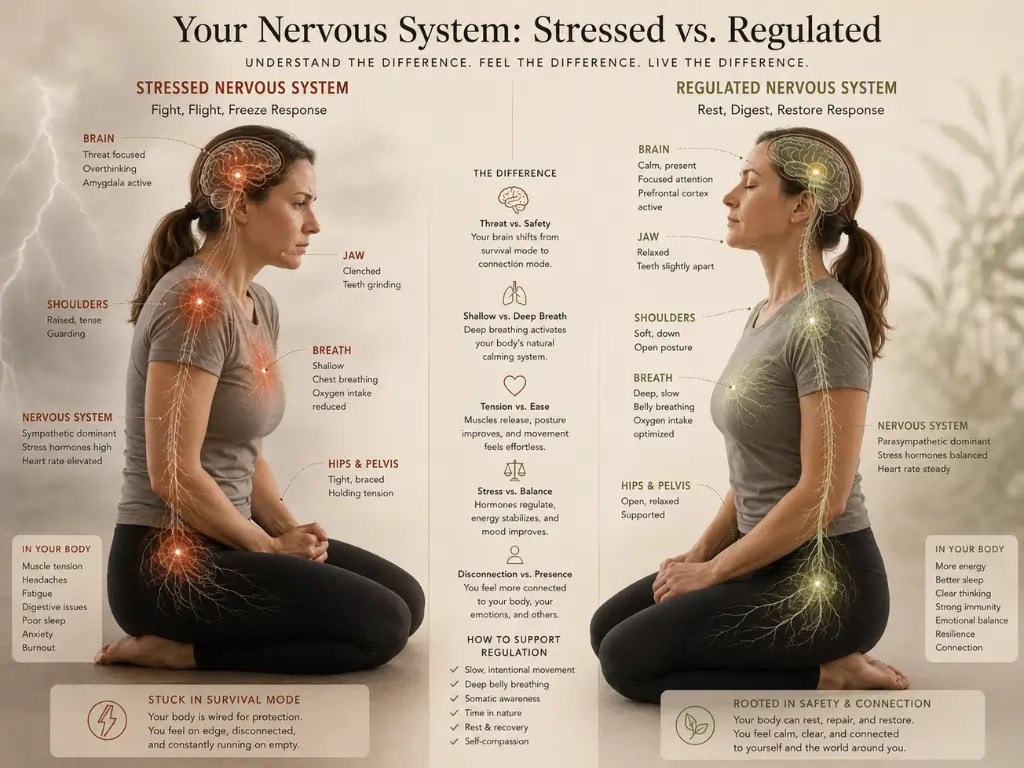
You’ve probably seen the phrase “vagus nerve stimulation” all over social media.
Unfortunately, a lot of what circulates online oversimplifies the science.
Here’s what we know.
The vagus nerve plays an important role in the parasympathetic nervous system, sometimes called the body’s “rest and digest” system.
Activities associated with parasympathetic activation often include:
- Slow breathing
- Relaxation
- Recovery
- Digestion
- Reduced physiological arousal
Because somatic Pilates emphasizes breath awareness and slower movement, many practitioners report feeling calmer after a session.
Researchers continue studying how breathing practices and mindful movement influence autonomic nervous system regulation.
Why This Matters
A calmer nervous system often creates a better environment for healing, recovery, and overall wellbeing.
What Current Research Suggests
After reviewing the available evidence, here’s the most balanced conclusion I can offer.
Research currently supports several principles that somatic Pilates is built upon:
✓ Neuroplasticity allows movement patterns to change.
✓ Motor learning improves through mindful repetition.
✓ Body awareness plays an important role in movement quality.
✓ Breath-focused movement may support nervous system regulation.
✓ Gentle movement can contribute to stress reduction and overall wellbeing.
However, researchers have not yet established that somatic Pilates specifically is a cure for pain, trauma, high cortisol, poor posture, or chronic health conditions.
That’s an important distinction.
The strongest claims are often the least scientific.
My Take As A Practitioner
What keeps bringing me back to somatic Pilates isn’t a promise of perfect posture or a dramatic body transformation.
It’s something much simpler.
The practice teaches awareness.
And awareness changes behavior.
I notice tension sooner.
I notice stress sooner.
I notice when I’m holding my breath.
I notice when I’m pushing through exhaustion instead of listening.
Science may describe this through neuroplasticity, motor learning, and nervous system regulation.
But in everyday life, it feels much more human than that.
It feels like rebuilding a relationship with your body.
And that’s what makes somatic Pilates so powerful.
Benefits of Somatic Pilates
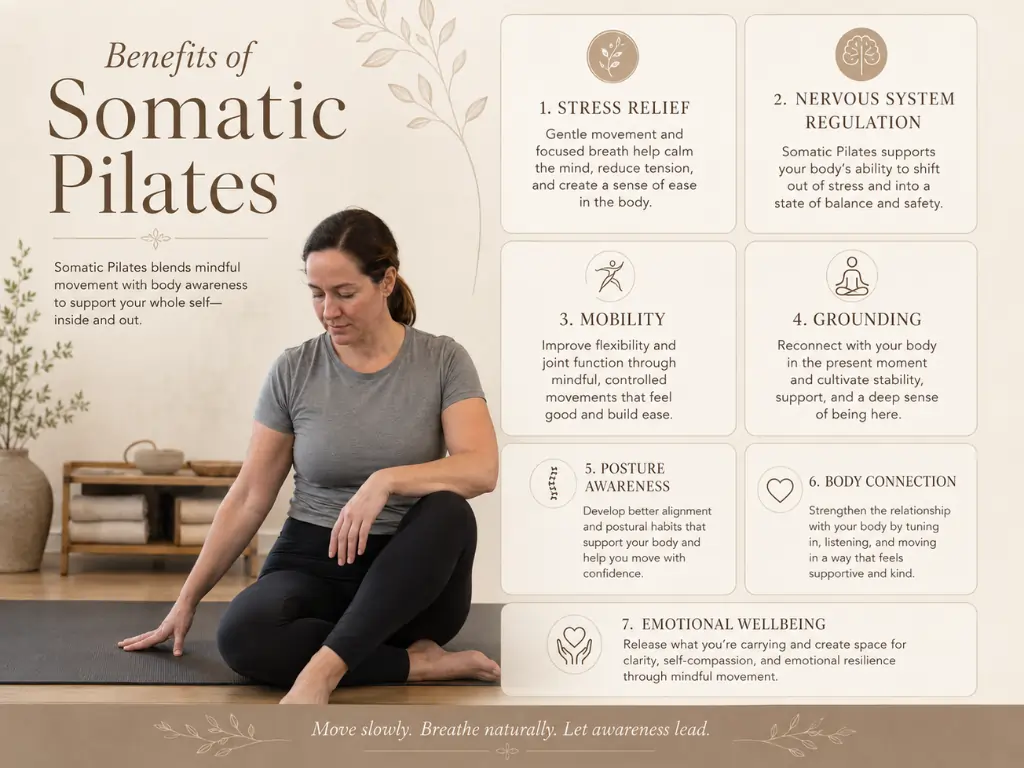
One thing I appreciate about somatic Pilates is that the benefits aren’t limited to what happens during a workout.
In fact, some of the most noticeable changes often show up outside the practice itself.
You might find yourself sitting differently at your desk.
Breathing more deeply during stressful moments.
Catching tension before it turns into discomfort.
Or simply feeling more connected to your body throughout the day.
The benefits tend to build gradually, often through small moments of awareness that accumulate over time.
Let’s look at both the physical and emotional benefits many people experience.
Physical Benefits of Somatic Pilates
Better Posture Through Awareness, Not Force
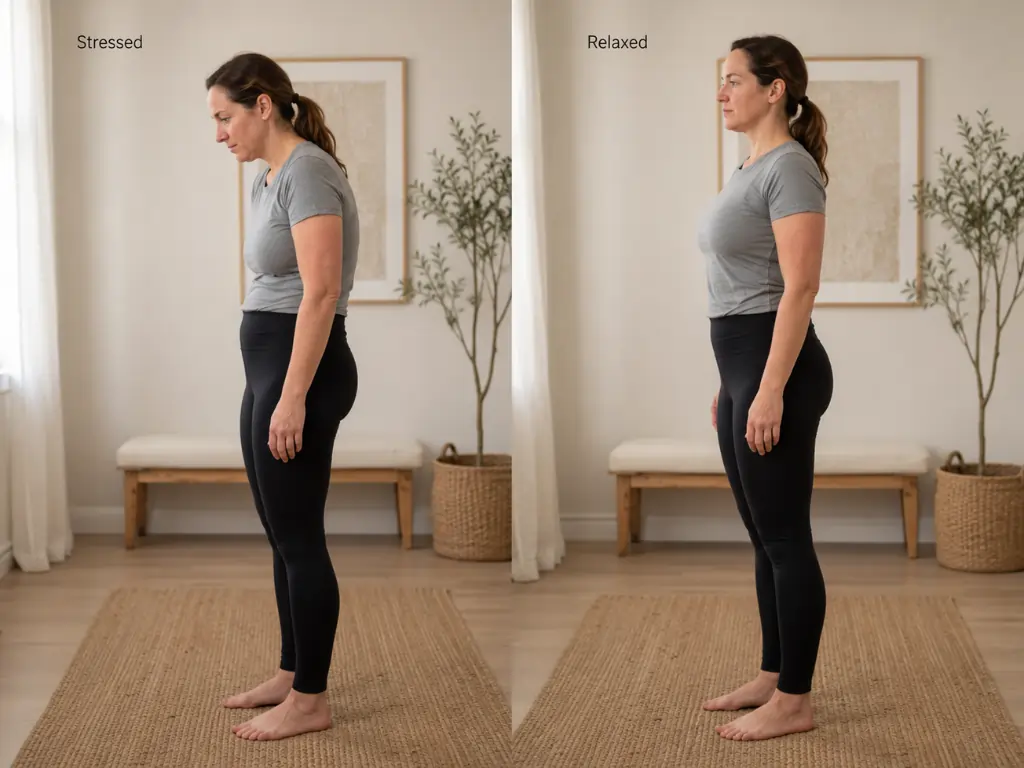
Most posture advice focuses on correction.
Sit straighter.
Pull your shoulders back.
Engage your core.
The problem is that forced posture rarely lasts.
Eventually, the body returns to its familiar habits.
Somatic Pilates approaches posture differently.
Instead of forcing alignment, it helps you become aware of the tension patterns that may be pulling your body out of balance.
For me, posture improved most when I stopped trying to “sit correctly” and started noticing when stress was causing my shoulders to creep toward my ears.
That awareness created change far more effectively than constant self-correction ever did.
What You May Notice
- Less shoulder tension
- Reduced neck stiffness
- More comfortable sitting
- Improved spinal awareness
- Easier upright posture
Stronger Core Awareness
When people hear the word “core,” they often think of six-pack abs.
But your core does much more than create visible muscle definition.
It helps support balance, stability, breathing, and everyday movement.
Traditional Pilates often strengthens the core through structured exercises.
Somatic Pilates adds another layer.
It teaches you how to actually feel your core working.
That may sound simple, but many people move through daily life with very little awareness of how their body is supporting itself.
The goal isn’t just a stronger core.
It’s a more connected one.
What You May Notice
- Better body control
- Improved stability
- More confidence in movement
- Greater awareness of posture and alignment
Improved Mobility
Mobility isn’t just about flexibility.
It’s about how comfortably and efficiently your body moves.
Many people assume they’re inflexible when they’re actually carrying chronic tension.
When unnecessary tension decreases, movement often feels smoother and easier.
One thing I’ve personally noticed is that mobility improves most when I stop forcing it.
The body often responds better to curiosity than pressure.
What You May Notice
- Easier bending and reaching
- Less stiffness after sitting
- More comfortable daily movement
- Greater freedom of motion
Better Balance and Coordination
Balance isn’t only important for athletes.
It’s important for everyone.
Walking upstairs.
Getting out of a chair.
Carrying groceries.
Navigating uneven surfaces.
All of these activities depend on balance and coordination.
Because somatic Pilates develops body awareness, many practitioners become more conscious of how they move through space.
That increased awareness often translates into greater stability and confidence.
What You May Notice
- Improved coordination
- Better movement control
- Increased confidence during daily activities
- More stable movement patterns
Easier Daily Movement
This might be my favorite benefit because it’s the one people talk about the least.
The real goal isn’t performing exercises perfectly.
The real goal is feeling better in everyday life.
Getting out of bed.
Walking the dog.
Playing with your children.
Standing in the kitchen.
Working at a desk.
Life is made of ordinary movements.
And often, those movements become easier when the body isn’t carrying quite as much unnecessary tension.
Emotional & Mental Benefits of Somatic Pilates
While most people start somatic Pilates for physical reasons, many stay because of how it affects their relationship with stress and self-awareness.
Reduced Stress and Nervous System Overload
Modern life rarely encourages us to slow down.
We’re constantly consuming information, multitasking, and moving from one responsibility to the next.
The body responds to that pace.
Sometimes through tight shoulders.
Sometimes through headaches.
Sometimes through fatigue.
Somatic Pilates creates an opportunity to step out of that cycle for a few minutes.
The combination of slow movement, breathing, and awareness can help create a sense of calm that many people struggle to find elsewhere.
What You May Notice
- Feeling calmer after practice
- Less physical tension
- Improved relaxation
- Greater awareness of stress signals
Improved Body Awareness
If there is one benefit that sits at the center of everything else, it’s this one.
Awareness.
The more aware you become, the sooner you notice tension.
The sooner you notice stress.
The sooner you recognize habits that may be contributing to discomfort.
This is why awareness is such a recurring theme throughout somatic Pilates.
Because awareness often comes before change.
What You May Notice
- Earlier recognition of tension
- Better understanding of movement habits
- Improved connection with physical sensations
- More intentional movement
Increased Resilience
Resilience isn’t about avoiding stress.
It’s about responding to stress more effectively.
Life will always include challenges.
Deadlines.
Difficult conversations.
Unexpected setbacks.
What changes is how we relate to those experiences.
Many practitioners find that developing awareness helps them respond rather than react.
That small difference can have a meaningful impact on overall wellbeing.
What You May Notice
- Greater emotional regulation
- Better stress recovery
- More patience with yourself
- Increased adaptability
Feeling More Grounded
This benefit can be difficult to measure but easy to feel.
Groundedness often shows up as a sense of being present rather than scattered.
Connected rather than disconnected.
Calm rather than constantly rushed.
For me, this is one of the most rewarding parts of the practice.
Not because life becomes perfect.
But because I become more present for it.
What You May Notice
- Greater presence
- Less mental overwhelm
- More connection to your body
- Improved sense of wellbeing
A Healthier Relationship With Exercise
Many people have spent years treating exercise as punishment.
Burn more calories.
Push harder.
Do more.
Be better.
Somatic Pilates offers a different perspective.
Movement becomes something you do with your body rather than against it.
That shift can be surprisingly powerful.
Especially for people who have spent years feeling disconnected from exercise or intimidated by fitness culture.
The Benefit That Matters Most
If I had to summarize all of these benefits into one sentence, it would be this:
Somatic Pilates helps you notice your body before it has to shout for your attention.
Sometimes that means less tension.
Sometimes it means better movement.
Sometimes it means recognizing stress sooner.
And sometimes it simply means feeling a little more at home in your own body.
For many people, that’s the benefit that changes everything.
The Weight Loss Truth Nobody Talks About
If you’ve searched for somatic Pilates for weight loss, you’ve probably seen some pretty bold claims.
“Lose belly fat naturally.”
“Melt stress weight away.”
“Transform your body in 30 days.”
Honestly?
Most of those promises oversimplify how weight loss actually works.
And one thing I never want to do on Mindfullyoga is promise results that no movement practice can realistically guarantee.
So let’s talk about what somatic Pilates can do, what it can’t do, and why the answer is more interesting than most people realize.
Can Somatic Pilates Help With Weight Loss?
The short answer is:
Potentially, yes—but probably not in the way most people expect.
Somatic Pilates is not designed as a calorie-burning workout.
You won’t spend the session jumping, sprinting, or pushing your heart rate into high-intensity training zones.
If your goal is simply maximizing calorie burn per minute, there are more effective options.
But weight loss isn’t only about calories.
Human beings are more complicated than that.
Sleep affects weight.
Stress affects weight.
Consistency affects weight.
Energy levels affect weight.
Eating behaviors affect weight.
And this is where somatic Pilates may have something valuable to offer.
What Somatic Pilates Does Well
It Helps People Stay Consistent
One reason many fitness programs fail isn’t because they don’t work.
It’s because people can’t sustain them.
They’re too intense.
Too exhausting.
Too time-consuming.
Or simply miserable.
I’ve seen people quit exercise programs because they felt punished every time they worked out.
Somatic Pilates feels different.
The sessions are gentle.
The barrier to starting is low.
And because the practice often feels supportive rather than punishing, many people find it easier to stick with long term.
And consistency almost always beats perfection.
A workout you do three times a week for a year is far more powerful than an extreme program you quit after three weeks.
It Improves Body Awareness
This benefit is often overlooked.
The more connected you become to your body, the more likely you are to notice things like:
- Hunger cues
- Fullness cues
- Stress eating patterns
- Energy levels
- Fatigue
- Emotional triggers
Somatic Pilates doesn’t tell you what to eat.
But it may help you become more aware of why you’re eating.
And awareness can be surprisingly powerful.
I’ve noticed that when I’m disconnected from my body, I tend to operate on autopilot.
When I’m more aware, my choices become more intentional.
It Supports Stress Management
Many people don’t realize how much stress influences health behaviors.
When stress is high, it’s often harder to:
- Sleep well
- Recover properly
- Exercise consistently
- Make thoughtful food choices
- Listen to hunger and fullness signals
Somatic Pilates encourages slower movement, breath awareness, and nervous system regulation.
While it isn’t a treatment for stress, many practitioners report feeling calmer and more grounded after practice.
And for some people, that shift creates healthier habits throughout the rest of the day.
What Somatic Pilates Does NOT Do
This is where honesty matters.
Somatic Pilates is not a magic weight-loss solution.
It does not:
✘ Burn massive amounts of calories
✘ Create rapid fat loss
✘ Replace a balanced diet
✘ Guarantee visible body transformations
✘ Produce overnight results
If someone promises otherwise, I would be skeptical.
The biggest strength of somatic Pilates has never been intensity.
Its strength is awareness.
The Cortisol Connection: What The Science Actually Says
You’ll often see claims that somatic Pilates “lowers cortisol and causes weight loss.”
The reality is more nuanced.
Cortisol is a stress hormone produced by the body.
Contrary to what social media sometimes suggests, cortisol is not the enemy.
You need cortisol to wake up, respond to challenges, and function normally.
Problems may arise when stress becomes chronic and recovery becomes limited.
Researchers have found associations between chronic stress, changes in appetite, sleep disruption, and weight-related challenges.
However, it’s important to be careful here.
No study has shown that simply doing somatic Pilates automatically lowers cortisol enough to cause meaningful weight loss.
The science doesn’t support that claim.
What research does suggest is that movement, stress-management practices, adequate sleep, and healthy lifestyle habits can support overall wellbeing.
Somatic Pilates may fit into that bigger picture.
But it isn’t a shortcut.
What I’ve Personally Noticed
When people ask whether somatic Pilates helps with weight loss, I think they’re often asking a deeper question.
They’re asking:
“Can I find a healthier relationship with my body?”
For me, that was the bigger change.
I became more aware of stress.
More aware of tension.
More aware of how exhaustion affected my choices.
More aware of when I needed rest instead of another challenge.
Those changes didn’t happen overnight.
But they felt sustainable.
And sustainability matters far more than quick fixes.
My Honest Answer
If your only goal is burning the maximum number of calories possible, somatic Pilates probably isn’t the most efficient choice.
But if your goal is to:
✓ Move consistently
✓ Reduce all-or-nothing thinking
✓ Improve body awareness
✓ Build healthier habits
✓ Create a more supportive relationship with exercise
Then somatic Pilates can absolutely be part of that journey.
The truth nobody talks about is that lasting change rarely comes from punishing your body.
More often, it comes from learning how to work with it.
And that’s exactly what somatic Pilates teaches.
Before You Start: A Beginner Success Checklist
Before we jump into exercises, I want to share something I wish someone had told me when I first started.
The people who benefit most from somatic Pilates aren’t usually the people who move the hardest.
They’re the people who learn how to pay attention.
A few simple things can make your practice feel much more enjoyable from the beginning.
✓ Wear Comfortable Clothing
You don’t need expensive workout outfits or special Pilates gear.
Choose clothing that allows you to breathe comfortably and move without restriction.
If you’re constantly adjusting your clothes, it’s harder to stay present with your body.
✓ Find a Quiet Space
Your practice doesn’t need a perfect home studio.
A small corner of your bedroom, living room, or office is enough.
The goal isn’t creating a Pinterest-worthy space.
The goal is creating a few minutes with fewer distractions.
✓ Leave Your Expectations At The Door
This might be the most important item on the entire list.
You don’t need to become more flexible today.
You don’t need to “do it right.”
You don’t need a breakthrough experience.
Some days you’ll notice a big shift.
Some days you’ll simply notice your shoulders.
Both are valuable.
✓ Move Slower Than Feels Natural
Most beginners move too quickly.
I did too.
When in doubt, slow down.
Then slow down a little more.
Somatic Pilates isn’t about completing movements.
It’s about experiencing them.
The slower you move, the more information your body can give you.
✓ Bring Curiosity, Not Judgment
Try replacing questions like:
“Am I doing this correctly?”
With:
“What am I noticing right now?”
That small shift changes everything.
Curiosity creates awareness.
Judgment usually creates tension.
And awareness is where the real practice begins.
The Mindfullyoga Reminder
You don’t need flexibility.
You don’t need experience.
You don’t need to be “good” at movement.
You only need a willingness to notice.
Because somatic Pilates isn’t about becoming a different person.
It’s about becoming more aware of the person who’s already here.
Somatic Pilates Exercise Library
One of the biggest misconceptions about Somatic Pilates is that you need dozens of exercises to feel a difference.
You don’t.
In fact, most beginners benefit from repeating a handful of simple movements and learning how to feel them more deeply over time.
The goal isn’t to master complicated choreography.
The goal is to improve awareness.
Move slowly.
Stay curious.
And remember: smaller movements often teach us more than bigger ones.
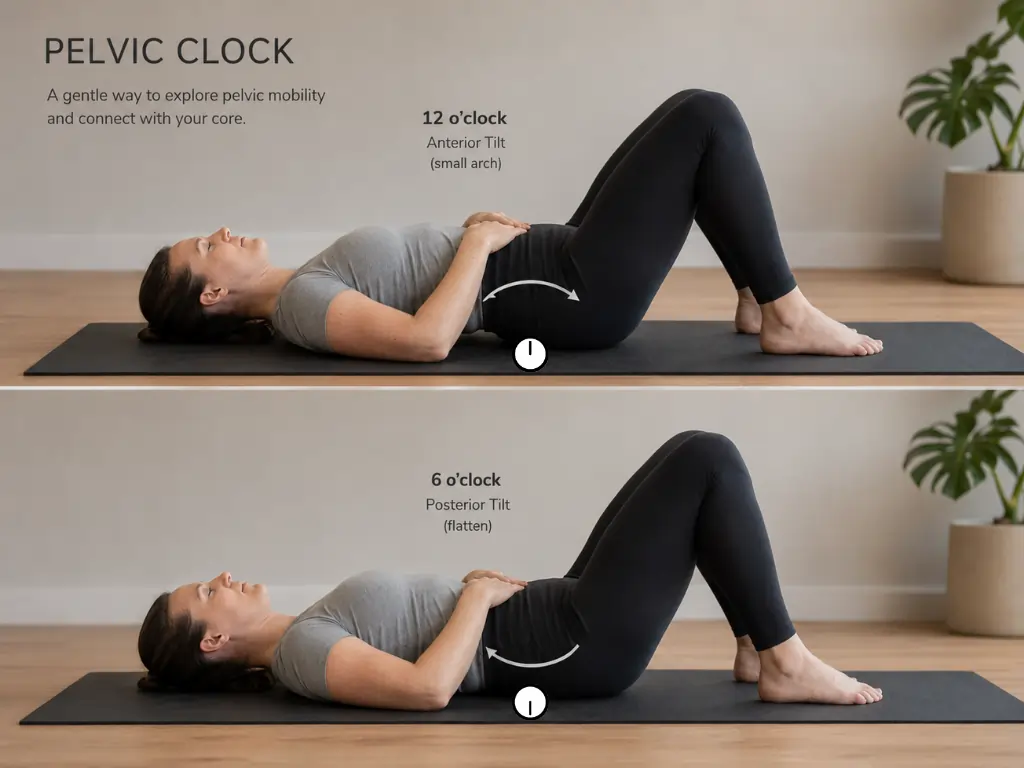
1. Pelvic Clock
What It Helps
The Pelvic Clock is one of the best somatic Pilates exercises for improving body awareness around the pelvis, lower back, and core.
It helps many people notice hidden tension patterns they didn’t realize were affecting their posture, breathing, or movement throughout the day.
How To Do It
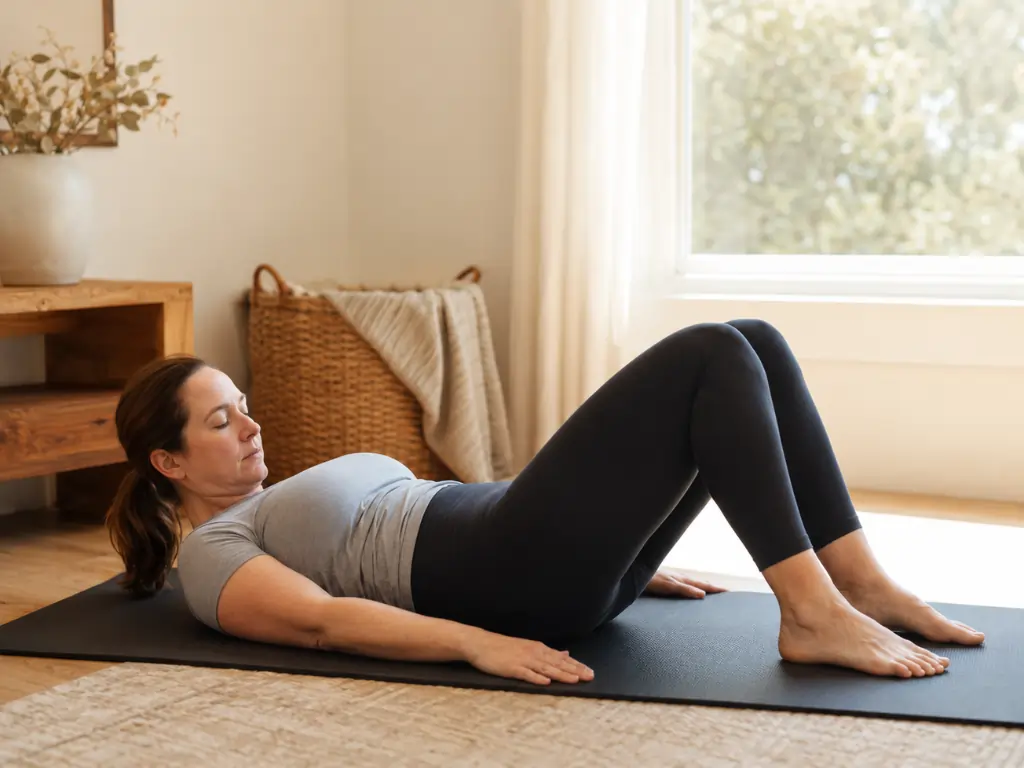
Lie comfortably on your back with your knees bent and feet flat on the floor.
Imagine your pelvis is the face of a clock.
Gently tilt your pelvis toward 12 o’clock, then toward 6 o’clock.
Slowly explore movements toward 3 o’clock and 9 o’clock.
Then begin creating small circles around the entire clock.
Move slowly enough that you can feel every part of the motion.
Common Mistakes
- Moving too quickly
- Making the circles too large
- Tightening the glutes excessively
- Treating it like an ab exercise
Easier Modification
Keep the movement extremely small.
Even imagining the movement can help build awareness when you’re first learning.
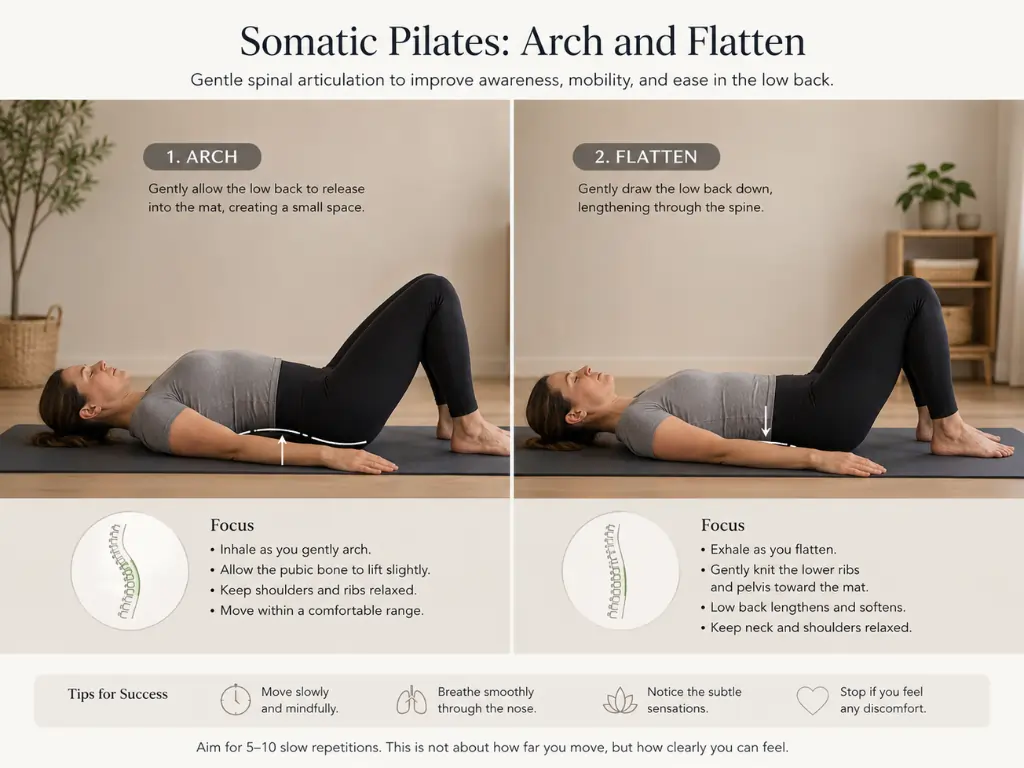
2. Arch & Flatten
What It Helps
This gentle movement helps improve awareness of the spine and pelvis while reducing unnecessary tension in the lower back.
It’s often one of the first exercises I recommend to beginners because it teaches control without force.
How To Do It
Lie on your back with your knees bent.
Slowly arch your lower back away from the floor.
Pause briefly.
Then gently flatten your lower back toward the floor.
Allow your breath to stay natural and relaxed.
Move as though you’re exploring the movement for the very first time.
Common Mistakes
- Forcing a large range of motion
- Holding the breath
- Rushing between positions
- Tightening the shoulders
Easier Modification
Place a folded blanket under your head for comfort and reduce the movement range until it feels effortless.
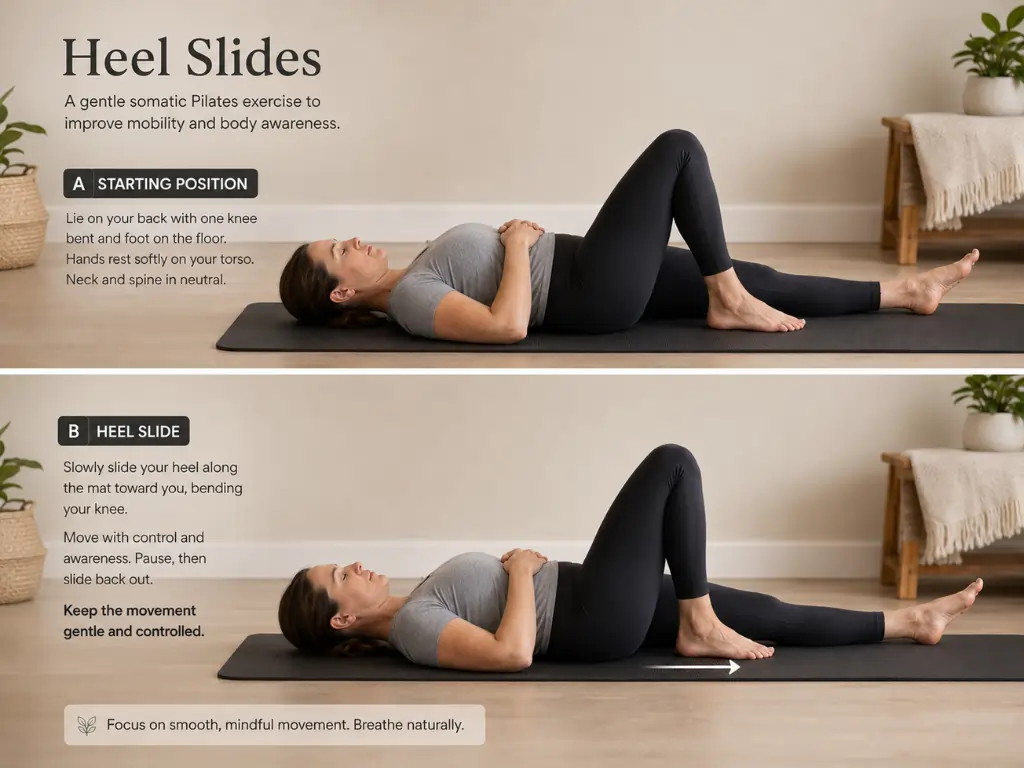
3. Heel Slides
What It Helps
Heel Slides improve coordination between the core, pelvis, and legs while teaching stability without rigidity.
They’re especially useful for beginners who spend long hours sitting or experience lower back stiffness.
How To Do It
Lie on your back with your knees bent.
Slowly slide one heel forward along the floor until the leg is nearly straight.
Pause briefly.
Then slowly return to the starting position.
Repeat on the other side.
Focus on keeping the movement smooth and controlled.
Common Mistakes
- Sliding too fast
- Allowing the pelvis to rock excessively
- Holding tension in the neck or shoulders
- Treating the movement like a strength challenge
Easier Modification
Shorten the distance of the slide and move only within a comfortable range.
4. Side Body Reach
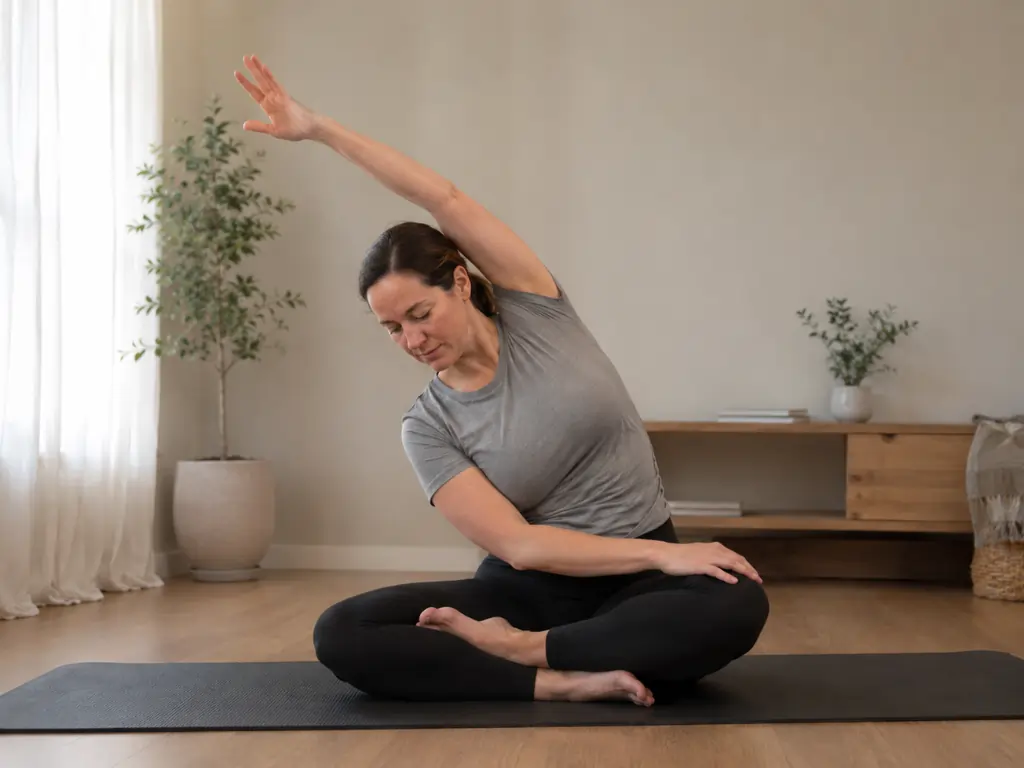
What It Helps
Many people carry tension through the ribs, waist, shoulders, and upper back without realizing it.
The Side Body Reach helps restore mobility through these areas while improving breathing awareness.
How To Do It
Reach one arm overhead.
Slowly lengthen through the side of your body.
Imagine creating more space between your ribs.
Pause and breathe.
Then return and switch sides.
Notice whether one side feels different from the other.
Common Mistakes
- Forcing the stretch
- Lifting the shoulders toward the ears
- Moving too quickly
- Comparing both sides
Easier Modification
Keep the arm lower or support it with a pillow if shoulder mobility feels limited.
5. Gentle Spinal Twist
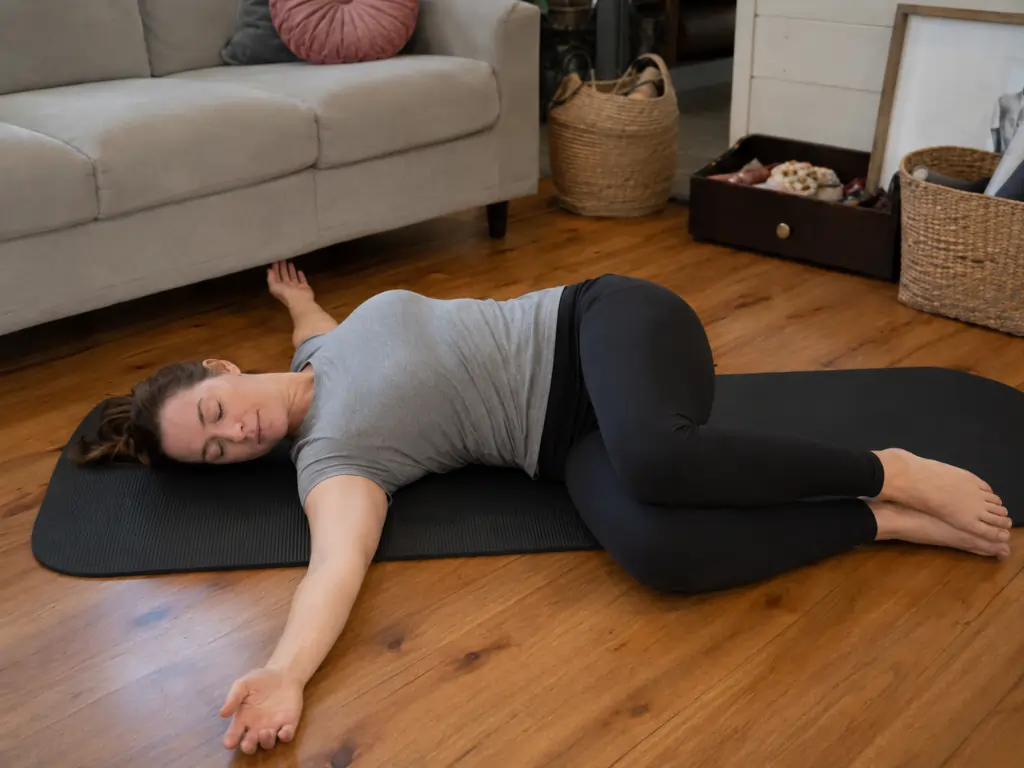
What It Helps
This movement encourages relaxation through the spine, hips, and nervous system.
Many people find it especially helpful after long periods of sitting, driving, or stressful days.
How To Do It
Lie on your back with your knees bent.
Allow both knees to slowly fall to one side.
Keep your shoulders relaxed.
Pause for a few breaths.
Return to center and repeat on the opposite side.
Move only within a comfortable range.
Common Mistakes
- Pulling the knees down forcefully
- Holding the breath
- Trying to create a deeper twist
- Lifting both shoulders off the floor
Easier Modification
Place a pillow beneath your knees for extra support and comfort.
6. Constructive Rest
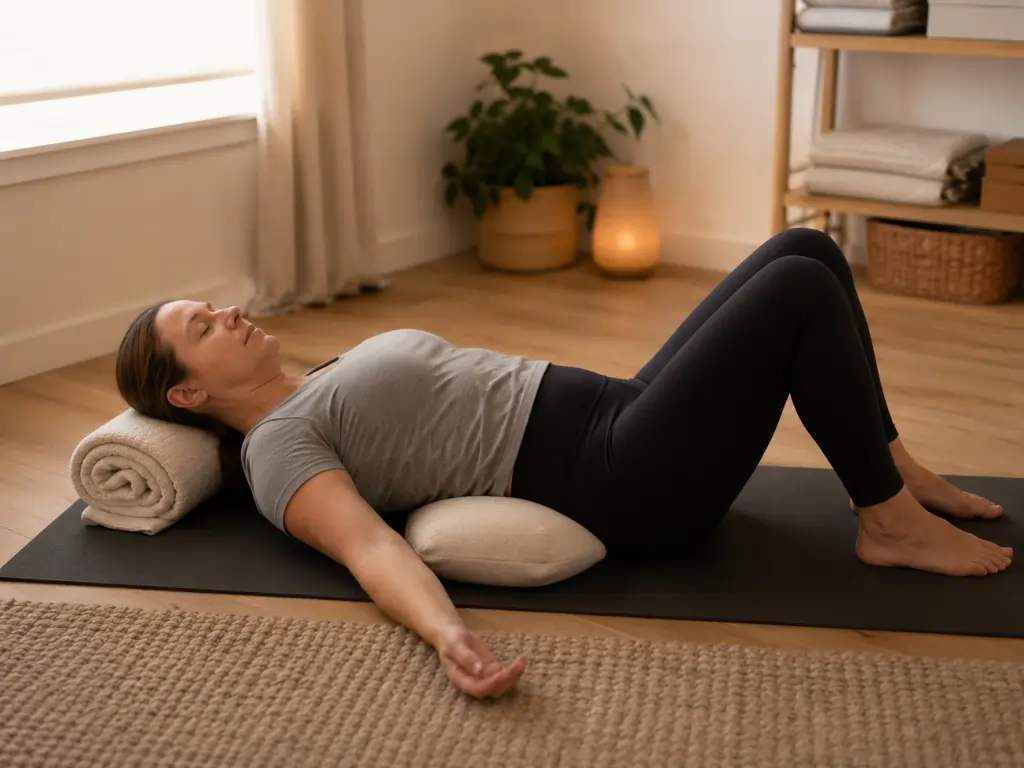
What It Helps
Constructive Rest may look like you’re doing nothing, but it’s one of the most powerful somatic practices for reducing tension and improving body awareness.
It’s often where people notice the biggest shifts.
How To Do It
Lie on your back with your knees bent and feet comfortably apart.
Allow your arms to rest by your sides.
Close your eyes if that feels comfortable.
Notice your breathing.
Notice areas of contact with the floor.
Notice areas holding tension.
Stay for two to five minutes.
Common Mistakes
- Trying to relax perfectly
- Controlling the breath
- Constantly adjusting position
- Expecting immediate results
Easier Modification
Place a pillow beneath your head or knees to make the position more comfortable.
A Gentle Reminder Before Moving On
The purpose of these somatic Pilates exercises isn’t to burn calories, break a sweat, or push through discomfort.
The purpose is awareness.
If one movement helps you notice your breath more clearly, soften your shoulders, or release tension you didn’t know you were carrying, that’s progress.
And in many ways, that’s where real change begins.
10-Minute Somatic Pilates Routine for Beginners
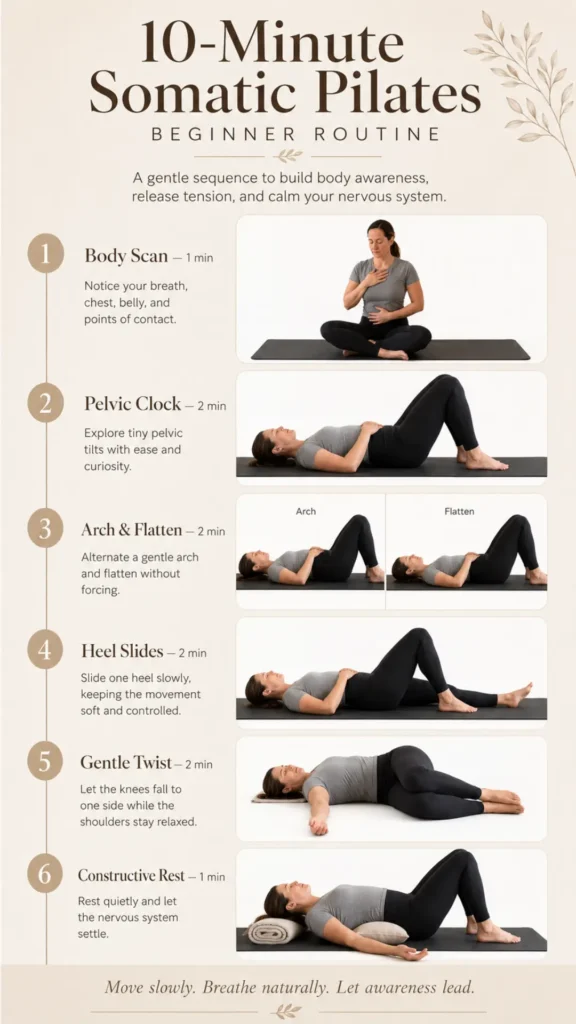
If you’re feeling overwhelmed by long workout plans, start here.
One of the things I love most about Somatic Pilates is that it doesn’t require an hour of your day. In fact, some of the most meaningful shifts I’ve experienced happened during short, consistent practices.
This 10-minute somatic Pilates routine is designed for beginners who want to feel more connected to their bodies, reduce tension, and build awareness without feeling exhausted afterward.
Move slowly.
Breathe naturally.
And remember: the goal isn’t to perform perfectly. The goal is to notice.
Minute 1: Body Scan
Before moving, take one minute to simply check in.
Lie comfortably on your back with your knees bent and feet resting on the floor.
Notice your jaw.
Notice your shoulders.
Notice your breath.
Notice your hips and lower back.
Instead of asking, “How do I fix this?” ask:
“What am I noticing right now?”
This simple shift creates the foundation for everything that follows.
Minutes 2–3: Pelvic Clock
Now begin exploring the Pelvic Clock.
Imagine your pelvis is the face of a clock.
Gently tilt toward 12 o’clock and then toward 6 o’clock.
Explore 3 o’clock and 9 o’clock.
If it feels comfortable, create slow circles around the entire clock.
There is no need to make the movement large.
Small, mindful movements often create the biggest awareness shifts.
Focus On:
- Lower back tension
- Hip awareness
- Pelvic mobility
- Breath quality
Minutes 4–5: Arch & Flatten
Stay on your back with your knees bent.
Slowly arch your lower back away from the floor.
Pause.
Then gently flatten it back down.
Think of this as a conversation with your spine rather than an exercise.
Move slower than feels necessary.
Most beginners discover tension patterns here they didn’t know existed.
Focus On:
- Spinal awareness
- Core connection
- Lower back mobility
- Relaxed breathing
Minutes 6–7: Heel Slides
Extend one heel slowly along the floor until the leg is nearly straight.
Pause briefly.
Then return to the starting position.
Alternate sides.
Notice whether one side feels smoother or easier than the other.
There is no need to correct the difference.
Simply observe it.
Focus On:
- Coordination
- Core stability
- Hip mobility
- Movement control
Minutes 8–9: Gentle Spinal Twist
Allow both knees to slowly fall to one side.
Pause for a few breaths.
Return to center.
Repeat on the opposite side.
Many people notice this movement feels especially calming after a stressful day.
Rather than forcing the twist, allow gravity to do most of the work.
Focus On:
- Releasing tension
- Spinal mobility
- Relaxation
- Nervous system regulation
Minute 10: Constructive Rest
For the final minute, do absolutely nothing.
And yes, this part matters.
Lie comfortably on your back.
Allow your arms to rest by your sides.
Notice your breathing.
Notice the weight of your body against the floor.
Notice any changes since the beginning of the practice.
Maybe your shoulders feel softer.
Maybe your jaw feels relaxed.
Maybe nothing feels different at all.
Every experience is valid.
Somatic Pilates isn’t about forcing a result.
It’s about building awareness one moment at a time.
The Mindfullyoga 10-Minute Formula
1 Minute → Notice
↓
2 Minutes → Explore
↓
2 Minutes → Mobilize
↓
2 Minutes → Coordinate
↓
2 Minutes → Release
↓
1 Minute → Integrate
Most people think healing starts with doing more.
In my experience, it often starts with noticing more.
And if you can give yourself ten slow minutes a day, you’re already practicing one of the most important skills Somatic Pilates teaches: learning how to come back to your body.
Quick Summary
| Time | Exercise | Primary Benefit |
|---|---|---|
| Minute 1 | Body Scan | Awareness |
| Minutes 2–3 | Pelvic Clock | Pelvic Mobility |
| Minutes 4–5 | Arch & Flatten | Spinal Awareness |
| Minutes 6–7 | Heel Slides | Core Coordination |
| Minutes 8–9 | Gentle Twist | Tension Release |
| Minute 10 | Constructive Rest | Nervous System Recovery |
Pro Tip: Do this routine daily for one week before deciding whether Somatic Pilates works for you. Most beginners notice awareness changes before they notice physical changes. That’s completely normal—and often where the biggest transformation begins.
Common Mistakes Beginners Make (And How To Avoid Them)
One of the most comforting things I can tell you is this:
If Somatic Pilates feels strange at first, you’re probably doing exactly what most beginners do.
We’re so used to exercising for results that slowing down and paying attention can feel surprisingly uncomfortable.
Over the years, I’ve noticed the same mistakes come up again and again—not because people are doing anything wrong, but because Somatic Pilates asks us to approach movement differently.
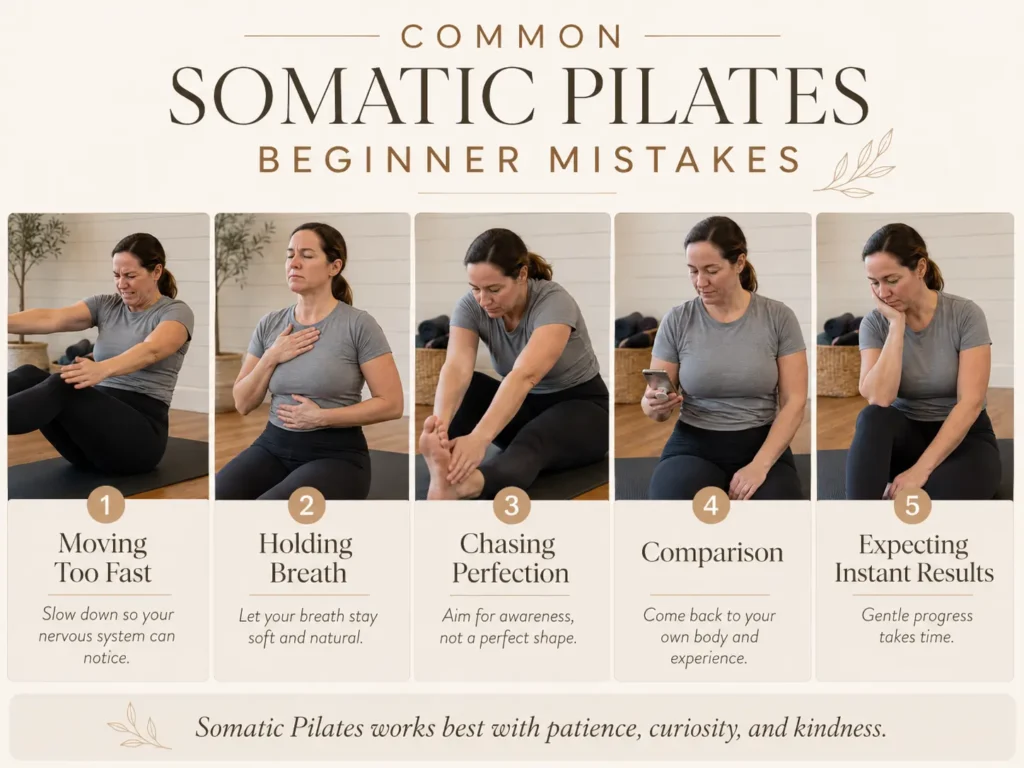
Here are the most common beginner mistakes I see.
1. Moving Too Fast
This is by far the most common mistake.
Many of us have spent years treating movement like a task to complete.
We want to finish the repetition.
Finish the workout.
Move on to the next thing.
But Somatic Pilates works differently.
The slower you move, the more information your brain receives from your muscles, joints, and nervous system.
When you rush, you often miss the very awareness you’re trying to develop.
Try This Instead
If you think you’re moving slowly enough, slow down another 20%.
Your body will teach you more there.
2. Holding Your Breath
I still catch myself doing this sometimes.
Many people unconsciously hold their breath when concentrating, stretching, or trying to “do the exercise correctly.”
The problem is that breath-holding often creates more tension.
And tension makes it harder to notice what’s actually happening in the body.
Try This Instead
You don’t need a special breathing technique.
Simply check in occasionally and ask:
“Am I breathing right now?”
That simple question is often enough.
3. Chasing Perfect Form
Fitness culture teaches us that there is one perfect way to perform every movement.
Somatic Pilates takes a different approach.
Your body isn’t identical to anyone else’s.
Your history, mobility, injuries, habits, and tension patterns are unique.
Sometimes the most valuable movement isn’t the prettiest one.
It’s the one that helps you feel something new.
Try This Instead
Focus less on how the movement looks.
Focus more on how it feels.
Awareness matters more than perfection.
4. Comparing Yourself To Others
Social media has made this harder than ever.
You watch someone move effortlessly through a sequence and immediately assume you’re behind.
But Somatic Pilates isn’t a performance.
It’s a conversation between you and your body.
Nobody else can feel what you’re feeling.
Nobody else has your exact nervous system, experiences, or movement patterns.
Try This Instead
Measure progress by awareness, not appearance.
A softer jaw can be progress.
A deeper breath can be progress.
Noticing tension sooner can be progress.
5. Expecting Instant Results
This is probably the mistake I understand most.
We live in a world of quick fixes.
So it’s natural to hope one session will change everything.
But Somatic Pilates usually works in quieter ways.
Many people notice awareness changes before they notice physical changes.
You might catch yourself clenching your jaw.
You might realize you’re holding your breath.
You might notice tension patterns that have been there for years.
Those small observations are often the beginning of lasting change.
Try This Instead
Give yourself at least one week of consistent practice before judging the results.
6. Treating It Like A Workout
This might sound surprising.
Somatic Pilates can absolutely strengthen the body.
But if your only goal is burning calories or feeling exhausted afterward, you may miss its biggest benefits.
The purpose isn’t to leave feeling depleted.
The purpose is to leave feeling more connected.
Some sessions may feel challenging.
Others may feel almost effortless.
Both experiences are valuable.
Try This Instead
Approach each practice with curiosity rather than achievement.
Ask:
“What can I notice today?”
instead of
“How hard can I work today?”
The Mindfullyoga Reminder
The biggest shift happens when you stop trying to perform the movement and start listening to it.
It’s not about the shape. It’s about the sensation.
A smaller movement performed with awareness will almost always teach you more than a bigger movement performed on autopilot.
And in many ways, that’s the entire heart of Somatic Pilates.
What Results Can You Expect From Somatic Pilates?
One of the things I dislike most about the wellness industry is how often it promises dramatic results in unrealistic timeframes.
“Transform your body in 7 days.”
“Fix your posture overnight.”
“Eliminate stress instantly.”
That’s not how real bodies work.
And it’s not how Somatic Pilates works either.
The truth is that most of the meaningful changes happen gradually. They’re often subtle at first. In fact, many people notice awareness changes long before they notice physical changes.
That’s completely normal.
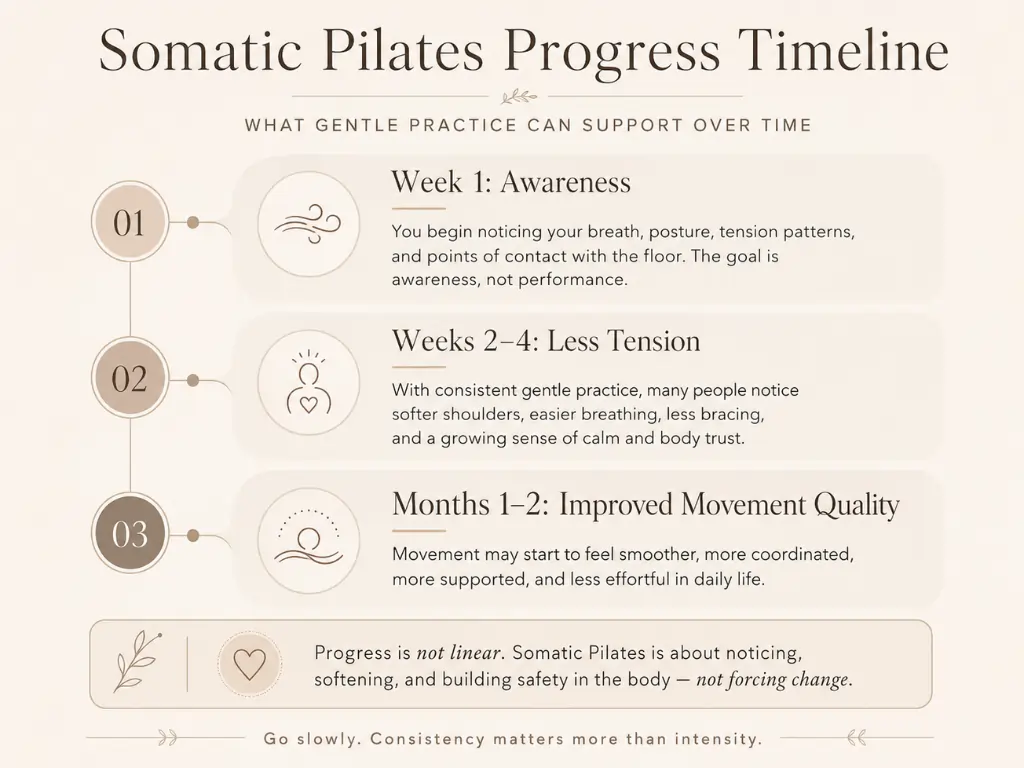
Here’s what a realistic Somatic Pilates journey often looks like.
Week 1: More Awareness Than Anything Else
During your first week, don’t be surprised if the biggest changes happen in your attention rather than your body.
This is usually when people begin noticing habits they’ve been repeating for years without realizing it.
You may discover that:
- Your jaw is clenched more often than you thought
- Your shoulders rarely fully relax
- You hold your breath during stressful moments
- One side of your body feels different from the other
- Certain movements feel surprisingly restricted
At first, this can feel frustrating.
But awareness is actually progress.
You can’t change a pattern you don’t notice.
What Most Beginners Notice
✔ Increased body awareness
✔ Better connection to breathing
✔ More mindfulness during daily activities
✔ A greater sense of calm after practice
Weeks 2–4: Less Tension, More Ease
As awareness improves, many people begin noticing physical changes.
Not dramatic transformations.
Just small moments of ease.
You may catch yourself relaxing your shoulders throughout the day.
You may notice less stiffness when getting out of bed.
You may feel more comfortable sitting, walking, or standing.
For many people, stress doesn’t disappear during this phase.
But their relationship with stress begins to change.
They notice tension sooner.
And because they notice it sooner, they can respond before it builds up.
What Many People Experience
✔ Reduced muscle tension
✔ Improved mobility
✔ More relaxed breathing
✔ Better stress awareness
✔ Less physical discomfort from sitting
Months 1–2: Better Movement Quality
This is often where the benefits become more noticeable.
By now, you’re no longer simply practicing Somatic Pilates.
You’re carrying the awareness into everyday life.
You may find yourself:
- Sitting with less strain
- Walking more comfortably
- Moving more efficiently
- Recovering from tension more quickly
- Feeling more confident in your body
This isn’t because you’ve learned complicated exercises.
It’s because you’ve improved the way you relate to movement itself.
And that tends to influence everything else.
What Many Consistent Practitioners Notice
✔ Better posture awareness
✔ Improved balance and coordination
✔ Greater movement confidence
✔ Easier daily activities
✔ More consistent energy levels
What Somatic Pilates Will NOT Do
This part is important.
Somatic Pilates is powerful, but it’s not magic.
It won’t:
✘ Instantly eliminate chronic pain
✘ Fix years of movement habits overnight
✘ Replace medical treatment when needed
✘ Burn massive amounts of calories
✘ Transform your body in a few sessions
Anyone promising those outcomes is overselling what the practice can realistically deliver.
The Result Most People Don’t Expect
When I first started exploring somatic movement, I thought the biggest benefit would be better mobility.
It wasn’t.
The biggest benefit was learning to notice what my body needed before it started shouting for attention.
Before the headache.
Before the neck tension.
Before the stress built up.
That awareness changed far more than any physical exercise ever had.
And that’s why so many people continue practicing Somatic Pilates long after the beginner stage.
Not because they’re chasing perfection.
But because they finally feel connected to their bodies again.
The Mindfullyoga Reality Check
If you practice Somatic Pilates consistently for the next 30 days, don’t judge success by how flexible you become or how many exercises you complete.
Instead, ask yourself:
- Do I notice tension sooner?
- Am I breathing more freely?
- Do I move through daily life with less effort?
- Do I feel more connected to my body?
Because in my experience, those are the changes that last.
And those are often the changes that matter most.
Your First 7 Days of Somatic Pilates
One of the biggest mistakes beginners make is trying to learn everything at once.
You don’t need to master every exercise.
You don’t need perfect posture.
You don’t need an hour-long routine.
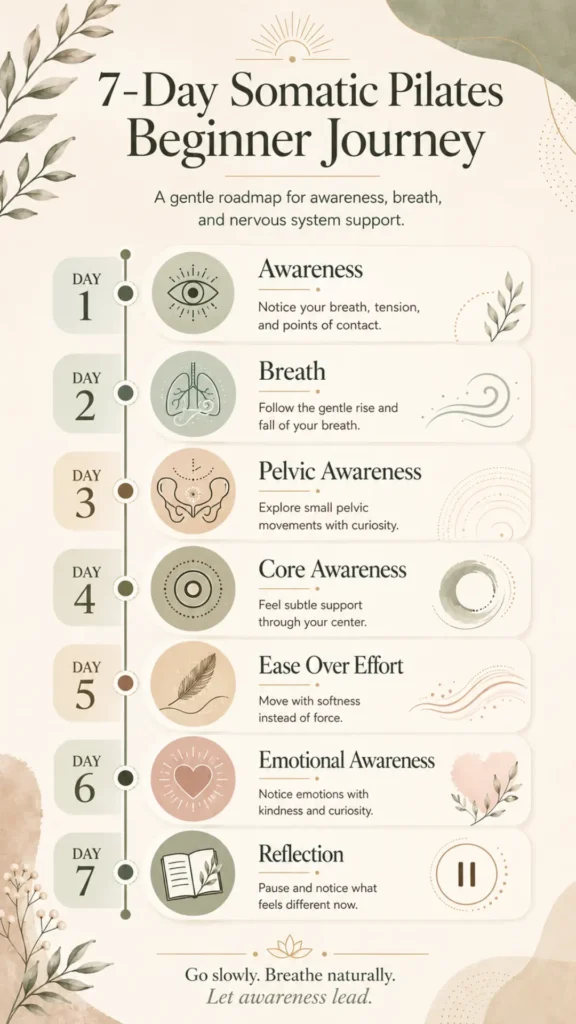
For your first week, focus on one simple theme each day.
Think of this as a week of exploration rather than a challenge to complete.
The goal isn’t perfection.
The goal is awareness.
Day 1 — Notice Your Patterns
Today, don’t try to change anything.
Simply observe.
Throughout the day, pay attention to where your body naturally holds tension.
For many people, it’s the jaw, shoulders, neck, stomach, or lower back.
The goal is not fixing.
The goal is noticing.
Reflection
Where do I hold stress most often?
Day 2 — Breath Awareness
Most of us don’t realize how often we hold our breath when we’re stressed, concentrating, or overwhelmed.
Today, pause a few times throughout the day and simply notice your breathing.
Is it shallow?
Deep?
Fast?
Restricted?
No need to change it.
Just observe.
Reflection
When did I notice myself holding my breath today?
Day 3 — Pelvic Awareness
The pelvis is one of the body’s major movement centers, yet many people have very little awareness of how it moves.
Spend a few minutes practicing Pelvic Clocks or gentle pelvic tilts.
Move slowly and explore rather than perform.
Reflection
What did I notice about my hips, pelvis, or lower back?
Day 4 — Core Awareness
Forget everything you’ve heard about “tightening your core.”
Today is about noticing support rather than creating tension.
During simple movements like standing up, walking, or reaching, pay attention to how your body naturally stabilizes itself.
Reflection
Did I notice unnecessary tension while trying to stay strong?
Day 5 — Ease Over Effort
This may be the most important day of the entire week.
Throughout the day, ask yourself:
“Can I do this with less effort?”
Maybe your shoulders can soften.
Maybe your jaw can relax.
Maybe your grip doesn’t need to be so tight.
You’ll be surprised how much energy we spend creating tension we don’t actually need.
Reflection
Where was I working harder than necessary?
Day 6 — Emotional Awareness
Emotions don’t only live in the mind.
They often show up in the body first.
Stress may appear in the shoulders.
Anxiety may show up in the chest.
Frustration may settle into the jaw.
Today, notice whether emotions have a physical location in your body.
Approach the experience with curiosity rather than judgment.
Reflection
What did my body teach me about my emotions today?
Day 7 — Reflection & Reconnection
Today isn’t about doing more.
It’s about looking back.
Spend a few quiet minutes reflecting on everything you’ve noticed during the week.
No grading.
No scoring.
No pressure.
Just curiosity.
Reflection Questions
- What surprised me most?
- What patterns did I notice?
- What feels different compared to Day 1?
- What practice would I like to continue?
A Final Thought For Week One
If you’ve completed this week, you’ve already done something many people never do.
You’ve paused long enough to listen.
Not perfectly.
Not constantly.
But intentionally.
And in my experience, that’s where Somatic Pilates truly begins.
Not with a stronger core.
Not with better flexibility.
But with the simple decision to pay attention to the body you’ve been living in all along.
Frequently Asked Questions About Somatic Pilates
Does Somatic Pilates Really Work?
In my experience, yes—but probably not in the way most people expect.
Somatic Pilates isn’t designed to produce dramatic results overnight. Instead, it helps you become more aware of how you move, where you hold tension, and how stress shows up in your body.
Many people notice improvements in body awareness, posture, movement quality, and overall tension levels after practicing consistently. The biggest changes often happen gradually rather than all at once.
What makes Somatic Pilates effective is its focus on retraining movement patterns rather than simply exercising muscles.
Is 20 Minutes Of Somatic Pilates Enough?
For most beginners, absolutely.
In fact, I often encourage people to start with 10 to 20 minutes rather than trying to do too much.
Somatic Pilates works through awareness, not intensity. A short practice done consistently is usually far more beneficial than a long session performed once in a while.
Even a few mindful minutes can help you notice tension patterns, improve mobility, and reconnect with your body.
Is Somatic Pilates Good For High Cortisol?
Somatic Pilates is not a treatment for high cortisol, but it may support stress management in ways that help the body feel calmer.
The slow movements, breath awareness, and nervous system-focused approach can encourage relaxation and help reduce the physical tension that often accompanies chronic stress.
Many people find that Somatic Pilates feels more restorative than high-intensity workouts during periods of burnout, overwhelm, or emotional exhaustion.
If you have concerns about cortisol or hormonal
Conclusion: Coming Home To Yourself
If you’ve made it this far, I want to leave you with something I wish someone had told me years ago.
You don’t need to wait until you’re more flexible. You don’t need to wait until life feels less busy. You don’t need to fix every ache, improve every habit, or become a different version of yourself before you begin. The practice starts exactly where you are.
One of the biggest lessons Somatic Pilates has taught me is that the body is always communicating. The problem isn’t that our bodies have stopped speaking. It’s that most of us have become very good at not listening.
We push through fatigue. We ignore tension. We override discomfort. We tell ourselves we’ll slow down later. But later rarely comes. And that’s why this practice feels so different.
It isn’t asking you to become better. It’s inviting you to become more aware. More aware of your breath. More aware of your posture. More aware of the way stress quietly settles into your shoulders, jaw, chest, or hips. And most importantly, more aware of yourself.
If your experience is anything like mine, you probably won’t notice dramatic changes overnight. What you’ll notice first is something much quieter. You’ll catch yourself clenching your jaw. You’ll realize you’ve been holding your breath. You’ll soften your shoulders without thinking about it. You’ll begin noticing the moments when your body needs rest instead of more effort.
Those small moments may not seem important.
But over time, they add up. Awareness becomes a habit. Movement becomes easier. Stress becomes easier to recognize. And your relationship with your body begins to change.
That’s the real gift of Somatic Pilates. Not perfection. Not performance. Not chasing a “better” body. A deeper connection with the body you already have.
So if you’re just beginning, start small. Try one exercise. Take one slower breath. Spend one minute noticing how you feel. That’s enough. More than enough.
Because every time you choose awareness over autopilot, you’re already practicing.
And every time you listen to your body instead of fighting it, you’re already moving in the right direction.
Thank you for spending this time with me.
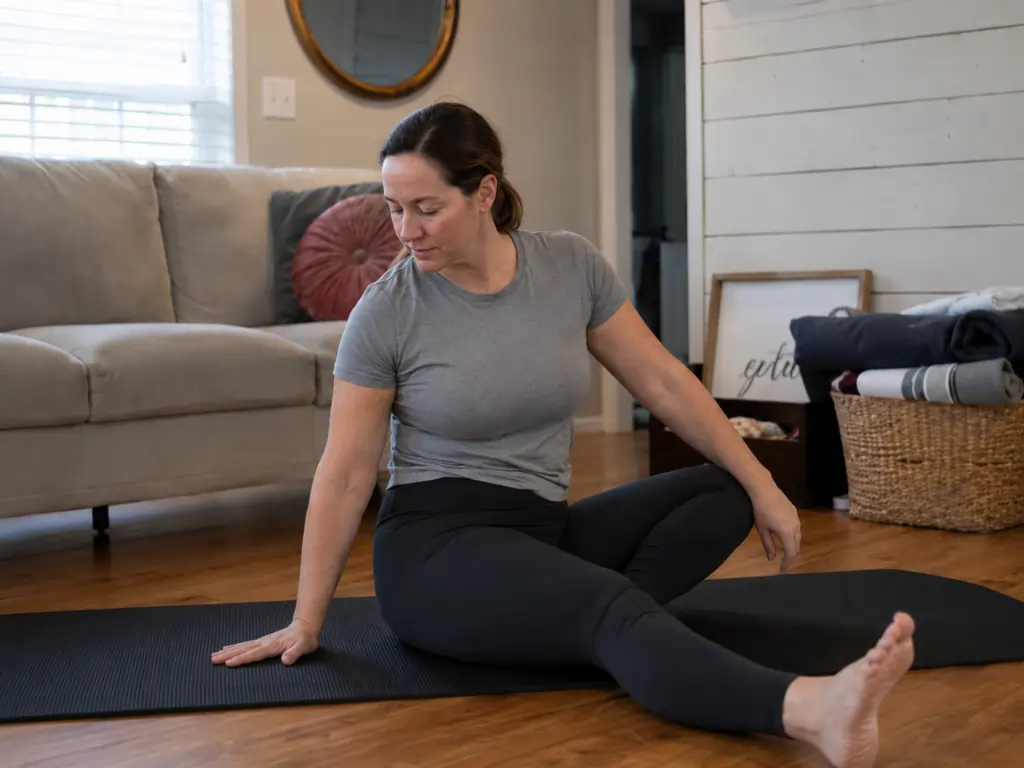
I hope this guide helped you feel a little less overwhelmed, a little more informed, and a little more connected to yourself.
And if you’d like a gentle place to start, download the free Somatic Pilates Beginner PDF and begin with the 10-minute routine we explored together.
Your body doesn’t need you to be perfect.
It only needs you to pay attention.
With love,
Nandini Sharma
Founder, Mindfullyoga
“Your body has been carrying you through every season of your life. Perhaps it’s time to start listening to what it has been trying to say.”
Also Read: 10 Minute Morning Yoga for Beginners at Home
Also Read: Free 28-Day Chair Yoga for Seniors (Printable PDF & Chart + Daily Challenge Plan)
Also Read: What Is Chair Yoga? A Safe, Evidence-Informed Guide for Seniors