Table of Contents
If you enjoy jigsaw puzzles, crossword puzzles, Sudoku, or word games, you may have wondered whether they really do anything for your brain as you get older. Yes, puzzles can be a useful and enjoyable activity for older adults, but the benefits depend on the type of puzzle and how you use it.
A jigsaw puzzle, for example, challenges you to recognize shapes, patterns, and where different pieces belong. Crossword and word puzzles involve language, recall, attention, and problem-solving. Research has linked cognitively stimulating activities with aspects of cognitive performance, but that doesn’t mean doing puzzles has been proven to prevent dementia or Alzheimer’s disease.
So, what are the actual benefits of playing puzzles for older adults? And is one type of puzzle better than another?
Let’s look at what the research says, what your brain is doing while you solve a puzzle, and how to choose one that is enjoyable, manageable, and worth coming back to.
What Happens to Your Brain When You Do Puzzles?
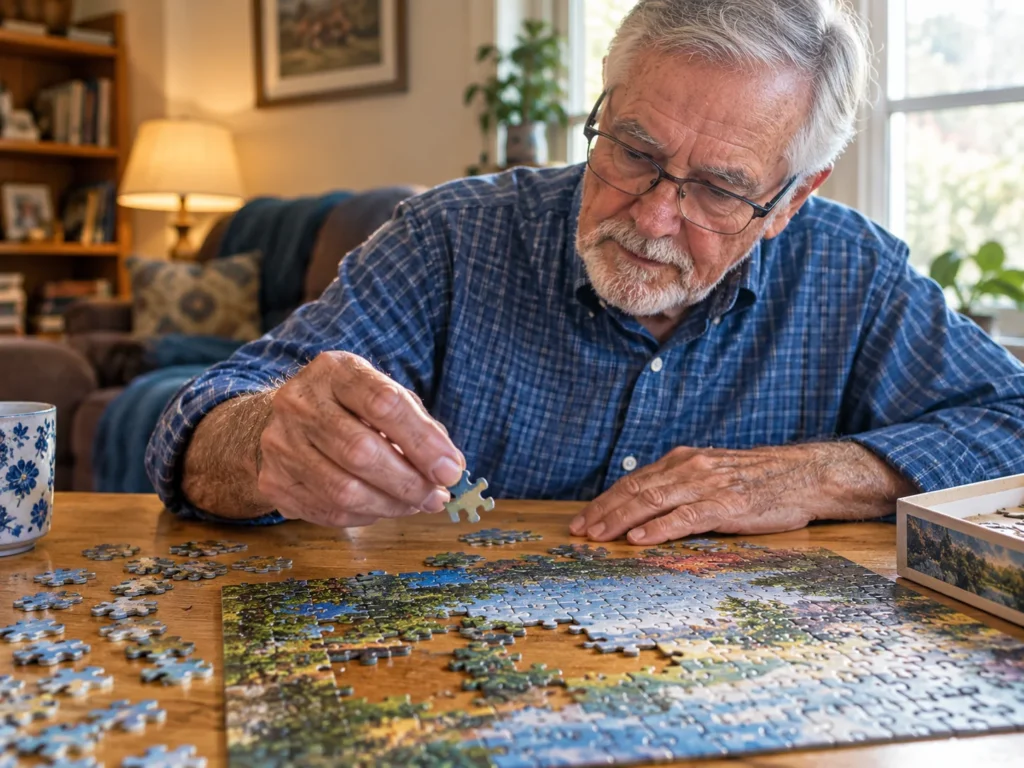
When you sit down with a jigsaw puzzle, crossword, Sudoku, or another type of puzzle, your brain is not doing just one thing. Depending on the puzzle, you may need to pay close attention, hold information in mind, search for patterns, retrieve words or facts, compare possibilities, and change your approach when your first idea does not work.
That makes puzzles an interesting form of cognitive activity for older adults. They give you something specific to work toward while asking you to use different kinds of thinking along the way.
Research on jigsaw puzzles gives us a useful example. In a randomized study of 100 cognitively healthy adults aged 50 and older, researchers found that jigsaw puzzle skill was strongly associated with several visuospatial abilities, including visual perception, mental rotation, processing speed, cognitive flexibility, working memory, reasoning, and episodic memory.

But this is where the evidence needs to be interpreted carefully.
The study did not show that simply spending 30 days doing jigsaw puzzles significantly improved overall visuospatial cognition compared with the comparison group. The people who did puzzles became better at solving the puzzles themselves, but the researchers did not find a significant between-group improvement in their broader measure of visuospatial cognition.
That distinction matters.
Using a cognitive skill during a puzzle is not the same as proving that the puzzle permanently improves that skill. And even when a study finds an improvement in a particular cognitive test, that still does not mean the activity prevents dementia or Alzheimer’s disease.
So it is more accurate to think of puzzles as meaningful mental engagement and practice, rather than as a guaranteed way to protect your brain.
Different Puzzles Challenge Different Cognitive Skills
Not every puzzle asks your brain to do the same work. The skills involved depend on what you are being asked to notice, remember, retrieve, calculate, or figure out.
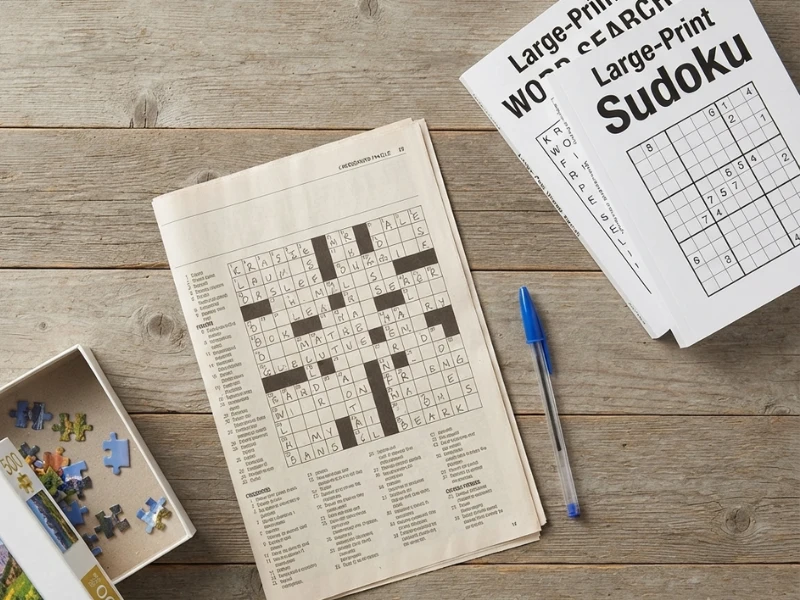
| Puzzle | Skills commonly involved |
|---|---|
| Jigsaw puzzles | Visual-spatial processing, attention, mental rotation, reasoning, working memory |
| Crosswords | Vocabulary, language, word retrieval, memory |
| Sudoku | Logic, reasoning, attention, working memory |
| Word searches | Visual scanning, attention, pattern recognition |
| Number puzzles | Reasoning, working memory, attention, problem-solving |
Jigsaw puzzles are particularly interesting because solving them can involve several visuospatial processes at once. You may examine shapes and visual details, remember where pieces might belong, mentally rotate a piece, compare patterns, and change your strategy when something does not fit. The research described above supports the idea that jigsaw puzzling engages multiple visuospatial cognitive abilities rather than one isolated skill.
Crosswords and other word puzzles place more emphasis on language and retrieval. You may search your memory for a word, use a clue to narrow down the possibilities, and keep several answers in mind while working through the puzzle. In one small randomized study involving older adults, people assigned to solve a crossword every day for four weeks performed better over time on a measure of verbal fluency than those assigned to keep a daily gratitude diary. That is an interesting finding, but it was a brief study measuring a specific cognitive outcome—not evidence that crosswords prevent dementia or Alzheimer’s disease.
Sudoku and number puzzles rely heavily on logical reasoning, attention, and keeping information in mind while testing possible solutions. They can therefore feel quite different from a crossword even though both are often grouped under the broad label of “brain games.”
This variety matters. If you enjoy puzzles, there is no scientific requirement to choose one particular type. A jigsaw puzzle may give you a very different mental challenge from a crossword, while Sudoku may require a different combination of reasoning and attention.
And perhaps the more useful question is not:
“Which puzzle is best for preventing memory loss?”
Instead, ask:
“Which puzzle gives me a manageable challenge that I enjoy enough to keep doing?”
That is a more realistic way to think about puzzles as part of an active, mentally engaged lifestyle. Puzzles can be one enjoyable cognitive activity among many—but they should not be presented as a substitute for medical care, treatment, or proven strategies for reducing dementia risk.
9 Benefits of Playing Puzzles for Older Adults
If you enjoy puzzles, there is a good reason to keep them in your routine—but the reason is a little more nuanced than “puzzles keep your brain young.”
The benefits of playing puzzles for older adults depend partly on the type of puzzle and the mental processes involved. A jigsaw puzzle asks you to work with shapes, patterns, and spatial relationships. A crossword relies more heavily on language and word retrieval. Sudoku asks you to reason through possibilities and keep information in mind.
Research has found associations between puzzle activity and certain aspects of cognitive performance, and some small intervention studies have reported improvements in specific cognitive measures. But that is not the same as proving that puzzles prevent dementia or Alzheimer’s disease. The National Institute on Aging notes that evidence for lasting cognitive benefits from many informal mentally stimulating activities is still not definitive.
So I would look at puzzles as one form of meaningful cognitive activity, rather than as a treatment or a guaranteed way to protect against cognitive decline.
For an older adult, the best puzzle is usually one that provides a manageable challenge, feels enjoyable, is physically accessible, and is interesting enough that they actually want to do it again.
1. Puzzles Engage Memory and Recall
Memory is not one single skill, and different puzzles can call on different kinds of remembering.
When you work on a jigsaw, you might remember where you saw a particular color or pattern, keep track of pieces you have already considered, or recall how part of the picture should look.
With a crossword, you may need to retrieve a word from memory after reading a clue. With Sudoku, you may hold several possibilities in mind while working through the next few steps.
That makes memory and recall a natural part of many puzzle activities.
The research on jigsaw puzzles is particularly interesting here. In the PACE study, researchers examined 100 cognitively healthy adults aged 50 and older and found that jigsaw puzzle skill was associated with several cognitive abilities, including working memory, reasoning, episodic memory, processing speed and cognitive flexibility, as well as multiple visuospatial abilities.
But there is an important catch.
The study did not show that simply doing jigsaw puzzles permanently improves all of those abilities. Participants assigned to the 30-day jigsaw intervention became better at solving jigsaw puzzles, but the intervention did not significantly improve the study’s primary measure of global visuospatial cognition compared with the counseling group.
That distinction matters.
The cognitive benefits of jigsaw puzzles are best understood initially as the cognitive processes the activity requires—not as proof that completing puzzles will prevent memory loss or dementia.
Still, if you enjoy sitting down with a puzzle and having to remember, compare, and retrieve information, that is a perfectly reasonable form of mental engagement.
2. They Challenge Attention and Concentration
A puzzle also gives your attention somewhere specific to go.
When you are searching for a jigsaw piece, comparing two possible answers in a crossword, or checking which number can fit into a Sudoku square, you have to stay with the task long enough to make a decision.
That can involve sustained attention, visual attention, and concentration.
For an older adult, this can be one of the simple benefits of doing puzzles for adults: the activity asks you to actively process information rather than simply watch or listen.
It also helps explain why the difficulty of the puzzle matters.
If a puzzle is so easy that you can complete it without thinking, it may provide little challenge. If it is so difficult that you become frustrated within a few minutes, you may not want to return to it.
A better target is a puzzle that makes you stop occasionally and think:
“Hmm. Let me try this another way.”
That is a useful level of challenge.
Does doing puzzles every day help you stay mentally active?
It can give you a regular opportunity for mental engagement, but there is no scientifically established rule that says an older adult must complete a puzzle every day for a particular number of minutes to protect their memory.
The National Institute on Aging recommends a broader approach to cognitive health that includes physical health, managing health conditions, staying socially connected, and keeping the mind engaged. NIA also cautions that evidence for lasting cognitive benefits from many informal mentally stimulating activities is not definitive.
So if you enjoy a crossword every morning, a daily Sudoku, or a jigsaw you work on throughout the week, there is nothing wrong with making it part of your routine.
Just don’t turn the routine into a promise that it will prevent dementia.
3. Puzzles Exercise Problem-Solving and Reasoning
One of the things that makes a puzzle different from simply consuming information is that you have to figure something out.
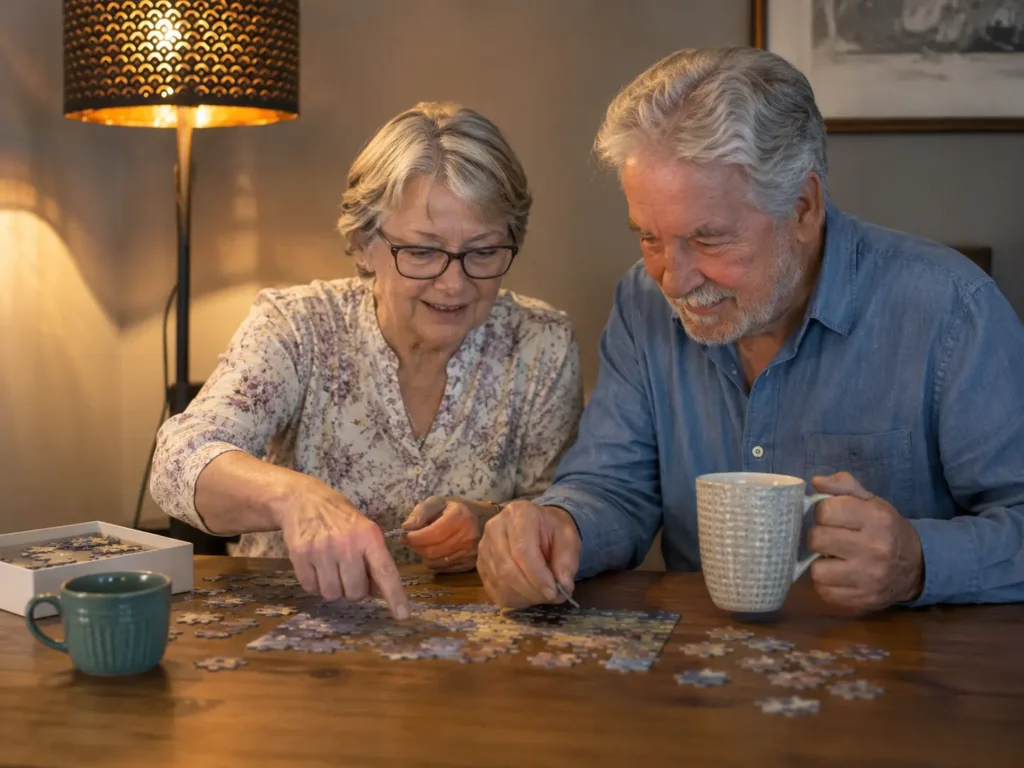
Depending on the puzzle, you may use:
- trial and error
- pattern recognition
- logical reasoning
- planning
- comparison
- elimination
- evaluating possible solutions
- changing strategies when your first approach fails
A jigsaw puzzle provides a simple example.
You may think a piece belongs in one area because of its color, turn it around, discover that the shape does not fit, and then reconsider where it might belong. You are constantly testing a possibility against the evidence in front of you.
Sudoku works differently. You eliminate possibilities, recognize numerical relationships, and work through a sequence of decisions.
Crosswords require another type of reasoning. A clue may be ambiguous until another answer gives you a letter that narrows the possibilities.
This is part of the answer to the frequently asked question:
What happens to your brain when you do puzzles?
You may be asking it to pay attention, retrieve information, compare alternatives, recognize patterns, reason through a problem, and adjust your approach.
But using these abilities during a puzzle is not the same thing as proving that the activity permanently improves them.
That distinction is especially important when talking about cognitive aging. The PACE research found strong associations between jigsaw puzzle skill and several cognitive abilities, but its randomized intervention did not demonstrate a significant improvement in global visuospatial cognition after the 30-day puzzle period.
In other words, puzzles clearly require thinking. The long-term health effects of that thinking are a more complicated question.
4. Jigsaw Puzzles Engage Visual-Spatial Skills
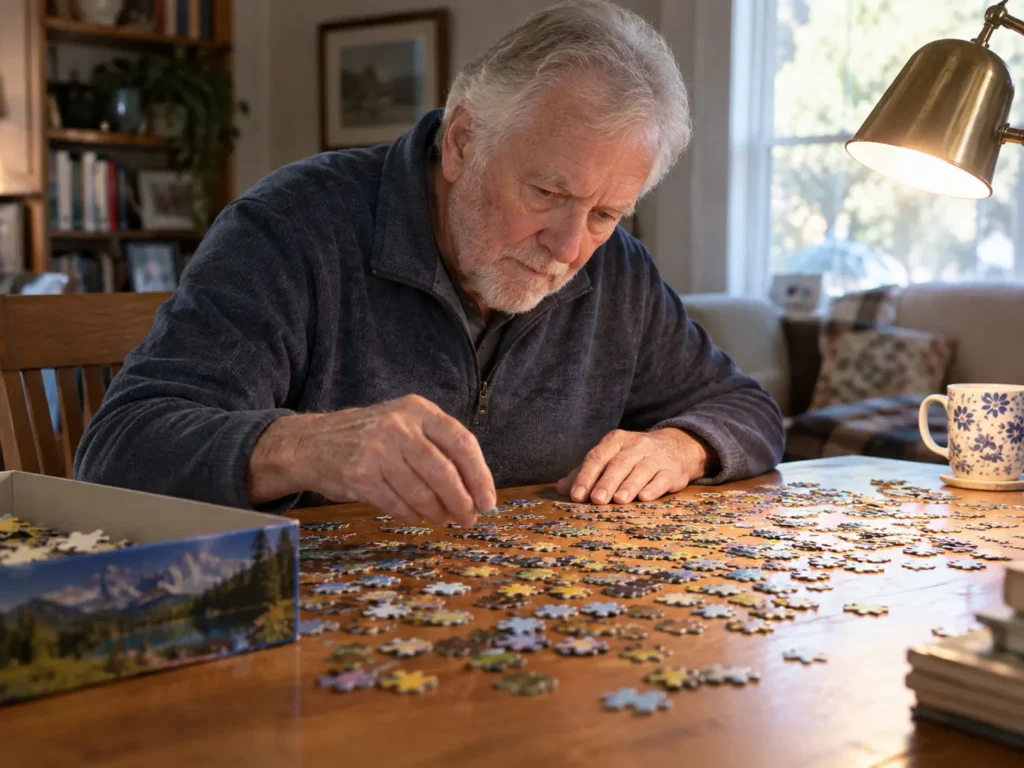
Among the benefits of jigsaw puzzles for elderly adults, visual-spatial processing is one of the most interesting.
When you solve a jigsaw, you are not simply matching colors.
You are also comparing:
- shapes
- edges
- patterns
- orientation
- size
- position
- spatial relationships
You may mentally rotate a piece before deciding where it belongs. You may compare a small section of the picture with the image on the box. You may recognize that two pieces have similar colors but cannot possibly fit together because their shapes are different.
Researchers studying jigsaw puzzling have found that the activity engages multiple cognitive abilities. In the PACE study, jigsaw puzzle skill was associated with perception, constructional praxis, mental rotation, processing speed, cognitive flexibility, working memory, reasoning, and episodic memory.
That gives us a much more useful explanation than simply saying that jigsaw puzzles are “good for your brain.”
They are a complex visuospatial activity.
However, the research does not justify turning that observation into a claim that jigsaw puzzles prevent Alzheimer’s disease.
The same study found that participants became better at jigsaw puzzles after the intervention, but the intervention itself did not significantly improve the primary measure of global visuospatial cognition compared with the control condition.
That is why I would describe jigsaw puzzles as a potentially worthwhile cognitive activity—not a dementia-prevention treatment.
For someone who enjoys hands-on activities, that distinction does not make the puzzle less valuable. It simply keeps the claim honest.
5. Word Puzzles Can Challenge Language and Retrieval
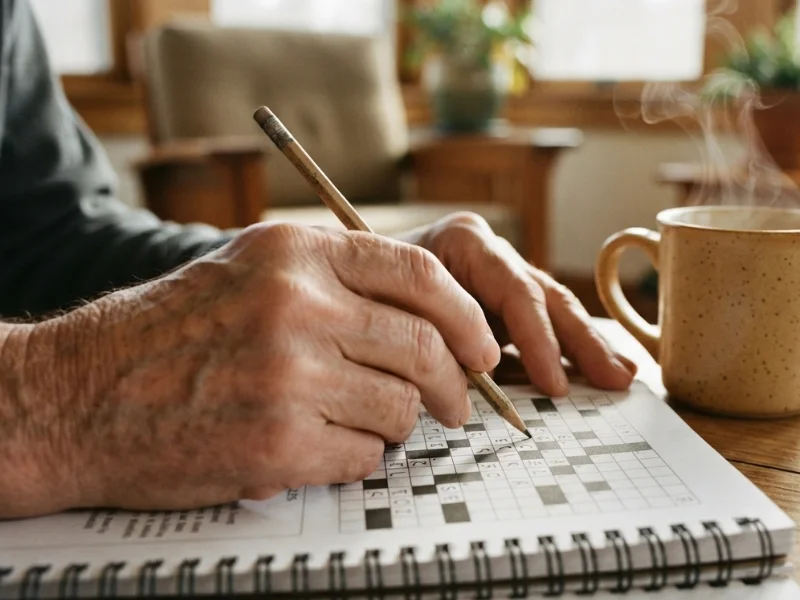
If pictures and shapes are not your thing, word puzzles offer a completely different type of challenge.
Crosswords, word searches, and other word games can involve vocabulary, spelling, language processing, attention, and retrieving words from memory.
This is where the benefits of crossword puzzles for elderly adults become particularly relevant.
You may read a clue and search your memory for the right word. You may use letters from other answers to narrow your choices. You may recognize a familiar word but have to work for a moment to retrieve it.
There is some intervention research worth knowing about.
In a small randomized study of 37 cognitively normal members of active retirement groups, participants who completed a crossword puzzle daily for four weeks performed better over time on measures of verbal fluency than participants assigned to a daily gratitude-diary activity.
That is encouraging, but it is not proof that crosswords prevent dementia.
The study was small, lasted only four weeks, and measured specific aspects of verbal fluency. It did not establish a long-term reduction in dementia risk.
That is an important distinction for anyone searching for the benefits of word puzzles for adults.
A crossword can challenge language and retrieval without being a medical intervention.
And if you genuinely enjoy words, that may be more than enough reason to keep one beside your morning coffee.
6. Puzzles Can Provide a Calm, Absorbing Activity
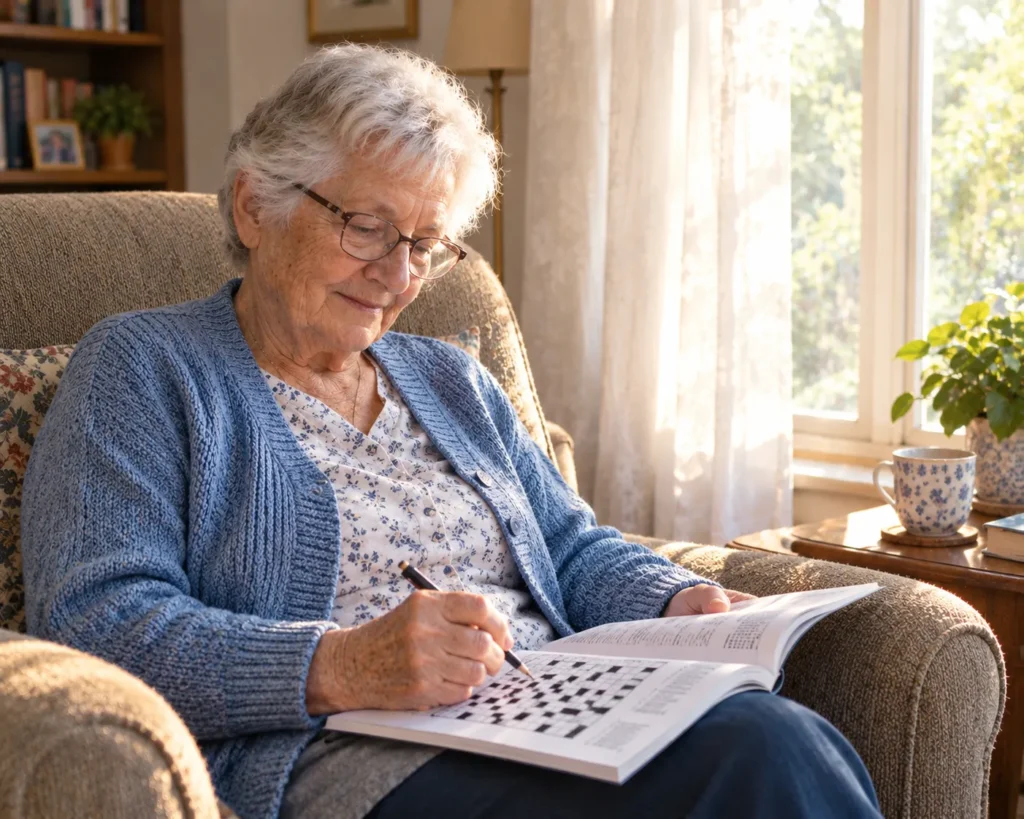
Some of the value of puzzles has nothing to do with whether a cognitive test score changes.
Sometimes, you simply enjoy doing the puzzle.
A crossword can give you a quiet few minutes in the morning. A jigsaw can become an afternoon project. A Sudoku can provide something to focus on before bed.
That kind of focused leisure may provide:
- concentration
- routine
- enjoyment
- a sense of progress
- accomplishment
- a temporary break from everyday distractions
This is where the question “Do puzzles improve mental health?” needs a careful answer.
Puzzles may be an enjoyable activity that supports a person’s sense of well-being. They can provide something absorbing to do and, for some people, a satisfying sense of accomplishment.
But I would not describe puzzles as a treatment for anxiety, depression, or another mental health condition.
There is a major difference between saying:
“This activity helps me relax.”
and:
“This activity treats anxiety.”
The first is an ordinary personal experience. The second is a medical claim that requires much stronger evidence.
NIA similarly emphasizes that meaningful activities may have cognitive and quality-of-life value, while noting that evidence for lasting cognitive effects from many such activities remains incomplete.
So if a puzzle gives you a peaceful hour away from your phone and something enjoyable to concentrate on, that is a worthwhile use of your time—even if you never measure its effect on your brain.
7. Solving Puzzles With Others Can Support Social Connection
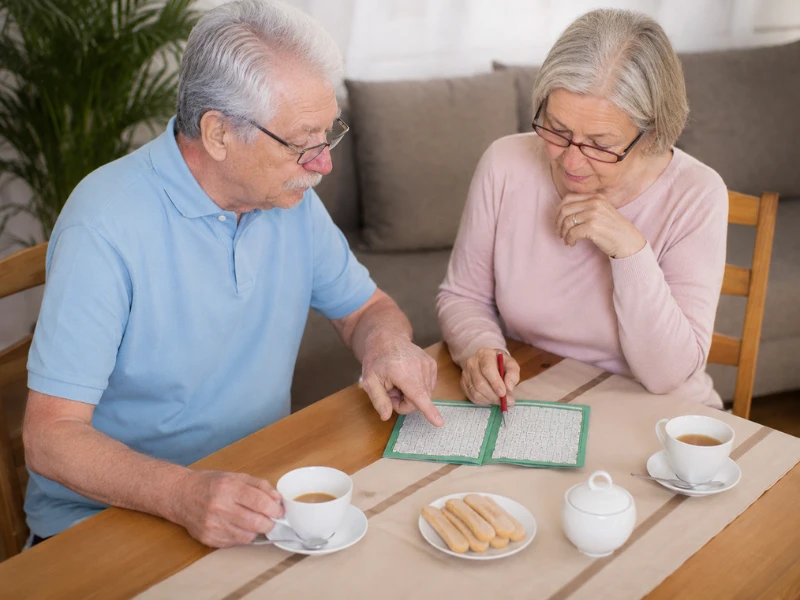
Puzzles do not have to be solitary.
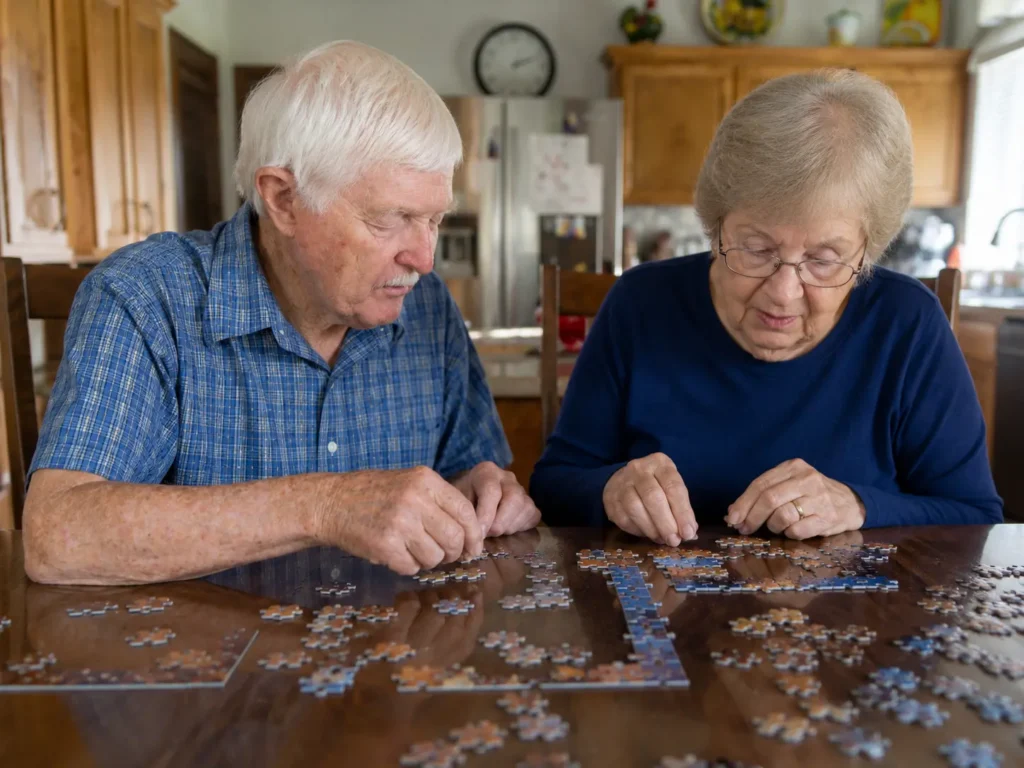
A jigsaw can become something you work on with a spouse, friend, child, or grandchild. A crossword can become a conversation. A Sudoku group can meet at a community center. A word-puzzle activity can give people who might otherwise sit separately a reason to spend time together.
This is where the social benefits of playing puzzles for older adults can be especially meaningful.
The benefit may not come from the puzzle itself, “improving social cognition.”
It may be much simpler:
You are doing something together.
You might ask someone for help with a clue. You might explain why a piece belongs somewhere. You might laugh about an answer. You might talk about the picture you are building.
The puzzle becomes the shared activity, while the conversation happens naturally around it.
That matters because healthy aging is about more than cognitive performance. Staying connected to other people is part of living a meaningful and engaged life.
NIA also recognizes meaningful and social activities as potentially important aspects of cognitive and overall health, while emphasizing that evidence for lasting cognitive effects from informal activities is not definitive.
So if a weekly puzzle group gets you out of the house, gives you something to look forward to and helps you spend time with people you enjoy, the social value may be just as important as the puzzle itself.
8. Physical Puzzles Can Involve Fine-Motor Skills
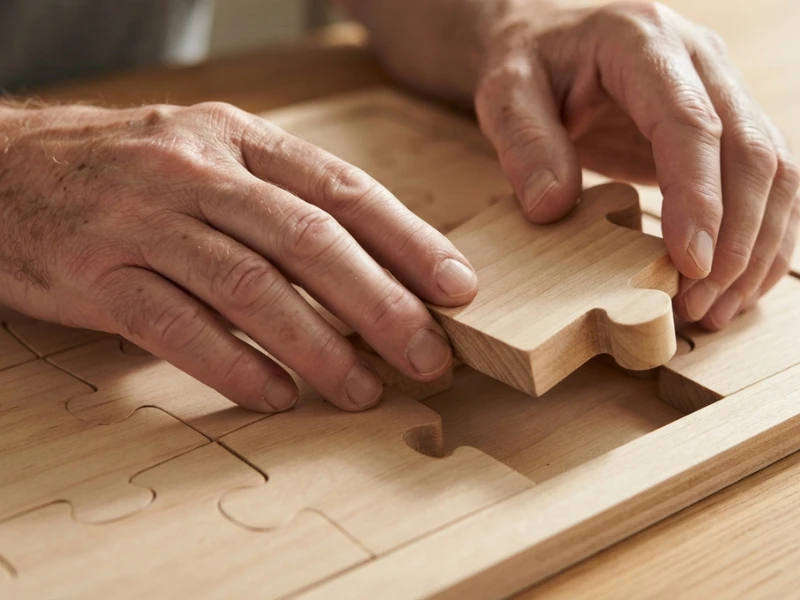
This is a smaller benefit, but one that is easy to overlook.
Working with physical jigsaw pieces involves repeated movements of the fingers and hands. You pick up a piece, turn it, examine it, compare it with another piece, and place it down.
For someone with comfortable hand function, that gives the activity a modest fine-motor component.
But this needs a clear boundary.
A jigsaw puzzle is not a substitute for hand therapy, strength training, balance exercise, mobility work or treatment prescribed for a medical condition.
If you have arthritis, tremor, reduced grip strength, or another condition affecting your hands, you may need to modify the activity rather than force yourself through it.
For example, you could choose:
- larger puzzle pieces
- easier-to-grip pieces
- a puzzle board that reduces reaching
- shorter sessions
- a well-lit workspace
The same principle applies to vision.
Someone with reduced eyesight may find a small, high-detail puzzle frustrating even if they would otherwise enjoy puzzles. A larger-piece, high-contrast puzzle in good lighting may be a much better choice.
Accessibility is not an afterthought.
The right puzzle is one you can comfortably use.
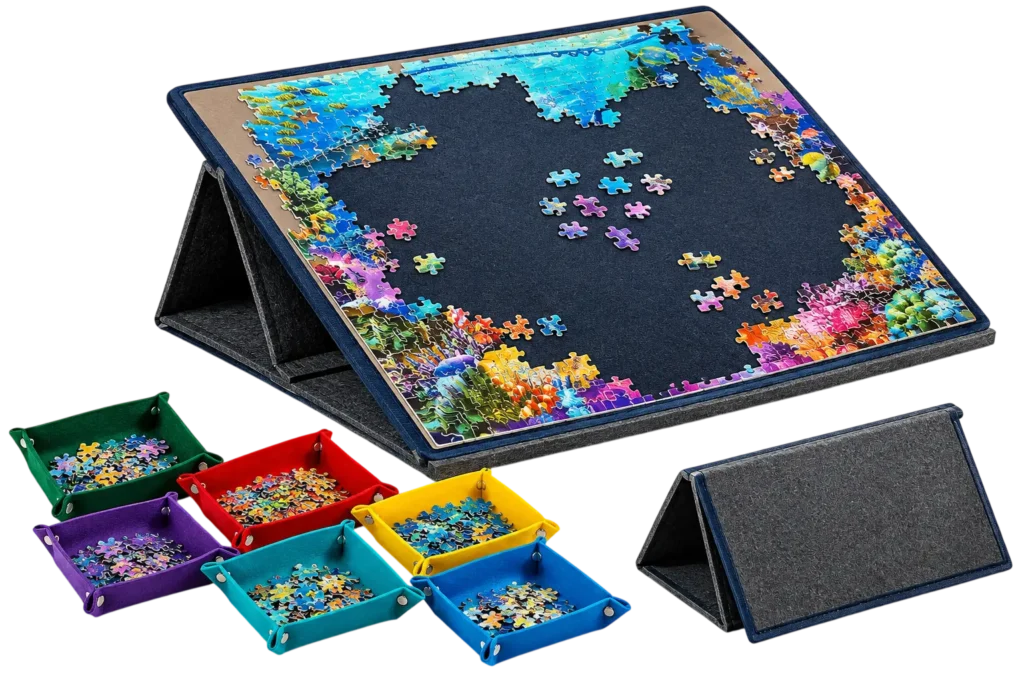
Becko US 1000-pc Tilting Puzzle Board with 6 Trays & Cover
Multi-angle tilting felt table designed to eliminate neck strain. Comes with 6 color-coded sorting trays and a protective cover.
9. Puzzles Can Give Older Adults a Meaningful Mental Activity
This is perhaps the benefit I would least like to reduce to a statistic.
An older adult does not need to spend every afternoon “optimizing brain health.”
Sometimes they simply need something they enjoy.
A puzzle can become a hobby. It can provide a sense of curiosity, progress, and mastery. It can give someone a reason to sit down with a cup of tea, spend time with another person, or work toward completing something over several days.
And that is important because healthy aging is not simply about keeping your brain “sharp.”
It is about continuing to have things that make life feel worth participating in.
Maybe that is a 500-piece landscape jigsaw.
Maybe it is the crossword in the newspaper.
Maybe it is Sudoku every Sunday.
Maybe it is a word-search book you keep beside your chair.
Or maybe you don’t enjoy puzzles at all.
That is perfectly fine.
Reading, learning music, gardening, walking, practicing yoga, volunteering, cooking, spending time with friends and learning new skills can all provide meaningful engagement too. NIA’s guidance on cognitive health emphasizes a broader approach rather than presenting one recreational activity as a magic solution.
So I would not ask:
“Which puzzle is best for preventing memory loss?”
I would ask:
“Which activity gives me enough mental challenge, enjoyment, and meaning that I actually want to keep doing it?”
For one person, that may be a difficult crossword.
For another, it may be a large-piece jigsaw shared with a grandchild.
For someone else, it may be Sudoku, a word search, or no puzzle at all.
There is no prize for choosing the hardest puzzle.
The real value is finding a mentally engaging activity that fits your abilities, interests, and everyday life.
And that is a much more realistic way to think about the benefits of playing puzzles for older adults: not as a promise to stop aging, but as one enjoyable way to keep learning, concentrating, solving problems, connecting with others, and doing something that matters to you.
Puzzles for Older Adults With Poor Eyesight, Arthritis or Limited Dexterity
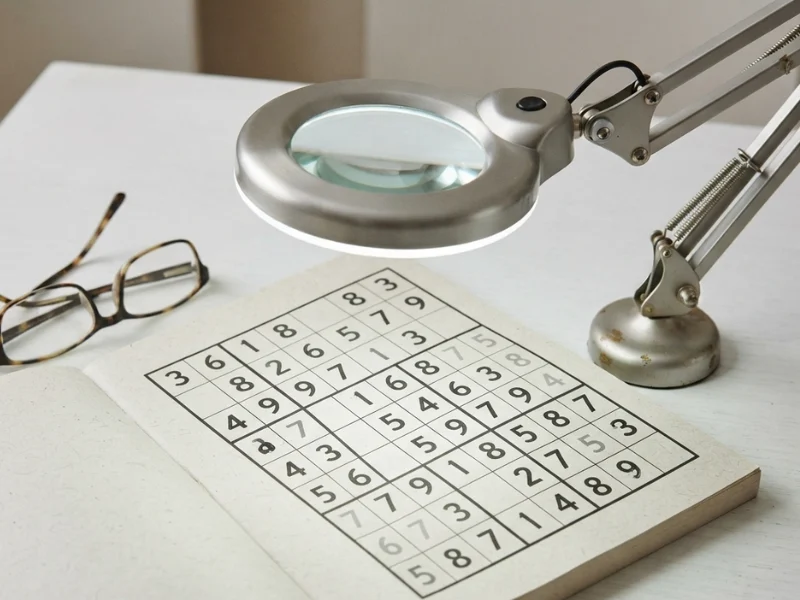
For some older adults, choosing a puzzle is less about finding the most challenging brain game and more about finding one that is comfortable to see, hold, and use.
If small pieces are difficult to handle or puzzle clues are hard to read, you do not necessarily need to give up the activity. A few simple changes can make puzzles much more accessible.
If You Have Poor Eyesight
If you’re looking for puzzles for elderly with poor eyesight, start with visibility rather than difficulty.
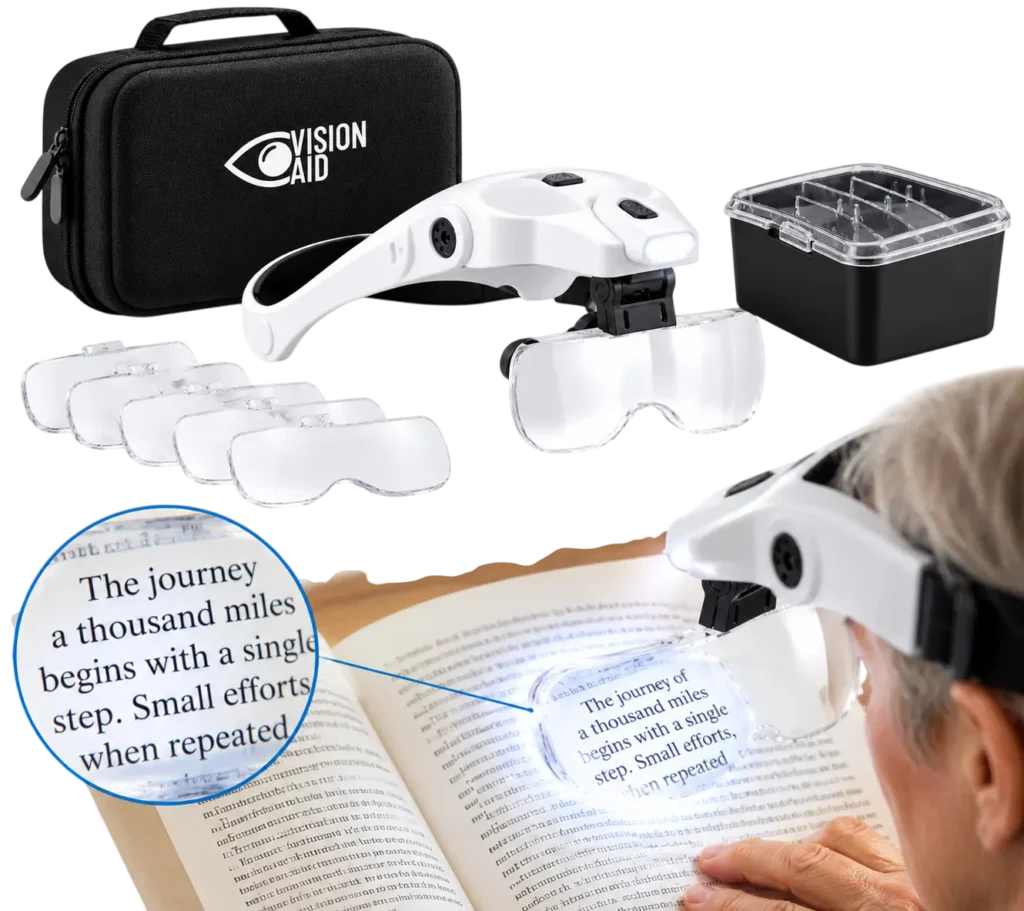
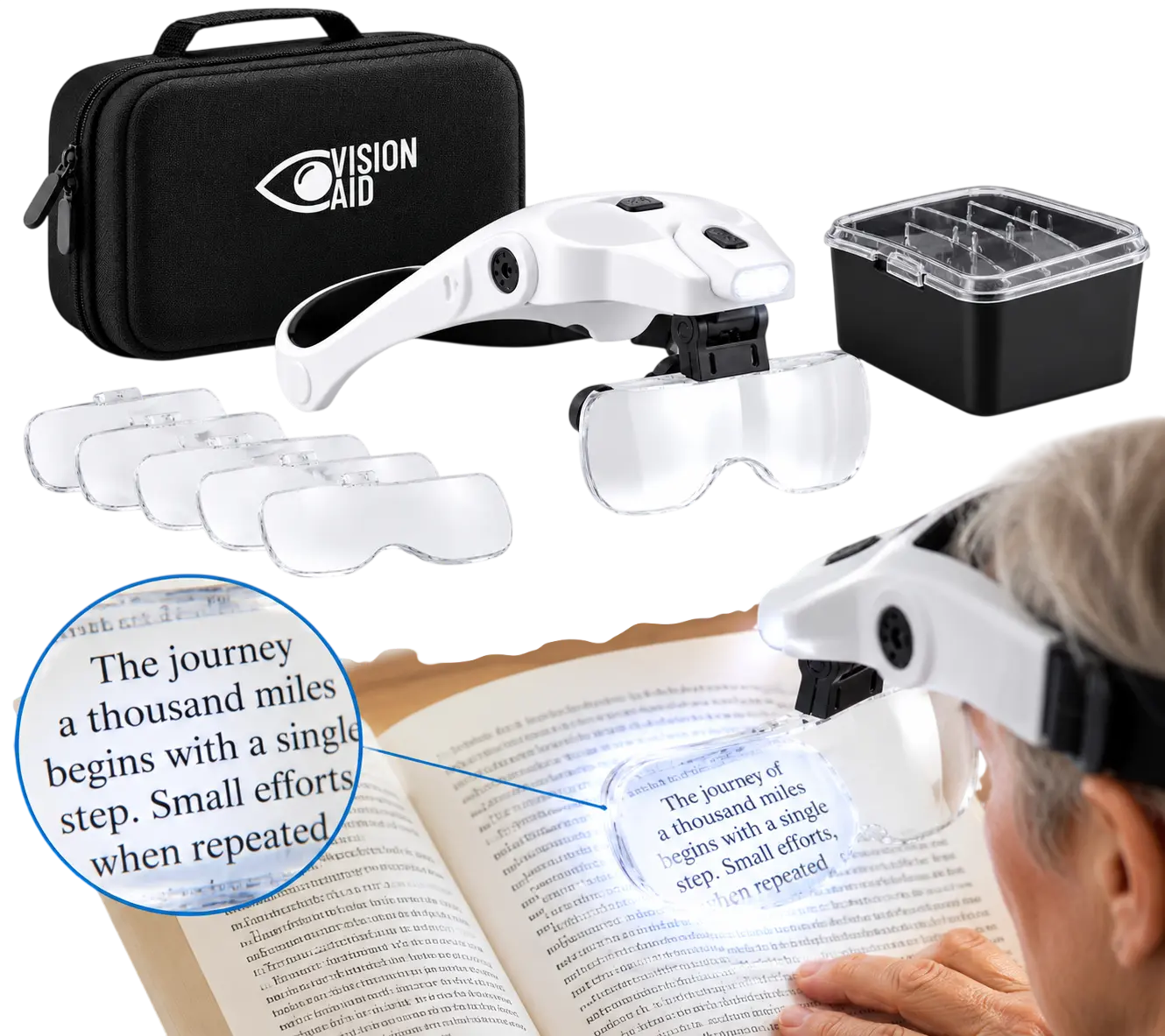
Vision Aid Head-Mounted Magnifying Glasses with LED Light
Hands-free headset with 5 interchangeable lenses (1x to 3.5x), rechargeable illumination, and a protective carrying case.
Large-print puzzles, large-piece jigsaw puzzles, and high-contrast designs can make it easier to distinguish letters, numbers, shapes, and individual pieces.
You can also make the environment work better for you:
- Choose larger fonts and clearly printed clues.
- Look for high-contrast colors rather than subtle patterns that are difficult to distinguish.
- Use good, even lighting over the puzzle area.
- Position the puzzle where you can work without uncomfortable glare.
- Consider magnification if you normally use it for close-up activities.
- Use your usual prescription glasses for reading or other close work if they have been prescribed for you.
- Choose a puzzle with fewer, larger pieces if a highly detailed puzzle becomes visually overwhelming.
The goal isn’t to make the puzzle easier just for the sake of making it easier. It is to remove a visual barrier that has nothing to do with the mental challenge itself.
And don’t automatically assume that a significant change in vision is simply a normal part of aging. If reading, seeing puzzle pieces, or performing everyday activities has suddenly become much harder, an appropriate eye examination is more useful than simply buying a larger puzzle.
If You Have Arthritis or Limited Dexterity
Small puzzle pieces can be surprisingly difficult to manipulate when your hands are painful, stiff, or less dexterous.
In that situation, larger pieces that are easy to grip and rotate may be a much better choice than a standard puzzle with hundreds of tiny pieces.
A few practical adjustments can help:
- Choose large, easy-to-grip pieces.
- Start with fewer pieces rather than choosing a very large puzzle.
- Work on a stable, non-slip surface so pieces do not move unnecessarily.
- Use a table and chair at a comfortable height.
- Keep the puzzle within easy reach rather than repeatedly stretching across the table.
- Take breaks if your hands become tired or uncomfortable.
- Stop rather than pushing through increasing pain.
You also don’t have to complete a puzzle in one sitting. Working on it for a shorter period and returning to it later can make the activity much more comfortable.
One important distinction: a puzzle is not a substitute for hand therapy or medical treatment. Picking up and rotating puzzle pieces involves hand movements, but that does not mean puzzles can treat arthritis, restore hand strength, or replace exercises recommended by a healthcare professional.
Persistent pain, weakness, numbness, stiffness, or a noticeable change in your ability to use your hands should not automatically be dismissed as “just getting older.” If these problems interfere with everyday activities, they deserve appropriate medical attention.
Make the Puzzle Fit You—Not the Other Way Around
The best puzzle is one that provides an enjoyable mental challenge without creating unnecessary physical frustration.
If your eyesight is limited, increase the print size, contrast, lighting, or magnification. If your hands are stiff or painful, choose larger pieces, a stable surface, and shorter sessions. If a particular puzzle remains uncomfortable, choose another format.
There is no prize for struggling with a puzzle that was never designed for your needs. Accessibility is part of choosing the right puzzle, not a sign that you are doing the activity incorrectly.
What Happens If You Do Puzzles Every Day?
Doing a puzzle every day can give you something simple but worthwhile: regular mental engagement.
The exact experience depends on the puzzle. A daily crossword may repeatedly challenge word retrieval and language. Sudoku can keep you working with logic, patterns, and possible solutions. A jigsaw puzzle can involve visual-spatial processing, attention, and problem-solving.
That does not mean that doing puzzles every day will automatically make your memory stronger or protect you from dementia. The evidence is more nuanced than that.
What you can reasonably expect from a daily puzzle habit is repeated practice, mental engagement, and an enjoyable routine. What you cannot assume is that those benefits will transfer into broad, long-term protection against cognitive decline.
Daily puzzles can give you regular cognitive engagement
When you return to a puzzle regularly, you repeatedly practice the skills that particular activity requires.
For example, working on a crossword means repeatedly searching for words, interpreting clues, and using letters already placed in the grid. A jigsaw puzzle asks you to compare shapes, colors, and patterns while remembering where pieces might fit. Sudoku requires you to keep possibilities in mind and apply a set of rules as you work toward a solution.
Research supports the idea that puzzles can engage multiple cognitive abilities. In a randomized study of adults aged 50 and older, jigsaw puzzling strongly engaged several visuospatial abilities, including perception, mental rotation, processing speed, cognitive flexibility, working memory, reasoning, and episodic memory. However, the 30-day jigsaw intervention improved participants’ puzzle skill without producing a significant improvement in global visuospatial cognition compared with the control group.
That distinction is important: getting better at a puzzle is not necessarily the same as getting better at cognition overall.
A daily puzzle can become an enjoyable mental routine
There is also value in having an activity you genuinely look forward to.
A puzzle can provide a defined task, a small goal, and a sense of progress. For some older adults, that may make it easier to build a regular period of focused activity into the day.
If you enjoy doing puzzles with another person, the routine can also become social. A crossword at the kitchen table, a shared jigsaw with family, or a Sudoku group at a community center combines mental activity with conversation and connection.
The key is that daily does not have to mean difficult. A short, manageable puzzle that you enjoy may be a better long-term habit than an extremely difficult one that leaves you frustrated.
Does doing puzzles every day help you stay mentally active?
It can be one way to stay mentally engaged, but there is no evidence that everyone needs to do puzzles every day to maintain cognitive health.
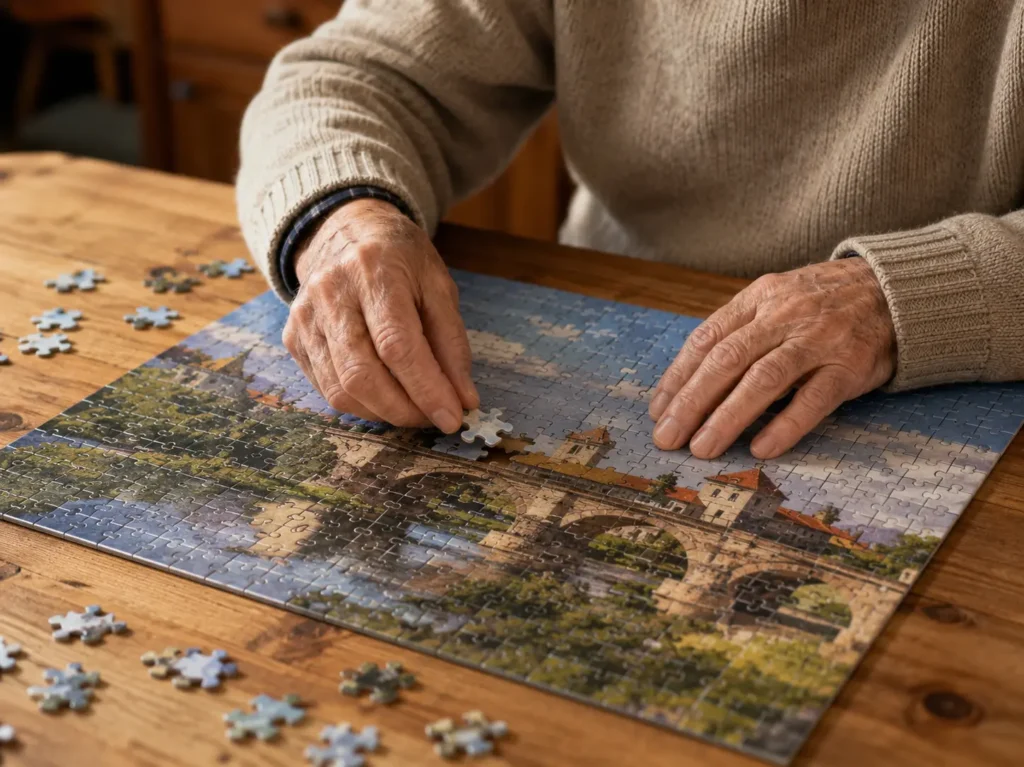
There is some encouraging evidence from specific puzzle interventions. For example, a small randomized study found that older adults assigned to daily crossword solving for four weeks improved more in verbal fluency than a comparison group.
But that finding should be interpreted narrowly. It shows an improvement on a particular measure after a particular intervention—not proof that daily crossword solving prevents dementia or produces the same result for everyone.
The National Institute on Aging similarly notes that evidence for lasting cognitive benefits from cognitively engaging leisure activities is not definitive.
So, should you do puzzles every day?
If you enjoy them, there is nothing wrong with making puzzles part of your daily routine.
Think of them as one form of cognitive engagement—not a prescription for preventing memory loss.
You can rotate between jigsaw puzzles, crosswords, Sudoku, word searches, or other brain activities for seniors depending on what you enjoy and what feels appropriately challenging.
And if you miss a day, nothing has gone wrong. Cognitive health is not determined by maintaining a perfect puzzle streak.
The more useful question is not “How many puzzles do I need to solve to protect my brain?”
It is:
“Does this activity challenge me, interest me, and fit comfortably into the life I want to live?”
That is a much more evidence-conscious way to think about the benefits of playing puzzles for older adults.
Do Brain Puzzles Actually Help?
Yes, there is evidence that some forms of cognitive training and mentally stimulating activity can improve performance on certain cognitive measures in older adults. But that is a more careful statement than saying that “brain puzzles prevent memory loss” or “keep dementia away.”
The difference matters.
A puzzle can clearly require attention, memory, reasoning, language, or visual-spatial processing. Research can also test whether regularly practicing these kinds of activities is associated with, or leads to, measurable changes in cognition. But those are different questions from whether puzzles prevent dementia or Alzheimer’s disease.
What observational research suggests
Observational studies have found that people who engage in cognitively stimulating activities can have different patterns of cognitive health as they age. This has led researchers to investigate whether mental activity might contribute to maintaining cognitive function.
But observational research has an important limitation: it can identify an association without proving cause and effect.
For example, someone who regularly does puzzles may also read, exercise, maintain social connections, continue learning, manage their health, or participate in other activities. Researchers cannot automatically conclude that the puzzle itself caused a difference in cognitive health.
That is why claims about the benefits of doing puzzles for adults should be interpreted carefully.
An association is a reason to investigate a possible relationship—not proof that one activity prevents a disease.
What intervention studies tell us

Randomized intervention studies provide stronger evidence because researchers can assign people to different activities and compare their outcomes.
Research on cognitive training in older adults has found that structured training can improve performance on some cognitive measures. A systematic review and meta-analysis of 31 randomized controlled trials, for example, found improvements in areas including executive function and some measures of memory and processing speed. However, the effects varied depending on the intervention and the outcome being measured.
Research specifically examining cognitive leisure activities has also reported encouraging findings. A systematic review of 20 intervention studies found improvements in at least one cognitive domain in 13 studies, but the authors emphasized that the number of studies was small and that more high-quality research was needed. The activities studied included several forms of intellectual leisure activity, including board games and a crossword-puzzle intervention.
This gives us a useful middle ground.
There is evidence that cognitive training and mentally stimulating activities can affect measured cognitive performance. But evidence for a particular recreational puzzle cannot automatically be generalized to every older adult or every type of puzzle.
Why “brain training” claims need caution
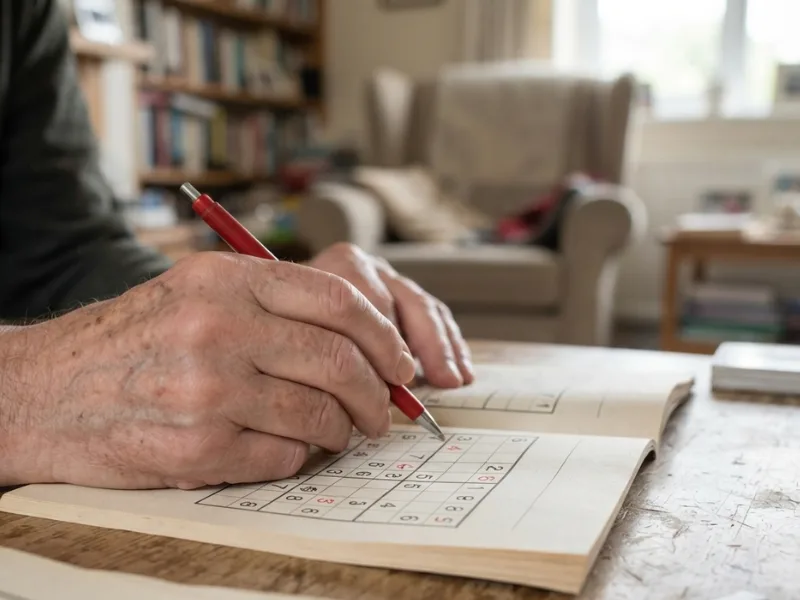
The most important distinction is between improving performance on a practiced task and preventing cognitive disease.
If you regularly practice crosswords, you may become more familiar with crossword clues and the kinds of word-retrieval tasks they require. If you regularly practice Sudoku, you repeatedly work with its particular rules and reasoning demands.
That does not mean the improvement necessarily transfers to every other aspect of cognition.
A systematic review of cognitive-training trials found moderate-strength evidence that, in healthy older adults, training improved performance in the cognitive domain being trained, while evidence for preventing cognitive decline or dementia was insufficient.
The National Institute on Aging makes the same broader distinction in its discussion of dementia research: lifestyle and cognitive-training interventions are being studied in controlled clinical trials to determine whether they actually reduce dementia risk, rather than assuming that an association automatically represents a preventive effect.
So when you see a claim that a particular puzzle “prevents dementia,” ask what the study actually measured.
Did it measure performance on the puzzle?
Did it measure a specific memory or attention task?
Did researchers follow participants long enough to assess cognitive decline?
Did the study measure dementia diagnoses?
Those are very different outcomes.
What this means for older adults
The evidence supports a reasonable conclusion: puzzles can be a worthwhile form of cognitive engagement, and some structured cognitive-training interventions can improve performance on particular cognitive measures.
What the evidence does not allow us to say is that doing jigsaw puzzles, crosswords, Sudoku, or other brain puzzles guarantees better memory or prevents dementia or Alzheimer’s disease.
That distinction does not make puzzles less worthwhile.
It simply puts them in the right place: one enjoyable way to challenge your mind and stay engaged, rather than a medical treatment or guaranteed disease-prevention strategy.
Can Puzzles Prevent Dementia or Alzheimer’s?
If you enjoy puzzles and are hoping they will protect your memory as you age, the most important thing is to separate cognitive engagement from disease prevention.
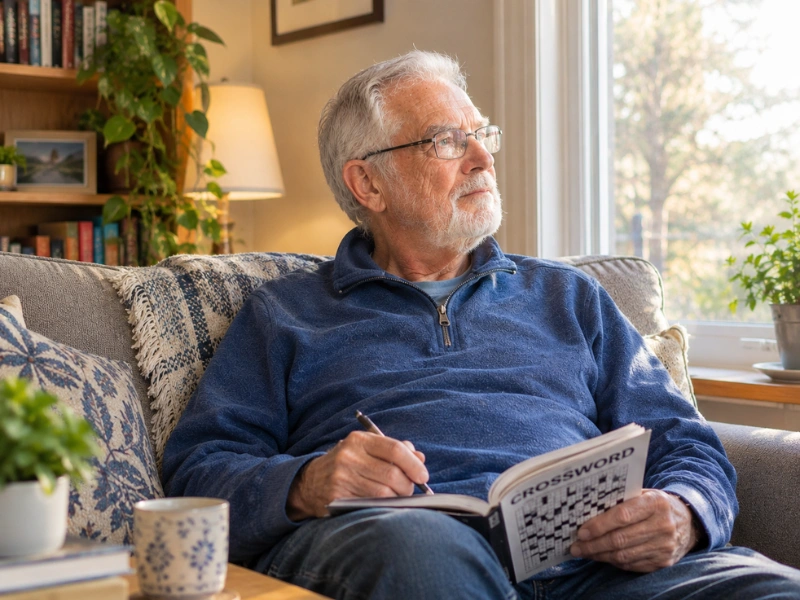
The short answer: we cannot say that doing puzzles prevents dementia or Alzheimer’s disease.
Puzzles can challenge attention, memory, reasoning, language, and visual-spatial skills. Research on cognitive training and mentally stimulating activities also suggests that some interventions can improve performance on particular cognitive measures. But those findings do not establish that completing a particular puzzle prevents the biological changes that cause dementia.
That distinction is especially important when discussing the benefits of playing puzzles for older adults. A puzzle can be a worthwhile part of an active, mentally engaged lifestyle without being a medical treatment or guaranteed way to prevent cognitive decline.
Does Doing Puzzles Help Prevent Dementia?
It has not been proven that doing puzzles prevents dementia.
There is evidence that cognitive stimulation and cognitive training can benefit certain aspects of cognitive performance. The National Institute on Aging notes that structured cognitive training can improve abilities such as memory, reasoning, and processing speed, although whether these improvements translate into longer-term protection from dementia remains an important research question.
There is also observational research linking cognitively stimulating activities with patterns of cognitive health. But observational research cannot, by itself, establish that the activity caused the outcome.
For example, people who regularly do puzzles may also read more, exercise regularly, maintain stronger social connections, have different educational backgrounds, or manage their health differently from people who rarely do puzzles. Those differences can make it difficult to isolate the effect of puzzling itself.
This is why the statement:
“People who do puzzles have better cognitive outcomes.”
is not equivalent to:
“Doing puzzles prevents dementia.”
The second claim requires much stronger evidence.
Current dementia-risk guidance takes a broader approach. The WHO’s 2026 guideline on reducing the risk of cognitive decline and dementia includes cognitive training and cognitive stimulation and engagement among interventions recommended for adults with normal cognition or mild cognitive impairment. At the same time, the guideline identifies areas where evidence remains insufficient and further research is needed.
In other words, cognitive engagement can be part of a broader approach to brain health, but it should not be treated as a stand-alone guarantee against dementia.
Do Jigsaw Puzzles Help Prevent Alzheimer’s?

There is currently no evidence strong enough to conclude that doing jigsaw puzzles prevents Alzheimer’s disease.
Jigsaw puzzles are certainly cognitively engaging. Depending on the puzzle, you may compare shapes and colors, recognize patterns, remember where pieces belong, mentally rotate objects, and adjust your strategy when something does not fit. These activities can involve several cognitive processes at once.
But there is a major difference between using these abilities while solving a puzzle and preventing Alzheimer’s disease.
Alzheimer’s disease is a complex brain disorder, and dementia can result from several different diseases and causes. Challenging a particular cognitive skill does not demonstrate that an activity can stop the underlying disease process.
The National Institute on Aging describes cognitive training as a promising area of research and reports improvements in specific trained abilities, but it also emphasizes that researchers are still studying whether these approaches can prevent or slow Alzheimer’s disease and related dementias.
That means it would be misleading to tell an older adult that doing a jigsaw puzzle every day will prevent Alzheimer’s.
It is more accurate to say that jigsaw puzzles can provide mental stimulation, an opportunity to practice particular cognitive skills, and an enjoyable activity that may fit into a broader brain-healthy lifestyle.
Those are meaningful benefits without making a medical promise the evidence cannot support.
Do Crosswords Help Prevent Dementia?

We cannot currently say that crosswords prevent dementia.
Crosswords are particularly interesting because researchers have tested them in controlled studies rather than relying only on observational research.
One randomized clinical trial involving older adults with mild cognitive impairment found that web-based crossword training performed better than computerized cognitive games on its primary cognitive outcome. The study followed participants for 78 weeks and also examined functional and brain-imaging outcomes.
That is an important finding—but the population and outcome matter.
The participants had mild cognitive impairment, and the researchers were testing a specific crossword-training intervention. The study does not establish that doing ordinary crossword puzzles prevents dementia in cognitively healthy older adults.
This is a common problem with health claims about puzzles: a genuine research finding gets stretched into a much broader conclusion than the study actually tested.
A study can show that:
“Participants receiving this intervention performed better on a particular cognitive outcome.”
That does not automatically mean:
“The intervention prevents dementia.”
To establish dementia prevention, researchers need evidence involving outcomes such as the development of dementia or clinically meaningful cognitive decline over an appropriate period—not simply performance on a task that resembles the activity being practiced.
What Does the Evidence Actually Tell Us?
The evidence supports a balanced conclusion.
Puzzles are not useless “brain games.” They can require genuine mental effort, and research on cognitive training and cognitive stimulation provides evidence that some structured interventions can improve particular aspects of cognitive performance.
But puzzles are also not proven dementia-prevention treatments.
The strongest current dementia-risk guidance looks at a much wider group of factors. The WHO’s 2026 recommendations include physical activity, management of conditions such as high blood pressure and diabetes, healthy behaviours, social engagement, hearing care, and cognitive training or cognitive stimulation among the areas relevant to dementia-risk reduction.
That broader view is important for older adults. Brain health is not something you can reduce to one crossword, one jigsaw puzzle, or one “brain game.”
So if you enjoy puzzles, there is no reason to stop doing them simply because they have not been proven to prevent dementia. They can be an enjoyable way to challenge yourself, stay mentally engaged, learn, pass time meaningfully, or connect with someone else.
Just keep the claim proportional to the evidence:
Puzzles can be a valuable cognitive activity. They are not a guaranteed way to prevent dementia or Alzheimer’s disease.
And if you or someone you care about is experiencing new or worsening memory or thinking problems that interfere with everyday life, doing more puzzles should not be used as a substitute for medical evaluation. Cognitive changes can have different causes, and identifying the cause is more important than assuming they are simply a normal part of aging.
Jigsaw Puzzles vs. Crossword Puzzles vs. Sudoku: Which Is Better?
If you’re wondering whether jigsaw puzzles, crossword puzzles, or Sudoku is better for the brain, there isn’t one puzzle that has been proven to be best for every older adult.
Different puzzles challenge different skills. The better choice is usually the one that matches your interests, provides an appropriate level of challenge, and is comfortable enough that you will actually keep doing it.
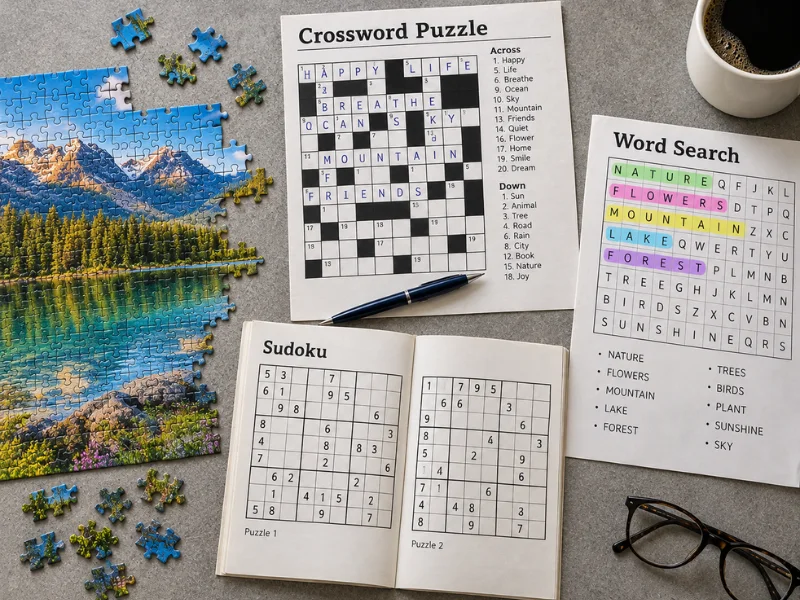
| If you enjoy… | Consider… | Main skills involved |
|---|---|---|
| Pictures and hands-on activities | Jigsaw puzzles | Visual-spatial processing, attention and problem-solving |
| Words, clues and vocabulary | Crosswords | Language, word retrieval and reasoning |
| Numbers, patterns and logic | Sudoku | Reasoning, attention and working memory |
| Finding hidden words | Word searches | Visual scanning and attention |
| Doing puzzles with others | Shared puzzles | Puzzle-solving plus social interaction |
Jigsaw puzzles
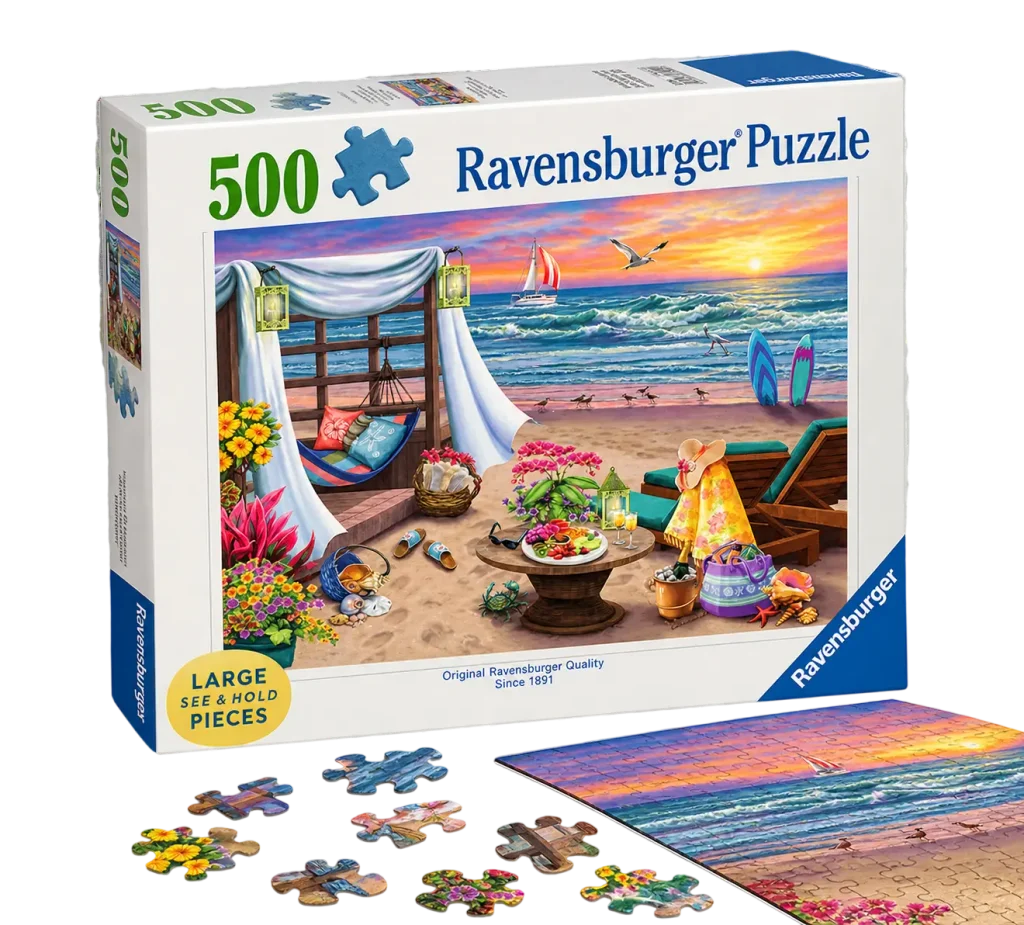
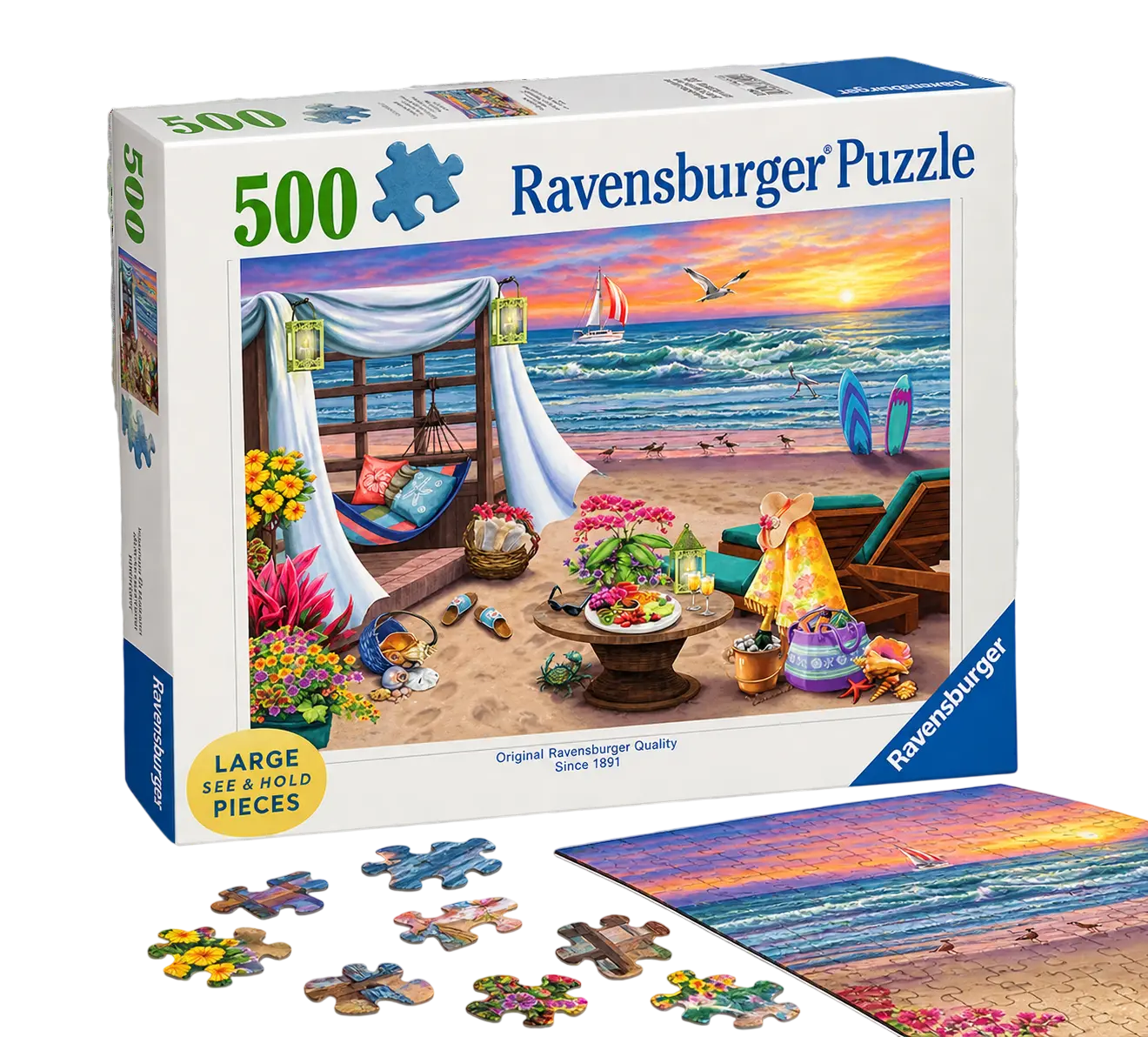
Ravensburger Cabana Retreat (500-Piece Large Format)
Features vibrant ocean sunset cabana artwork by Nancy Wernersbach. Crafted with extra-large pieces and a glare-free linen finish for comfortable, frustration-free assembling.
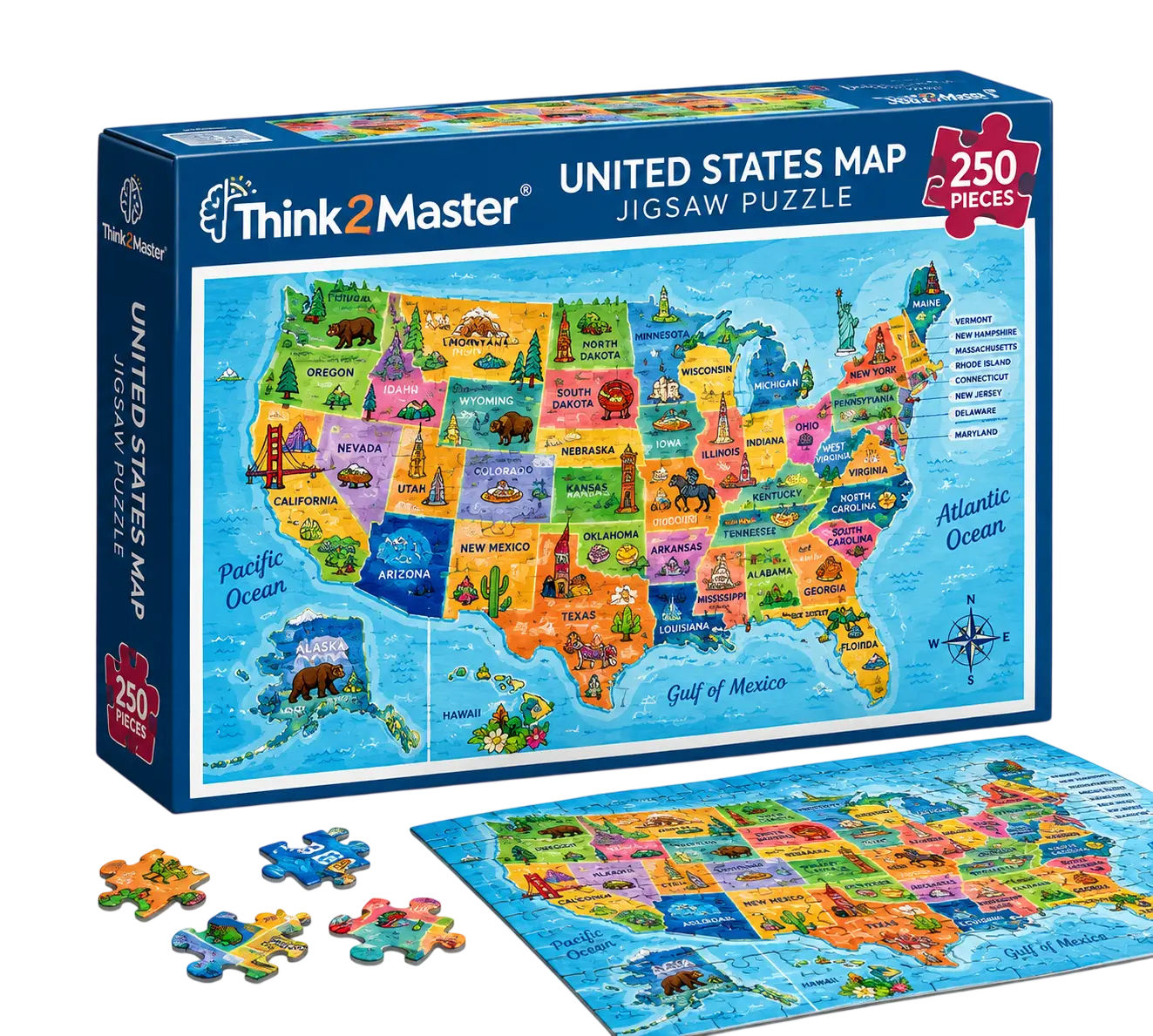
Think2Master United States Map Jigsaw Puzzle (250 Pieces)
An educational, color-coded map highlighting U.S. national parks, mountain ranges, and major landmarks. Features extra-large pieces ideal for adults and seniors.
Jigsaw puzzles are a natural choice if you enjoy pictures, hands-on activities and visual problem-solving.
You may compare shapes and colors, search for patterns, rotate pieces, remember where you have already looked, and work out where a piece might fit. These tasks can involve several cognitive and visual-spatial processes at once.
That helps explain the interest in the cognitive benefits of jigsaw puzzles, but it does not mean that completing jigsaw puzzles has been proven to prevent dementia or Alzheimer’s disease.
Crossword puzzles
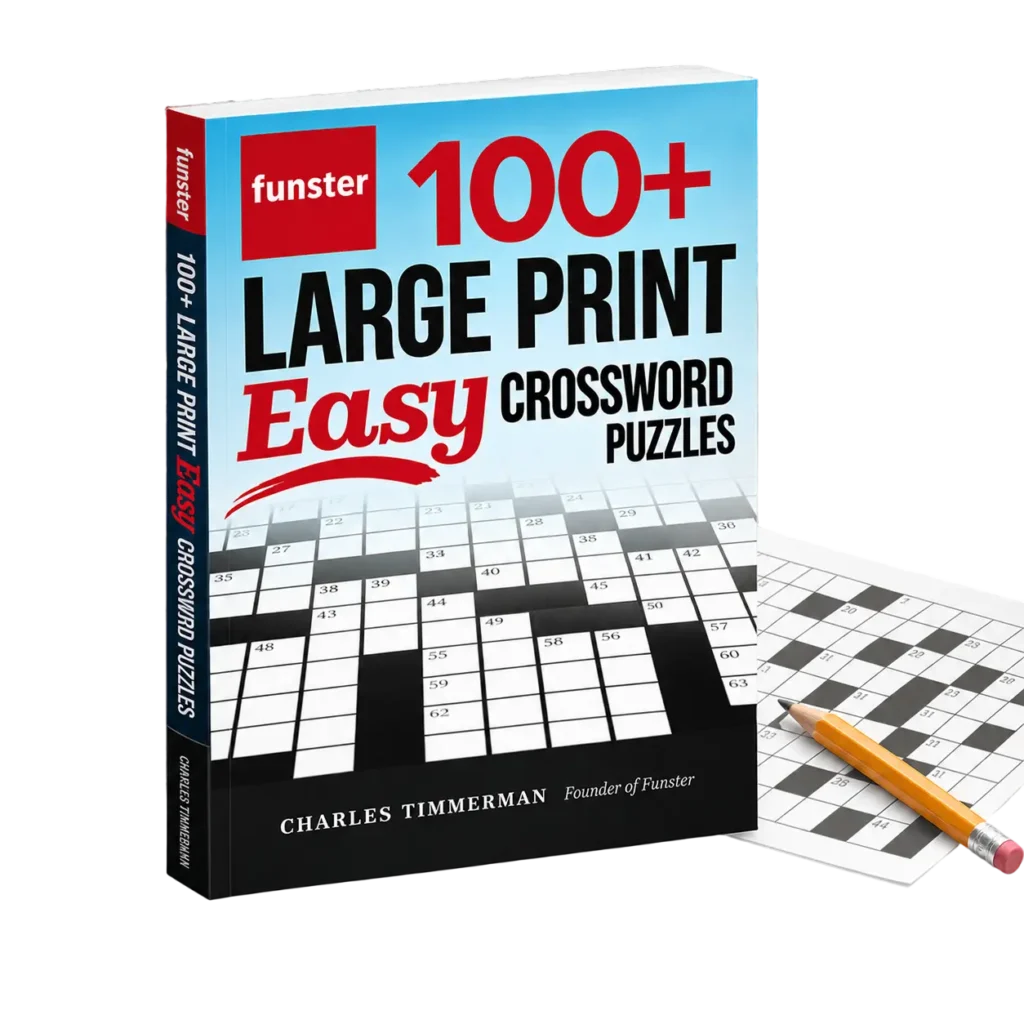
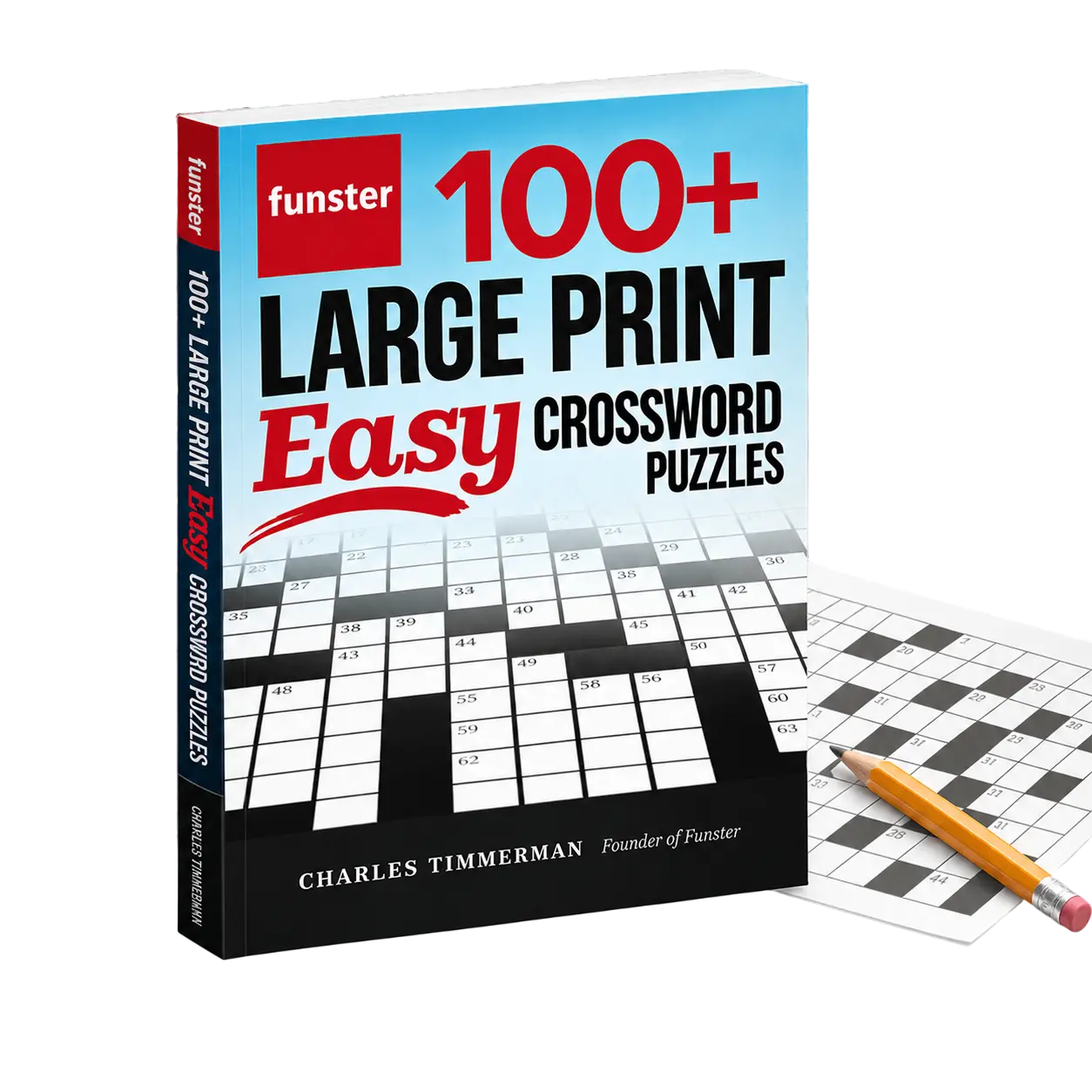
Funster 100+ Large Print Easy Crossword Puzzles
Authored by Charles Timmerman, offering over 100 solvable puzzles printed in giant grids with easy-to-read lettering.
If you enjoy words, vocabulary, and clues, a crossword may be a better fit.
Solving one can involve retrieving words, interpreting clues, considering possible answers and using letters already in the grid to narrow down possibilities. This makes crosswords particularly relevant to people interested in the benefits of crossword puzzles for elderly people.
Research has examined crossword solving and cognitive performance, but that evidence should not be exaggerated into a promise of dementia prevention.
Sudoku and number puzzles
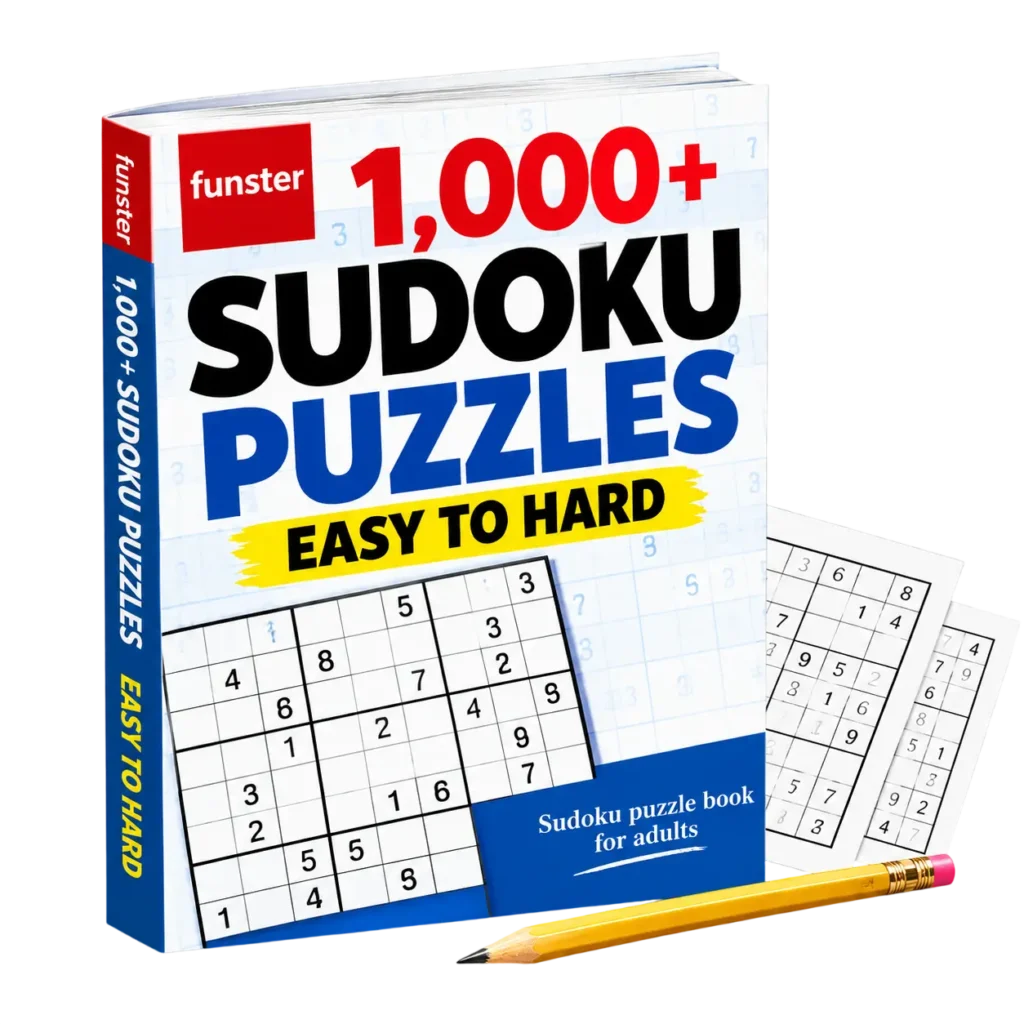
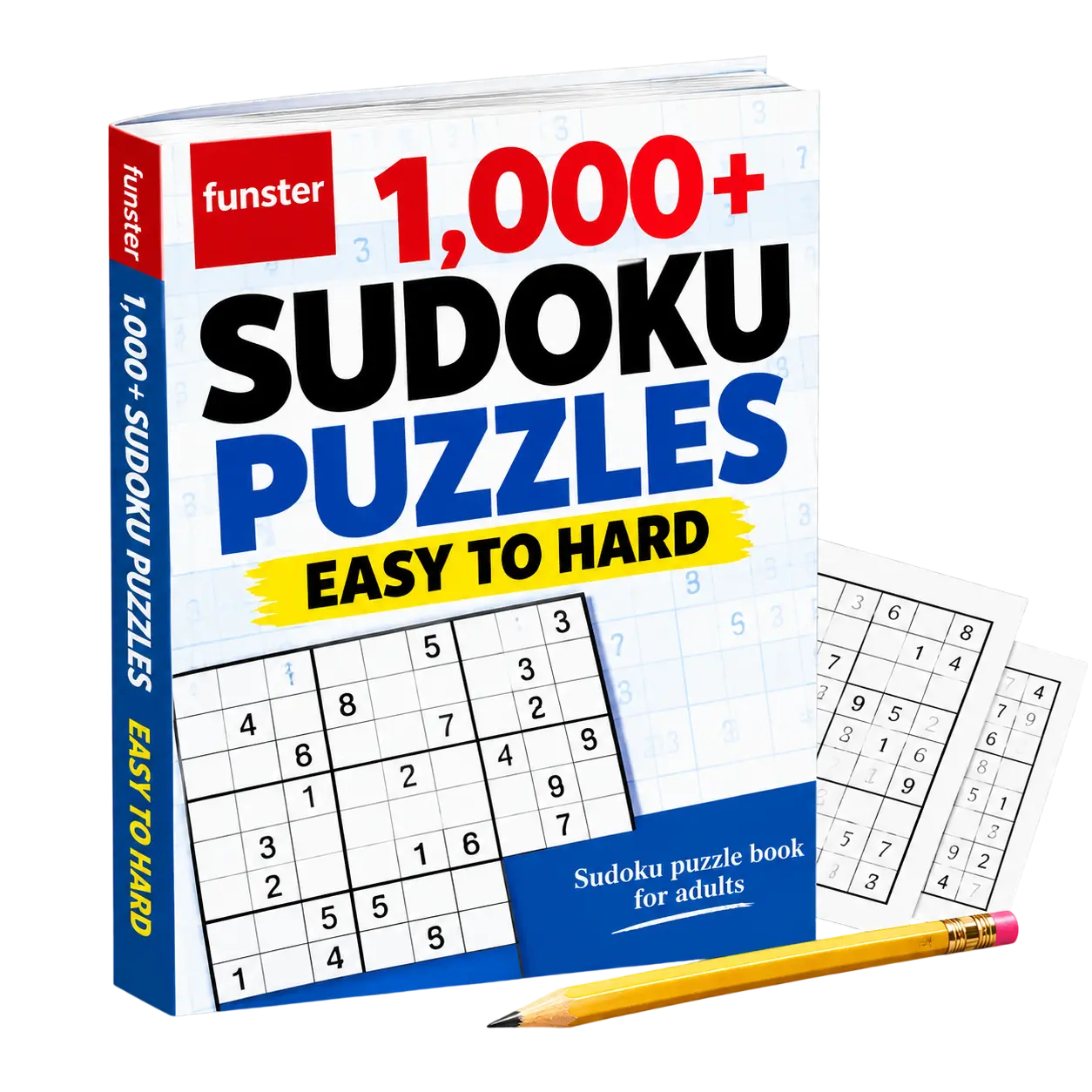
Funster 1,000+ Sudoku Puzzles (Easy to Hard)
A massive puzzle collection printed with large, clear numbers on high-quality paper, tailored for all proficiency levels.
Sudoku may suit someone who enjoys numbers, patterns, rules and logic.
Rather than requiring complicated mathematics, Sudoku involves keeping track of possibilities and reasoning through what can or cannot fit in each space. It therefore provides a different type of mental challenge from a crossword or jigsaw.
As with other puzzles, however, using reasoning and working memory during Sudoku is not proof that Sudoku prevents cognitive decline.
Word searches
Word searches are a straightforward option for someone who prefers visual scanning and simple rules.
You know which words you are looking for and scan the grid until you find them. They can also work well when you want a shorter activity rather than a puzzle that requires a long sitting.
So, which puzzle is best for the brain?
There is no scientifically established “best” puzzle for the brain.
If you love pictures, choose a jigsaw. If you enjoy language, try a crossword. If logic and numbers appeal to you, Sudoku may be more satisfying. If you prefer something simpler, a word search is perfectly reasonable.
The strongest choice is not necessarily the puzzle with the biggest list of advertised brain benefits. It is one that is appropriately challenging, enjoyable, accessible, and meaningful enough that you want to return to it.
That is a more realistic way to approach the benefits of doing puzzles for adults: as one enjoyable form of mental engagement, rather than a guaranteed way to prevent dementia or keep the brain “young.”
How Difficult Should a Puzzle Be for an Older Adult?
The right puzzle is not necessarily the easiest one—or the hardest.
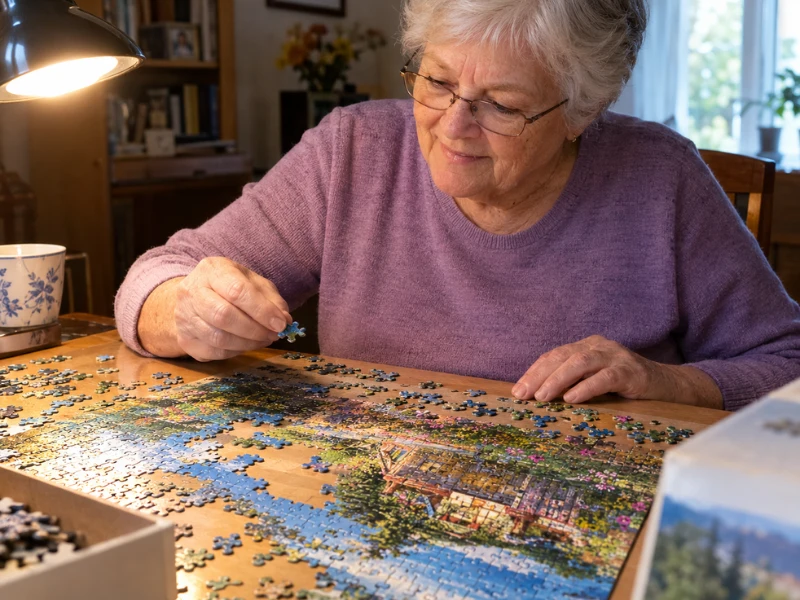
A puzzle that is too easy may provide very little challenge, while one that is far beyond your current ability can become frustrating. A better starting point is a puzzle that makes you think without making the activity feel like a test.
There is no evidence that choosing a particular difficulty level predicts whether someone will develop dementia. The goal is much simpler: find a level that feels engaging and manageable.
For jigsaw puzzles
Consider more than just the number of pieces. A 1,000-piece puzzle with a simple image may feel easier to some people than a 300-piece puzzle with a highly detailed design.
Think about:
- Piece size: Larger pieces can be easier to see and handle.
- Number of pieces: Start lower if a large puzzle feels overwhelming.
- Image complexity: Clear, recognizable sections can make the puzzle easier to organize.
- Contrast: Distinct colors and patterns can make pieces easier to distinguish.
If you can make steady progress but still need to stop, look carefully, and work things out, you may have found a comfortable level.
For crossword puzzles
Difficulty can depend on the clues as much as the size of the grid.
If you’re new to crosswords or finding them frustrating, consider an easier puzzle with:
- familiar vocabulary;
- straightforward clues;
- larger, easy-to-read print;
- fewer obscure words.
Using a clue or checking an answer is also perfectly reasonable. The purpose is to enjoy the activity and engage with it—not to prove that you can complete every puzzle without help.
For Sudoku
Sudoku commonly comes in levels such as beginner, intermediate, and advanced.
Starting with a beginner puzzle can make sense if you are learning the rules or have not done Sudoku before. If the puzzles become too predictable, you can gradually try a more difficult level.
The same principle applies in the other direction: if an advanced puzzle leaves you frustrated rather than interested, stepping back to an easier one is not “giving up.” It may simply be a better fit.
How to Make Puzzle Time More Enjoyable and Accessible
The benefits of playing puzzles for older adults are more practical when the activity actually fits into everyday life.
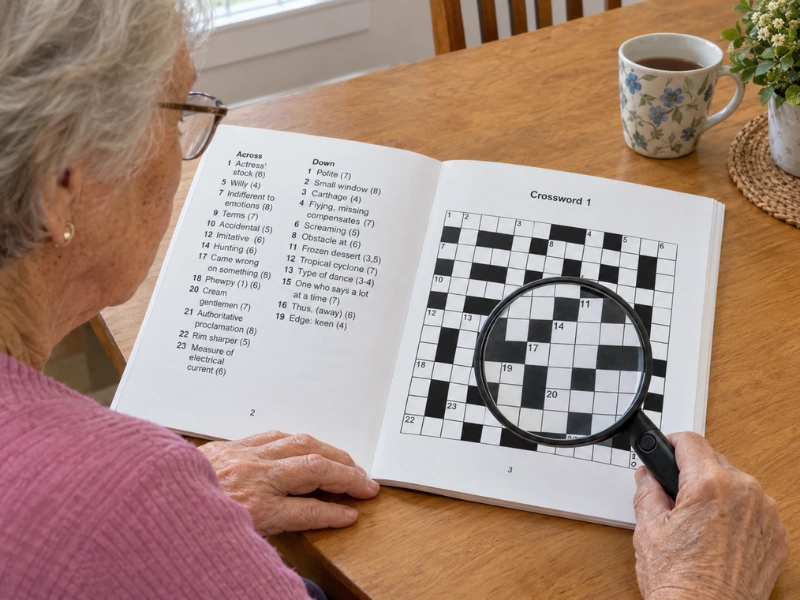
A few simple changes can make puzzle time more comfortable:
Choose something you genuinely enjoy. Pictures, words, numbers and logic appeal to different people. Interest matters.
Start at a manageable difficulty. You should have to think, but you shouldn’t feel as though you’re constantly fighting the puzzle.
Make the puzzle easy to see. Good lighting, larger print and higher contrast can help when small details are difficult to distinguish.
Adapt the pieces or format. Larger pieces, fewer pieces or large-print puzzles may be more comfortable if vision or hand dexterity is limiting you.
Take breaks. There is no requirement to finish a puzzle in one sitting. Shorter sessions can be easier to fit into your day.
Try different types. You don’t have to choose between jigsaws, crosswords and Sudoku forever. Rotating between different puzzles can keep the activity interesting.
Invite someone to join you. A crossword, jigsaw or Sudoku can become a shared activity with a spouse, friend, family member or community group.
Pay attention to discomfort. If a puzzle causes significant eye strain, increasing hand pain, or persistent frustration, change the setup, reduce the difficulty, take a break, or choose another activity.
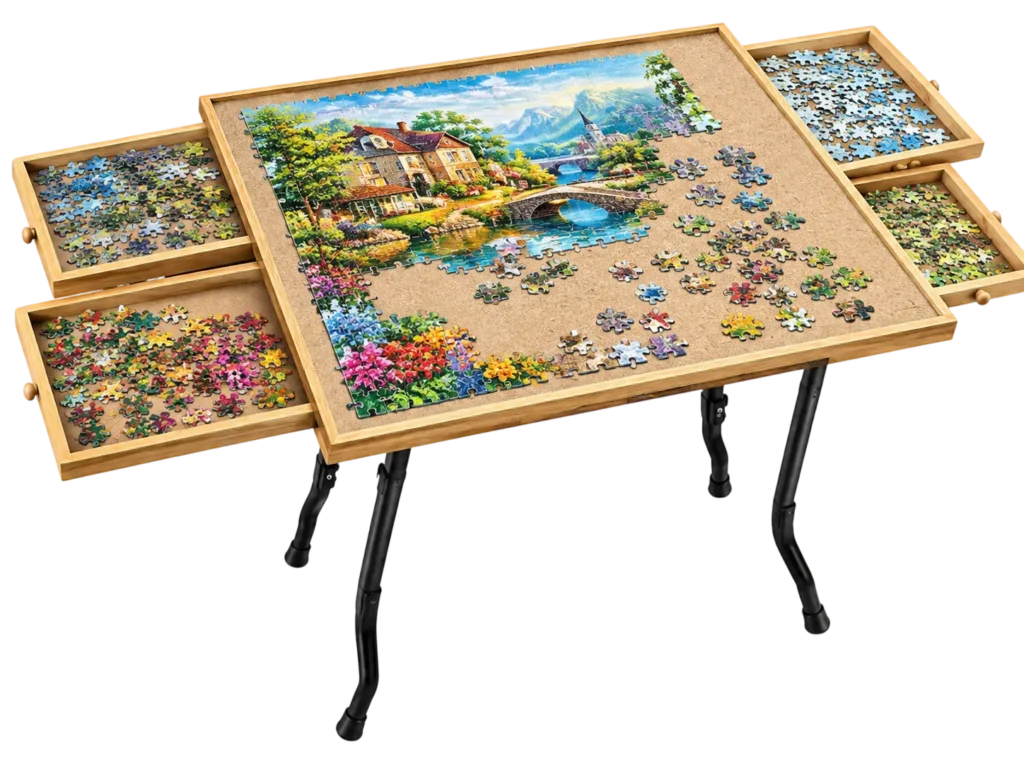
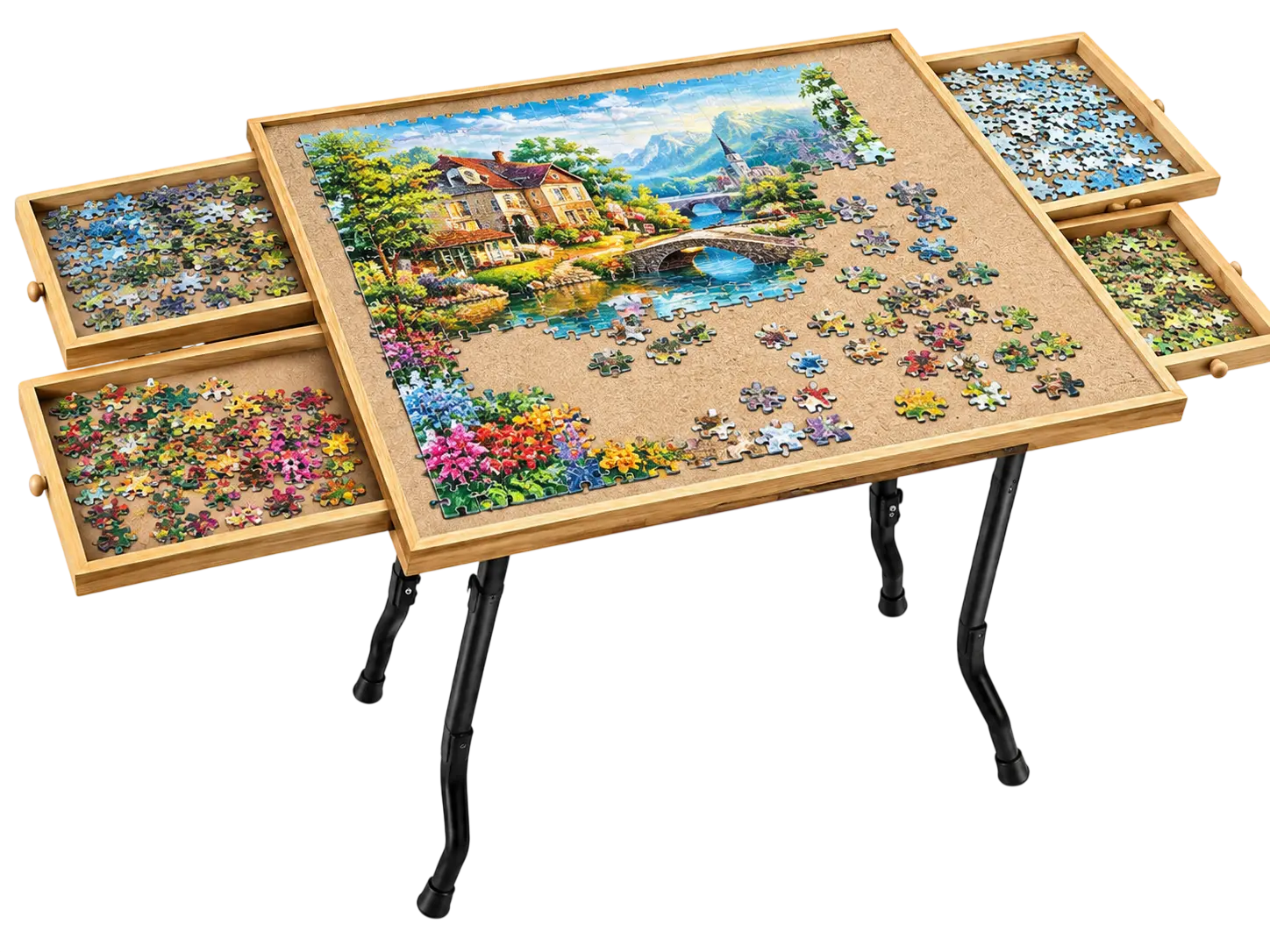
Bits and Pieces Original Wooden Puzzle Board with Drawers (1000 Piece)
Built from smooth fiberboard with a non-slip surface and 4 sliding wooden drawers to organize pieces by color or edge.
Ultimately, the best puzzle is one that gives you enough challenge to stay interested without creating unnecessary barriers. It should fit the person—not the other way around.
Puzzles as Part of a Brain-Healthy Lifestyle
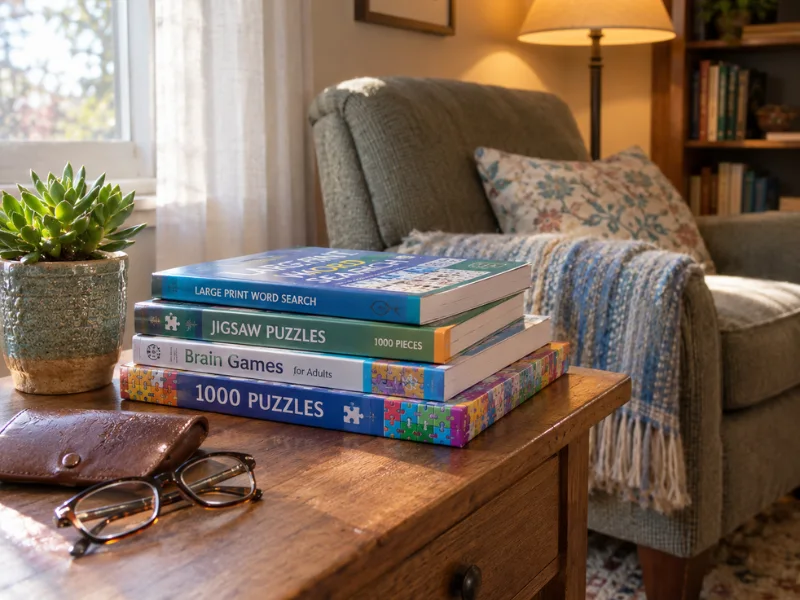
Puzzles can be a worthwhile part of an active, mentally engaged life—but they are only one piece of the picture.
If you enjoy jigsaw puzzles, crosswords, Sudoku or other brain activities for seniors, there is no reason to give them up simply because they are not a guaranteed way to prevent dementia. They can provide an enjoyable opportunity to think, learn, concentrate and spend time with other people.
But healthy aging involves much more than keeping the brain occupied.
A broader brain-healthy lifestyle can include:
- Regular physical activity to support overall health and physical function.
- Adequate sleep and good sleep habits.
- Social connection, including regular contact with friends, family and community.
- Nutritious food and an overall balanced eating pattern.
- Managing health conditions with appropriate medical care.
- Hearing and vision care, including getting changes assessed rather than assuming they are simply part of normal aging.
- Meaningful activities that give you enjoyment, purpose or a sense of accomplishment.
- Continued learning and mental engagement, whether that comes from puzzles, reading, hobbies, music, learning a skill or other activities you genuinely enjoy.
This broader approach is important because no single activity can carry the responsibility for healthy cognitive aging.

For a more complete look at the foundations of healthy aging—including movement, nutrition, sleep, social connection, emotional wellbeing and purpose—see our Healthy Aging: The Complete Evidence-Based Guide to Aging Well After 50, 60, 70 & Beyond.
Think of puzzles as one enjoyable activity within a larger lifestyle, not as a treatment or a guarantee against cognitive decline.
Common Questions About Puzzles for Older Adults
Are jigsaw puzzles good for your brain for adults?
Yes. Jigsaw puzzles can engage visual-spatial processing, attention, pattern recognition, reasoning and other cognitive skills. However, using these skills while puzzling does not prove that jigsaw puzzles prevent dementia or Alzheimer’s disease.
What are the mental benefits of doing puzzles for adults?
The mental benefits of doing puzzles for adults can include opportunities to practice attention, recall, reasoning, problem-solving, language or visual-spatial skills, depending on the puzzle. They can also provide an enjoyable, absorbing activity.
What are the social benefits of playing puzzles for older adults?
The social benefits of playing puzzles for older adults can come from doing puzzles with family, friends or community groups. Shared activities can create opportunities for conversation, cooperation and regular social interaction.
What kind of puzzle is best for the brain?
There is no single puzzle proven to be best for everyone’s brain. Jigsaws, crosswords, Sudoku and word searches challenge different skills. The best choice is one that is appropriately challenging, enjoyable, accessible and something you will actually keep doing.
Are puzzles good for 70-year-olds?
Yes. Puzzles can be an enjoyable form of mental activity at 70 and beyond. The appropriate choice depends on the person’s interests, vision, dexterity and preferred difficulty level.
What happens to your brain when you do puzzles?
Puzzle-solving can require attention, working memory, recall, reasoning, problem-solving, visual-spatial processing and cognitive flexibility. The specific skills involved depend on the type of puzzle.
What happens if you do puzzles every day?
Doing puzzles every day can provide regular cognitive engagement and repeated practice of the skills involved in that particular puzzle. It can also become an enjoyable routine or social activity. However, daily puzzling does not guarantee better memory or protection against dementia.
Do puzzles actually help prevent dementia?
We cannot currently say that doing puzzles prevents dementia. Research on cognitive activities can show associations with cognitive health, and some intervention studies examine changes in particular cognitive abilities, but these findings should not be presented as proof that puzzles prevent dementia.
Do crossword puzzles help prevent dementia?
There is not enough evidence to promise that crossword puzzles prevent dementia. Crossword solving can provide a language, retrieval and reasoning challenge, but that is different from demonstrating a disease-prevention effect.
Do jigsaw puzzles help prevent Alzheimer’s?
There is not enough evidence to say that regularly doing jigsaw puzzles prevents Alzheimer’s disease. Research into jigsaw puzzling and cognitive aging is interesting, but associations or improvements on particular cognitive tasks should not be presented as proof of Alzheimer’s prevention.
The Bottom Line
Puzzles are not a magic way to prevent dementia, stop normal aging, or guarantee better memory. The evidence simply does not support making promises like that.
But that does not make them pointless.
For older adults, puzzles can be a genuinely enjoyable way to stay mentally engaged, challenge different cognitive skills, spend time with other people, and continue learning. A jigsaw can turn visual-spatial problem-solving into a hands-on activity. A crossword can make word retrieval and language part of an enjoyable routine. Sudoku can provide a structured reasoning challenge. And doing a puzzle with someone else can turn a quiet activity into an opportunity for connection.
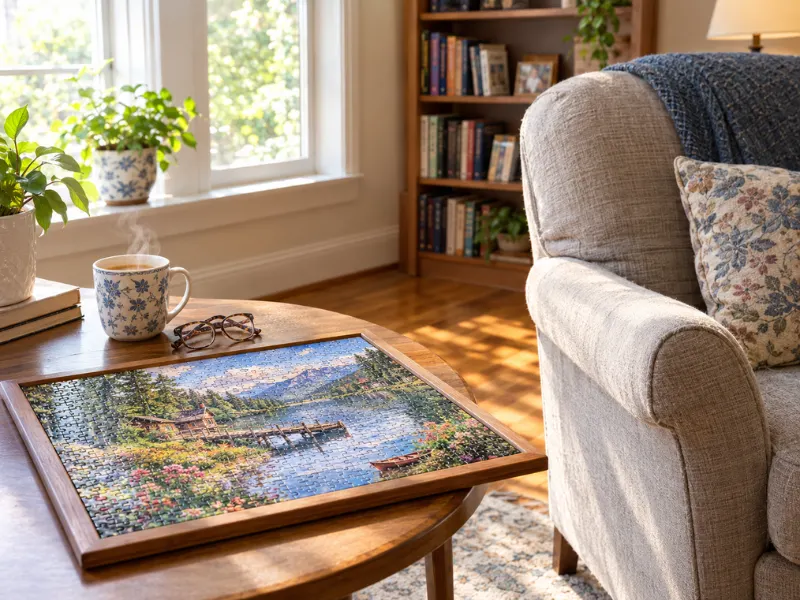
The best puzzle for an older adult is ultimately not the one with the biggest list of advertised “brain benefits.” It is the one that is challenging enough to be interesting, accessible enough to be comfortable, and enjoyable enough that you want to come back to it.
If your eyesight, hands, or energy level has changed, adapt the activity rather than assuming you have to stop. Use larger print or pieces, improve the lighting, choose a simpler puzzle, take breaks, or try a completely different type.
And most importantly, keep puzzles in perspective. They can be one small, enjoyable part of a brain-healthy and meaningful lifestyle—alongside physical activity, good sleep, social connection, nutritious food, appropriate healthcare, continued learning, and activities that give you a reason to look forward to the day.
Also Read: Free 28-Day Chair Yoga for Seniors (Printable PDF & Chart + Daily Challenge Plan)
Also Read: Normal Aging vs Dementia: Key Differences, Early Signs & What’s Normal
Also Read: Yoga for Beginners: Complete Step-by-Step Guide to Start at Home 2026 (Poses, Routine & Free PDF)